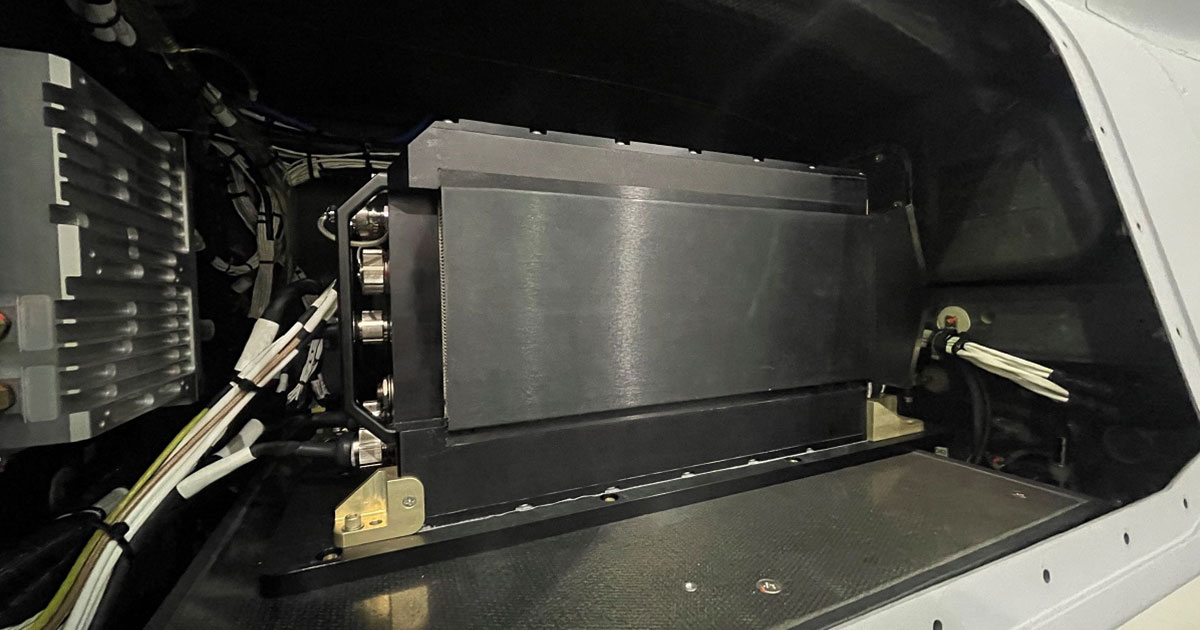
Saturday, April 16, 2022

Multifunction AESA Radars Sources Proliferate

 Multifunction AESA Radars Sources Proliferate

AESA Fighter Fire Control & Multifunction Radars

For air forces outside the major powers of US, NATO, and Russia, the development of active electronic scanned array (AESA) radars for acquisition without political strings has driven the demand for indigenous development. As usual, the Israelis lead the way with their EL/M-2052 with similar functions to the ELM-2032 mechanicaly scanned array. India LRDE has followed with their UTTAM Mk2 AESA. Sweden's Saab, a provider of military defense and civil security services and solutions, has successfully completed the first air trials with its new fighter X-band Active Electronically Scanned Array (AESA) radar, which will be offered as a new addition to Saab’s PS-05/A radar family. AESA radars have been develped by Hanwha Systems for South Korea' fighters and frigates.

Table 1 Characteristics of EL/M-2032-2052  from ITI Brochure

Mode/Characteristic

Submode

Notes

Supports all avionic interfaces

Full software control

Small size,

very light weight

requires very low power and

cooling resources


<100 kg (220 lb)

Air-to-Air

(detection and tracking range up to 120 NM):

  • Range While Search (RWS)
  • Single Target Track (STT)
  • Track While Scan (TWS)
  • Situation Awareness Mode (SAM)
  • Dual Target Track (DTT)
  • Raid Assessment (RA)
  • Air Combat Modes (ACM):
    • Vertical Scan 
    • Slewable ACM 
    • HUD ACM 
    • Boresight 
    • Adaptive Boresight


  •  

Air-to-Ground

(Imaging and surface target detection up to 120 NM):


  • High resolution mapping - SAR mode with 3000x3000 image pixels
  • SMTI over RBM or SAR
  • SMTT over RBM or SAR
  • Real Beam Map (RBM)
  • Air-to-Ground Ranging (AGR)
  • Beacon (BCN)
  • Weather (WA)
  • Terrain Avoidance


  •  

Air-to-Sea

(detection, tracking and classification up to 200 NM):


  • Sea Search (SS)
  • Sea Targets TWS
  • Sea Target Continuous Track (STCT)
  • Inverse SAR (ISAR) Sea target Classification
  • Range Signature (RS) Sea target Classification
  •  

Wikipedia

The EL/M-2032 is an advanced pulse Doppler, multimode planar array fire-control radar intended for multi-role fighter aircraft originated from the Lavi project. It is suitable for air-to-air and air-to-surface modes.[1]

As of 2009, Elta has integrated this radar system into the Sea Harrier, A-4, F-4, F-5, F-16, FA-50, Mirage and MiG-21 fighters.[1] It has also been used in the HAL Tejas fighter.[2]

Specifications

·         Weights: Max Weight 100 kg (220 lb)[1]

·         Performance: Max Range for air to air targets - 222 km (120 nm),[3]

·         Max Range for air to ground targets - 222 km (120 nm),[3]

·         Max Range for air to sea targets - 370 km (200 nm)[3]

ELM-2032 https://www.radartutorial.eu/19.kartei/08.airborne/karte040.en.html

ELM-2032 is operating in the X-Band multimode fire control radar for multi-missions fighters. It uses a mechanically tilted slotted waveguide antenna. It is designed for air-to-air, air-to-ground and air-to-sea missions. Modular hardware design, full software control and flexible avionic interfaces, ensure that the radar can be installed in most fighter aircraft and may be customized to meet the most stringent user requirements. It has been fitted to F-16s, including Israel’s own fleet. It has also been used to upgrade V/STOL Sea Harriers, F-5E/F Tiger light fighters, and F-4 Phantom, Kfir C10s, and Jaguar strike fighters around the world; and was picked for South Korea’s TA-50 and India Tejas lightweight fighters.

The radar is partially replaced by the successor model ELM-2052 with higher power and range.

ELM-2052
https://www.radartutorial.eu/19.kartei/08.airborne/karte039.en.html

The Elta ELM-2052 is operating in the X-Band airborne fire control radar designed for air-to-air superiority and advanced strike missions. The radar is based on fully solid-state active phased array technology. The ELM-2052 is an upgraded version of the ELM-2032. Its antenna can be fitted with either 300, or 500, or 1500 active Gallium- Arsenide TR-Modules.

The ELM-2052 is suitable for a number of aircrafts, e.g. in McDonnell Douglas F-15I and Kfir C10 used in Israeli Airforce, Russian MiG-29, French Mirage 2000, Indian Jaguar DARIN III, and LCA Tejas. Its weighs about 130 … 180 kg and consumes 4 … 10 kVA, depending on the design configuration. It can detect targets at very long-range while tracking up to 64 targets, and, simultaneously engaging several targets with missiles.

https://military-history.fandom.com/wiki/EL/M-2052

https://www.quora.com/What-is-the-range-of-an-Elta-Hal-EL-M-2052-AESA-radar

The ELM-2052 is an advanced Fire Control Radar (FCR) designed for air-to-air superiority and strike missions, based on fully solid-state Active Electronically Scanning Array (AESA) technology, enabling the radar to achieve

1.      long detection ranges,

2.      high mission reliability and

3.      multi-target tracking capabilities.

The ELM-2052 radar provides simultaneous modes of operation supporting multi-mission capabilities for air-to-air, air-to-ground, and air-to-sea operation modes, and weapon deployment.

The Radar has a peak power of ~ 10KW+ and has around 1500 TR Modules (Though its a modular radar and TRM can be increased and decreased based on the requirement) so its very much implied as Alec speculated that the Radar has a gallium nitrite variant as well, GaAs based TR modules itself have a range of around 180–250 KM for the 3 Sq M RCS

·         ELTA 2052 AESA Radar can do multi missions. They can perform various tracking during operation SEA LAND AIR Threats at a time.

·         The range of elta 2052 is near about 290 km depending upon the variants of radar and TR Modules.

·         It's can track 64 Targets and engage with 4 simultaneously.

https://defense-update.com/20070302_aesaradar_2052.html

The Israel’s Aerospace Industries (IAI) subsidiary Elta is developing an AESA version of its airborne fire control radar family designated EL/M-2052. This radar utilizes an array of transmit/receive solid-state modules designed to dynamically shape the radiation pattern using ultra-low side-lobe antenna. The radar supports pulse doppler and two axes monopulse guard channel, providing all aspect, look-down shoot-down performance, operating simultaneous multi-mode air-to-air superiority and advanced strike missions. The radar is based on solid-state, active phase array technology enabling the radar to achieve a longer detection range, high mission reliability and a multi-target tracking capability of up to 64 targets. It can also support high resolution target identification and separation, performing raid assessment at long range. as well as surface moving target detection and ranging. In the anti-shipping role the new radar provides long-range target detection, classification and tracking.

With high peak power the radar support simultaneous multi-mode operation. It can detect targets at very long range while tracking up to 64 targets, and, simultaneously engaging several targets with missiles. In ground attack missions the radar supports mapping, navigation and high resolution imagery (SAR), supported with Real Beam Map (RBM) and Doppler Beam Sharpening (DBS) modes. The EL/M-2052 is designed as a modular system, with built in growth capability, computation and memory reserves. Its weighs about 130 – 180kg and consumes 4 – 10KVA, depending on the design configuration.

https://www.defensenews.com/air/2015/08/23/chinese-radar-strongly-resembles-israeli-product/

Chinese Radar Strongly Resembles Israeli Product

Usman AnsariWendell Minnick

A Chinese avionics marketing and manufacturing firm has put Israeli-US relations under a microscope after marketing an advanced fire control radar identical to Elta's ELM-2052 active electronically scanned array (AESA).

Elta is the same Israeli state-owned subsidiary at the heart of an incendiary chapter in US-Israel relations that continues to reverberate 15 years after Washington forced Israel to cancel a controversial Phalcon airborne early warning aircraft contract with Beijing.

Beijing-based NAV Technology  claims https://nav.sell.everychina.com/products.html  in its 63-page product catalog to offer an unnamed AESA radar that is identical to the ELM-2052. The two-page description appears to be identical to current ELM-2052 product brochures distributed by Elta, including a photograph of the radar. Elta is a subsidiary of the state-owned Israel Aerospace Industries (IAI).

idrw.org

https://idrw.org/hal-sticks-with-elm-2052-aesa-radar-for-tejas-mk1a-hints-at-advance-and-better-derivate/

HAL sticks with ELM-2052 AESA Radar for Tejas Mk1A, hints at advance and better derivate – Indian Defence Research Wing

3-4 minutes


SOURCE: IDRW NEWS NETWORK

With latest media reports hinting that indigenously developed UTAAM AESA Airborne AESA Fire Control Radar (FCR ) will be ready for integration and trials with new upcoming updated Tejas Mk1A within next one year, HAL Sources close to idrw.org have confirmed that the management is still sticking with the Israeli ELM-2052 AESA Fire Control Radar for Tejas Mk1A program and swapping Israeli AESA FCR with Indian AESA FCR is not been considered for time being for various reasons.

HAL source close to idrw.org confirms that LRDE and DRDO have kept IAF and HAL in the loop about progress made by the UTAAM Team on the LCA LSP-2 which has been Test-bed aircraft but the Test-bed (LSP-2) is now down for regular maintenance and weapons modes are yet to be activated and its software integration is yet to be performed which means Radar will take time to mature.

When asked about UTAM AESA FCR performing better than the ELM-2052 AESA FCR in developmental trials, idrw.org was informed that EL/M-2052 Active Electronically Scanning Array (AESA) equipped onboard the Jaguar DARIN III fighter jets of the air force have smaller antenna size and Power supply due to under-powered engine and smaller nose cone size found on the Jaguar fighter jets which came initially with very basic small radar system in the ’70s.

idrw.org was given hints that Tejas Mk1A will be getting advance derivative of the EL/M-2052 AESA FCR which has possible bigger antenna size and with additional Power supply option then what was procured by the HAL previously for the Jaguar DARIN III fighter jets. ELTA Website maintains that EL/M-2052 can weight from 80kg to 180kg depending on the size of the antenna used on the aircraft and requires a power supply from 3-10 kVA again directly related to antenna size which explains the claim made to idrw.org also confirming that their exits Modular hardware and software growth potential of the Radar on the offer.

HAL’s Mission & Combat System Research & Design Centre will be in charge to work closely with ELTA engineers for integration and testing of the EL/M-2052 AESA FCR when it is supplied for integration in 2021-22. ELTA engineers have a past history of working closely with the HAL engineers in Bangalore for MMR/2032 Hybrid Radar used on the Tejas Mk1 and ELM-2052 on Jaguar DARIN III fighter jets, they have assured full cooperation also on Tejas Mk1A program.

idrw.org

Uttam Mk2 Aesa Radar to get “Game Changer” rotating repositioner – Indian Defence Research Wing

2-3 minutes


SOURCE: IDRW NEWS NETWORK


Captor-E AESA FCR on rotating repositioner

In our previous report, idrw.org had revealed that DRDO’s Electronics and Radar Development Establishment (LRDE) has started work on the development of upgraded Uttam Active electronically scanned array (AESA) fire-control radar (FCR) with the main antenna incorporating 992 arrays of TR modules instead of 780TR modules that is on the Uttam Mk1 radar antenna meant for Tejas Mk1A program.

Recently idrw.org has learned from the fresh tenders that has been issued that the Uttam Mk2 antenna will be mounted on a swashplate repositioner that enables the electronically scanned antenna, which is normally fixed in a forward position on a fighter aircraft, to be slewed to the left and to the right to increase its field-of-view this comes as a huge benefit during BVR [Beyond Visual Range] engagements when you don’t want to point the aircraft directly into a specific area.

The swashplate repositioner allows AESA radar to be pointed at the target without the aircraft’s nose pointing at it which minimizes the possibility of an opponent launching a missile toward the aircraft. The swashplate allows the pilot to take a beyond-visual-range missile shot and then turn 90 degrees while still giving mid-course updates to the missile fired.

Uttam Mk1 will be incorporated from the 21st Tejas Mk1A that goes into production from 2025-26 onwards. Uttam Mk2 is much smaller but packs more TR modules catering to the reduced nose section of the LCA AF-Mk2 with improved search and tracking capacities with the inclusion of the swashplate repositioner, Uttam Mk2 gets a large field of view that makes it possible to have a 140-degree search volume within a 200-degree look-angle around the nose of the aircraft.

defenceupdate.in

Uttam AESA radar: Everything you need to know — Indian Defence News

by defenceupdate

8-10 minutes


The home-grown Uttam Active Electronically Scanned Array (AESA) radar developed by Electronics & Radar Development Establishment (LRDE) seems to be making the right moves to get the attention of the Indian Air Force (IAF).

With the addition of AESA radar being one of the key features of Tejas MK1A, LRDE hopes that Uttam can even meet the schedules of the upgraded programme.

It has already completed more than 100 hours of flying on a hired aircraft and nearly 25 hours on Tejas test platforms. It is now confirmed that Uttam’s air-to-air mode and its sub-mode functionalities have been already tested.

Uttam is in competition with the Israeli Elta radar and the official word is not yet out on the question of how many Tejas MK1As (total 83) will be fitted with the desi technology.

Uttam Radar

The Uttam is an advanced active phased array radar (APAR) system being developed by Electronics and Radar Development Establishment (LRDE) for the HAL Tejas and other combat aircraft of Indian Air Force. Development of Uttam started in 2008 and it was first unveiled at Aero India 2009. Uttam is slated to be a successor to hybrid passive electronically scanned array radar EL/M-2032 currently equipping LCA Tejas. Radar is currently being integrated with an LCA.

Difference between AESA and PESA radar:

Conventional passive phased array radars have a single high power RF source (usually Travelling Wave Tube) at ‘back-end’ and RF signals are fed into slotted array antenna via a waveguide or coaxial tube. Introduction of the phase difference between each transceiver element allows the radiation pattern to be steered electronically. In the reception cycle, a PESA antenna cannot transmit. PESA radar has a light antenna which can be mounted on a mechanical steering mechanism thereby giving it a wide frontal coverage area or FOV.

Active phased array antennas have transmitter-receiver modules or transceiver module (TRM) built right into the antenna. A single array may feature hundreds or thousands of TRMs depending upon antenna size and operational requirement. Each TRM can either operate independently or under a hierarchy. Each TRM can generate and radiate its own signal of different phase and frequency as required, thus the transmitted signal is wideband in nature. Unlike PESA radar, signals can be transmitted and received simultaneously in an AESA radar. Active phased array antennas are usually heavier than slotted planner array antenna so it is difficult to mount them on a steering mechanism, which limits their field of view (FOV). Electronic steering is faster compared to mechanical steering but at high steering angle (90-120 degree) it may also increase side lobe power which is undesirable. FOV limitation can be mitigated by using a swash-plate repositioner.

Various aspects of Uttam AESA radar:

UTTAM has capabilities like, Identification friend or foe (IFF), electronic and communication support measures, C-band line-of-sight and Ku-band SATCOM datalinks, etc., similar to those on the AWACS and Conformal Airborne Early Warning & Control Systems (CAEW) systems.

The important modes of operation of the UTTAM radar system are the surface surveillance and the air surveillance. The sensor has the abilities to search, track-while-scan, priority tracking, high performance tracking, etc. In priority tracking, the targets will be placed in full track mode even if these cross the primary surveillance area. In high performance tracking, additional measurements are made to improve the tracking accuracy. Utilizing active aperture technology, the radar provides a fast-beam agile system that can operate in several modes concurrently.

Uttam features an active phased array (APAR) which gives it superior scanning performance over legacy passive phased array radar. Unlike most contemporary radars, Uttam features Quad TRM i.e. a single plank consists of 4 TRMs. It allows the array to be more densely packed. Each TRM is equipped with low noise power amplifier, built-in test facility, digital phase-gain, and side lobe control elements. The inert model displayed at Aero India 2015 had ~184 QTRMs i.e. 736 TRMs. The array temperature is controlled by a liquid coolant circulation system. The QTRM configuration makes Uttam maintenance friendly. The radar can be scaled up or down depending on antenna size requirement.

Uttam’s QTRM configuration

The radar is capable of tracking 100 targets simultaneously and engage 6 of them by SARH/ARH missiles in high priority tracking mode. For comparison, Elta EL/M-2052 is capable of tracking 64 targets in TWS mode.

In 2015 Uttam was stated to be capable of tracking a target having RCS of 2m2 at a distance of 92 kilometers. According to the new reports, the range has been increased to 150 kilometers for the target of the same RCS. In GMTT mode 2 targets can be tracked.

Uttam has over 16 different types of operational modes and the radar can operate in multiple modes simultaneously by changing modes pulse-to-pulse which gives the pilot exceptional situational awareness and mission flexibility.

LRDE hopes that Uttam can even meet the schedules of the upgraded programme.

It has already completed more than 100 hours of flying on a hired aircraft and nearly 25 hours on Tejas test platforms. It is now confirmed that Uttam’s air-to-air mode and its sub-mode functionalities have been already tested.

LRDE is hopeful that if all trials are completed in the decided time frame it might still be selected to be used on last batches of MK-1A if desired bythe customer. UTTAM Aesa Radar is most likely will be refined and re-tuned to be used on Indigenous developed Medium Weight Fighter (MCW)/(MWF) which was previously known as Tejas MK-2.

LRDE reportedly also has been tasked to develop a more powerful variant for India’s 5th Generation AMCA Fighter jet in near future.

FOCUS ON AIRBORNE RADAR FOR TEJAS

Hardware has already been realized for this radar which has a range of 100 km against small fighter sized targets and rooftop testing has been completed. Though the Uttam AESA currently weighs 120 kg which is some 40 kg more than the current MMR, there will be no problem in integrating it with the LCA Mk-II which can easily carry a radar of this weight. It is a 3D radar for fighters, a MMR follow on, the Active Phased Array Radar (APAR) project aims to field a fully fledged operational AESA fire control radar for the expected Mark-2 version of the Tejas.

This will be the second airborne AESA program after the AEW&C project and intends to transfer the success DRDO has achieved in the Ground based radar segment to airborne systems. The overall airborne program aims to prevent this technology gap from developing, with a broad based program to bring DRDO up to par with international developers in airborne systems: both fire control and surveillance. The earlier versions of radars has mechanically moving parts, whose output was painfully slow when compared to the new generation electronic technology. LCA also has a sophisticated fly by wire system and glass cockpit.

AESA in the LCAs will obviously have a lower range, but it will be well integrated within the IAF network, and give a quantum technology jump to IAF’s combat capabilities. Notably, the 36 Rafales being acquired by IAF in the Government-to-Government deal will also have the AESA radar, developed by Thales.

FUTURISTIC 360°-CAPABLE ANTENNA

Preliminary studies have been carried out at Center for Airborne Studies (CABS) for a possible optimal design of a futuristic antenna with the desirable 360°-vision for roles identified under various war situations. The unique aerodynamically-shaped delta radome will blend with the aerodynamics of the platform-aircraft to provide the required radar performance together with better operational economy by virtue of its better aerodynamics, reduced weight, and better or similar electro-magnetics. This radar may be dorsal or conformal fuselage mounted doubts still remain as not much is known about its specifications or configuration.

The foregoing summarises the efforts made by DRDO towards development of the AESA radar for its current and future AEW&C applications as well as for realising essential allied technologies. The necessary core competence to evolve futuristic applications in AESA radar has thus been adequately established.

Source:- Futureuniverse, Maxima Vigilantia Blog


everythingrf.com

Saab Completes First Air Trials of its New X-band AESA Radar


Saab, a provider of military defense and civil security services and solutions, has successfully completed the first air trials with its new fighter X-band Active Electronically Scanned Array (AESA) radar, which will be offered as a new addition to Saab’s PS-05/A radar family. The new fighter X-band AESA radar performs better against small targets, has enhanced Electronic Counter-Countermeasures (ECCM) capability as well as an improved ability to support more advanced weaponry.

The radar is designed for fighter aircrafts and can be adapted to a variety of platforms. As Saab previously announced, a version of the new AESA antenna has been sold to a U.S. Government customer. This is an important step in the development of Saab’s fighter AESA radar. It has unveiled great possibilities for the radar, and its modular, adaptable and scalable design means it can also be used for a range of other applications.

The host aircraft during the air trial was a Gripen D aircraft, which is currently offered with Saab’s latest Mk4 radar. The new version of the radar can be offered to Gripen C/D operators, as an upgrade. The new AESA radar uses GaN, a material that gives lower power consumption and improved heat resistance. This enables wider bandwidth and greater reliability, availability, and efficiency.

The trials were successful and collected data while detecting and tracking objects.

https://www.saab.com/newsroom/press-releases/2020/saabs-new-fighter-radar-in-the-air

navalnews.com

South Korea's AESA Radar Technology to Benefit ROK Navy Programs - Naval News

Authors

4-5 minutes


The latest (01/2022) design of the future Ulsan-Class FFX Batch III frigate of the ROK Navy. DAPA image

AESA radar technology will be applied to most South Korean upcoming defense programs such as FFX Batch III, KDDX, KF-21 and L-SAM...

The AESA radar will be placed on the next Ulsan-class frigates (FFX Batch III), the first one of which will be delivered to the ROK Navy in 2024. The new radar by Hanwha Systems will improve anti-air and anti-ship operational capabilities. The Ulsan-class FFX Batch III will be 4,000 tons ships, meaning that the new FFX would be equivalent to the in-service Gwanggaeto the Great-class (also known as KDX I) destroyers in terms of firepower and defense capability.

Ulsan-class FFX Batch III Frigate Integrated Mast by Hanwha featuring four phased arrays.

In addition to the FFX, the next-generation of Korean destroyers known as KDDX will also have the AESA radar by Hanwha Systems. They will thus be able to detect and monitor up to 4,000 targets simultaneously thanks to the four phased array placed on each side of their integrated mast.

KDDX destroyer integrated mast by Hanwha featuring four phased arrays.

The Korean military and DTaQ (Defense Agency for Technology and Quality) explained that the previous destroyers used spinning radars that update target information by rotating 360 degrees for beaming. As the spinning radar had difficulties detecting inbound air threats such as fighter jets and missiles at very high speed, South Korea developed its own AESA non-rotating radar.

A key of the AESA radar are the transmitter and receiver (T/R) modules that simultaneously detects several targets at a distance far away. Small modules gathered in the AESA radar functions as separate radars that give the user 3D-based target information with distance, altitude, and bearing, even enabling missile guidance and interception or electronic warfare. Unlike the spinning radar which is vulnerable to enemy threats, the AESA radar can be installed inside the mast and easily repaired since it only requires the replacement of a single module if this one malfunctions.

KDDX I Mast scale model on Hanwha Systems booth during MADEX

Local reports added that the naval variant of L-SAM (long-range surface-to-air missile) will have the K-AESA radar, since the DAPA (Defense Acquisition Program Administration) gave a green light to the development of naval L-SAM for air defense at sea.

Hanwha Systems developed the AESA radar for the KF-21 fighter. Hanwha Systems image.

There had been domestic and overseas concerns that South Korea’s development and deployment of localized AESA radar will be challenging after the United States refused to provide Seoul with technical transfer of AESA-related knowledge, but South Korea has become the world’s 12th country that developed its own AESA radar in 2020, four years after the ADD (Agency for Defense Development) and Hanwha Systems started its development projects. Initial AESA radar development by Hanwha Systems was for South Korea’s domestic stealth fighter project known as KF-21.


Daehan Lee is a political, security affairs researcher who worked at the U.S. Embassy in Seoul and the People Power Party. Prior to his work in politics and diplomacy, Lee served for the Republic of Korea Navy as a secretary to the Vice Admiral and a translator for Master Chief Petty Officers of the Navy, shortly working at the Joint Chiefs of Staff. He writes about Korean naval acquisition and development. Fields of interest include maritime security, defense acquisition, Korean politics and foreign policy.


Tuesday, April 5, 2022

A matter of speed? Understanding hypersonic missile systems | SIPRI

A matter of speed? Understanding hypersonic missile systems | SIPRI

sipri.org

A matter of speed? Understanding hypersonic missile systems

Kolja Brockmann is a Researcher in the SIPRI Dual-Use and Arms Trade Control programme.

Over the past weeks and months, ‘hypersonic missiles’ have again made headlines in global defence news. On 5 and 11 January, North Korea performed test flights of what it claims is a ‘hypersonic missile’. The announcement, the released pictures and the flight path suggest North Korea tested a rotational symmetric glide vehicle atop a rocket booster that performed pull-up and cross-range manoeuvres during its flights. However, many analysts have argued that in this case, the label of manoeuvrable re-entry vehicle would be more appropriate. In September 2020, North Korea tested what it called its first ‘hypersonic missile’, a ballistic missile booster with a wedge-shaped hypersonic glide vehicle. Another example where the term ‘hypersonic missile’ was used by media outlets was in August 2020, when China was reported to have tested a ‘hypersonic glider’. 

These examples demonstrate how confusing—and potentially distorting—the term ‘hypersonic’ is when it is applied to a whole range of missile systems by a range of different actors. Some of the news coverage of these events also indicated a lack of understanding of the different types of ‘hypersonic missiles’, the role of their speed and manoeuvring capabilities, the physics behind them, and their military capabilities and missions. This SIPRI Topical Backgrounder seeks to improve the understanding of hypersonic speed, the nature of hypersonic missile systems, as well as their key subsystems and technologies. Improving the understanding among policymakers and journalists could help inform political and public discourses and identify opportunities for applying targeted non-proliferation and arms control measures to reduce the risks associated with them.

Understanding hypersonic speed

The term ‘hypersonic speed’ is widely defined as any speed beyond Mach 5, meaning five times faster than the speed of sound. This threshold is used to define a subset of air vehicles because a range of physical effects start becoming a significant engineering challenge at that speed. Specifically, the object endures a massive heat flux when it flies through dense layers of the earth’s atmosphere at hypersonic speeds. This and other physical effects make developing aerial vehicles for hypersonic flight particularly difficult and costly. However, there are also some problems linked to the definition of ‘hypersonic speed’, and with that, part of the definition of ‘hypersonic missiles’.

First, defining hypersonic speed as anything beyond Mach 5 actually results in a variation of the object’s speed, depending on its altitude. The speed of sound, which defines the speed of Mach 1, depends not only on the chemical composition of the gas that the sound is moving through (in this case, the air in the earth’s atmosphere) but also on its temperature. The most common standard model of the earth’s atmosphere, the US Standard Atmosphere, shows a significant change of temperature with altitude. This results in a different measurement of what the speed—in kilometres per hour—of a missile moving with Mach 5 is, simply depending on the altitude that the missile is flying at (see figure 1).

There is also another factor to add to this variation. Since the Mach number strongly depends on the surrounding gas that the object is moving through, using a Mach number for definitions becomes more and more difficult once the surrounding gas gets thinner and thinner—and disappears completely at higher altitudes. While scientists and engineers agree that it still makes sense to talk about Mach numbers at altitudes around 30 km—which weather balloons and special aeroplanes can reach—there certainly is not enough atmosphere at an altitude of 300 km—where satellites are already orbiting the earth. Due to the nature of the earth’s atmosphere, which becomes exponentially thinner with altitude, it is difficult to agree upon a clear altitude limit where Mach numbers should still be used as a measurement of speed, and with that, where hypersonic missiles can sensibly be defined by stating that such missiles travel faster than Mach 5.

Distinguishing hypersonic weapon systems

Hypersonic speed is often pointed to as one of the key factors—if not the key factor—that set ‘hypersonic’ missiles apart from other missiles. However, the speed of ballistic missiles (predating the current hype around hypersonic missiles by almost a century) in many cases far exceeds that of today’s ‘hypersonic missiles’. The ancestor of ballistic missiles, Germany’s A-4 (which later became commonly known as the V-2) was first launched in the 1940s. During ascent, it could reach a speed greater than Mach 5 (although only for a brief period) and could do so again momentarily on its way back down. But, no one would claim that the V-2 was a hypersonic missile. In a similar vein, should one apply this label to modern intercontinental ballistic missiles that reach speeds beyond Mach 20 at ascent and re-entry? 

Certainly not, and there are other characteristics commonly cited when defining ‘hypersonic missiles’. However, while a combination of defining characteristics is increasingly adopted among experts, hypersonic missiles are often not well understood within public discussions in politics and the media. Wikipedia, a common starting point for those new to the topic, defines ‘hypersonic flight’ as ‘flight through the atmosphere below about 90 km at speeds ranging between Mach 5–10, a speed where dissociation of air begins to become significant and high heat loads exist.’ However, a V-2 missile would be classified as a hypersonic missile under this definition. The US-based Missile Defense Advocacy Alliance states that ‘hypersonic weapons refer to weapons that travel faster than Mach 5 (~3800mph) and have the capability to maneuver during the entire flight.’ An article published by the Russian International Affairs Council states that ‘there are two major defining characteristics [that] are prerequisite[s] to label a weapon “hypersonic”: Speed exceeding Mach 5 [and the] capability to make maneuvers (both vertical and horizontal) while traveling at this speed inside the atmosphere.’ Many ballistic missiles fall outside of the definition since they do not meet these prerequisites.

Given the speed and manoeuvrability characteristics, hypersonic weapons are further subdivided into two different types of missile systems: hypersonic cruise missiles (HCMs) and hypersonic glide vehicles (HGVs). HCMs keep a constant hypersonic speed (and usually altitude) and are powered over the entire course of their flight. In contrast, HGVs are usually launched on tops of ballistic missiles (often referred to as a boost-glide system) and then glide back through the atmosphere to their target at hypersonic speeds. There are also hybrid cases that do not match either of these categories, but exploring these is beyond the scope of this backgrounder.

It is worth considering the speeds of hypersonic missiles (in this case HCMs) and comparing them with those of ballistic missiles (which may or may not carry an HGV as a re-entry vehicle) to get an idea of how long it takes for both types to reach targets at different distances (see figure 2).

The distance a ballistic missile can fly depends on the speed which it accelerates—the faster it flies, the further it goes, just like throwing a rock. In contrast, HCMs travel at an (almost) constant speed, which is independent of how far away their target is. As illustrated by figure 2, ballistic missiles reach their target quicker than hypersonic missiles at distances beyond roughly 600–800 km for HCMs constantly travelling at Mach 5 (depending on the altitude). Conversely, hypersonic missiles reach their targets faster at ranges of more than roughly 1900–2500 km for HCMs constantly travelling at Mach 8, which is currently seen as the maximum speed they may travel using current technology. This means that HCMs usually take longer than ballistic missiles to reach distant targets. As HGVs are usually carried by ballistic missiles, the time they require to reach a target depends on the trajectory the booster is launched at, the distance covered, and the manoeuvres performed while gliding towards the target.

Speed, manoeuvrability and the characteristics of each of these types of hypersonic missile systems make them more or less suitable for specific military missions and present challenges for missile defence systems. This also influences their possible impact on strategic stability. However, reaching the desired performance characteristics often implied when talking about HGVs and HCMs requires overcoming a range of significant technical challenges.

Subsystems and technology challenges for hypersonic glide vehicles

Any HGV, whether it carries a conventional, nuclear, or no weapon payload, is designed so it can independently perform the necessary manoeuvres to fly precisely into a given target. Sensors and computational capabilities are required to enable the vehicle to maintain a certain degree of autonomy. Consequently, an HGV requires many of the same (or at least similar) basic subsystems a ballistic missile requires, with the exception of the propulsion system. Because an HGV is launched on a rocket booster, it is usually intended to glide towards its target and does not need a main engine. 

The main subsystems of an HGV are:

  • a guidance and control system;
  • a lightweight airframe (with sufficient thermal shielding);
  • the payload (for some limited missions, an HGV could potentially rely on the kinetic energy of the impact alone).

As with ballistic missile systems, developing and integrating these subsystems is very difficult. For example, the guidance and control system needs a power source, a computer, sensors, and actuators—such as aerodynamic control surfaces or small cold gas thrusters that enable performing manoeuvres. As one adds the cables, bolts, screws, nuts and elements where these components are affixed, the total weight and the required space increase. There also needs to be enough room to carry the actual payload in most cases. As a result, HGVs are usually neither small nor light, which significantly impacts the capabilities of the overall system and the necessary trade-offs between some of its capabilities.

Any HGV is intended to move through thicker layers of the atmosphere at a very high speed, thus creating a huge heat load and ionizing the air around it. This heat load puts a huge strain on the airframe, which should also be able to withstand any stresses generated by manoeuvres that the HGV is to execute. Also, the plasma cloud generated by the HGV moving at hypersonic speed makes it very hard for any type of sensor to sense anything, let alone to identify and lock onto a target. The HGV, therefore, must know exactly where it is without any help from the outside, thus requiring very precise inertial sensors, among others. The technological challenges of these requirements are comparable to those of a spacecraft designed to re-enter the earth’s atmosphere. But they are even more demanding due to the stricter size and weight limits of HGVs as well as additional requirements derived from their military role. 

Designing, building and operating a reliable HGV presents many challenges, including access to technology, high development costs and testing requirements. 

Subsystems and technology challenges for hypersonic cruise missiles

The basic requirements for HCMs are similar to those of HGVs, with the exception that the speeds may be lower (even top speeds of Mach 8 have not been convincingly demonstrated yet). In addition, HCMs carry propulsion systems, which have to be highly sophisticated to maintain hypersonic speeds over significant durations. Currently, it seems that only some advanced ramjets and supersonic combustion ramjets (scramjets) are capable of meeting these requirements. Hypersonic propulsion using air-breathing engines over longer distances presents extreme technical challenges. So far, no state has deployed a missile system using a scramjet engine, but research, development and testing continue.

The same basic elements that are required for an HGV (albeit in a very different design) are also relevant for HCMs, with the addition of the propulsion system:

  • a guidance and control system;
  • a lightweight airframe (with sufficient thermal shielding);
  • a highly efficient propulsion system (usually a scramjet);
  • the payload.

Adding the propulsion element adds to the problems mentioned for HGVs, as is illustrated by the US X-51A ‘Waverider’ prototype (which would be an HCM). The X-51A was only designed to demonstrate scramjet operations for a few minutes of hypersonic flight without the capacity to carry a weapons payload. At more than 4 metres in length, the X-51A cruiser module was completely packed (see figure 3), with no extra room for a payload. This shows the severe limitations regarding weight and volume for any subsystem elements in HCMs.

A cutaway diagram of a X-51A’s subsystems packaging.

Figure 3. A cutaway diagram of a X-51A’s subsystems packaging.
 

Source: Hank, J. M., Murphy, J. S. and Mutzman, R. C., ‘The X-51A Scramjet Engine Flight Demonstration Program’, 15th AIAA International Space Planes and Hypersonic Systems and Technologies Conference, May 2008, p. 7.

As with HGVs, many of the same technology requirements arise for HCMs. Heat loads may be comparable (depending on the mission), and sensors, as well as the guidance system, have to meet comparable requirements. The sophisticated technology required for a workable scramjet propulsion system is currently a major obstacle for HCM development efforts.

The capabilities of different states’ HGVs and HCMs, respectively, can vary significantly depending on the sophistication of the technology, design and engineering choices. Assessing and comparing the real capabilities of any such systems should thus go deeper than a capability to reach speeds greater than Mach 5 and a certain degree of manoeuvrability.    

Conclusions

Returning to the reported hypersonic missile tests by North Korea, in both cases, enabling manoeuvrability appears to be one of the main objectives behind the apparent design choices. Therefore, merely describing these systems as ‘hypersonic missiles’ neither provides the necessary understanding of their actual speed, nor their manoeuvrability or the type of hypersonic weapon system they are. These examples are also a reminder that different degrees of manoeuvrability may be achieved using different types of re-entry or glide vehicles and that speed—and even manoeuvrability—are only two of the key characteristics of a missile system. As North Korea continues its intensive testing cycle, it is important to consider characteristics and types of systems and assess them for their capabilities and possible missions—beyond the ‘hypersonic’ label. 

The excessive focus on ‘hypersonic missiles’, particularly in some popular media, paired with a lack of understanding of the limitations of this descriptor, has meant that discussions on the risks created and possible responses have sometimes overly focused on the threat of reduced response times, or impact on missile defences and other countermeasures. Questioning why certain actors—be they states or industry—adopt this terminology can help reveal motivations and vested interests in the hype around hypersonic missiles, i.e. to appear threatening or attract funding. More informed discussions have explored, for example, the potential impact of significant manoeuvring capabilities, including target ambiguity and the evasion of radars and other sensors. In the way that it is currently being used, the term ‘hypersonic’ often has little to no meaning and at the same time fuels competitive dynamics and a fear of missing out on the technology. Overcoming this lack of nuance could help put a brake on some of the competitive dynamics and hype-driven military spending. For example, the capabilities of some existing missiles often already provide the desired capabilities. Conversely, the advantages of future hypersonic missiles over other systems are sometimes exaggerated and come with a large price tag. Considering the technical and economic challenges of developing and deploying viable hypersonic weapon systems can help inform arms control and non-proliferation efforts addressing risks posed by hypersonic missiles.


GA-ASI Introduces New Eagle Eye Radar

GA-ASI Introduces New Eagle Eye Radar

GA-ASI Introduces New Eagle Eye Radar | sUAS News - The Business of Drones

https://www.ga-asi.com/ga-asi-introduces-new-eagle-eye-radar

GA-ASI Introduces New Eagle Eye Radar

By Press

General Atomics Aeronautical Systems, Inc. (GA-ASI), a leader in Multi-mode Radar technology for Unmanned Aircraft Systems, introduces the Eagle Eye radar. The new MMR is installed and has flown on a U.S. Army-operated Gray Eagle Extended Range (GE-ER) UAS. Eagle Eye joins GA-ASI’s line of radar products, which includes the Lynx® MMR.

Eagle Eye is a high-performance radar system that delivers high-resolution, photographic-quality imagery that can be captured through clouds, rain, dust, smoke and fog at multiple times the range of previous radars. It’s a “drop-in solution” for Gray Eagle ER and is designed to meet the range and accuracy to Detect, Identify, Locate & Report (DILR) stationary and moving targets relevant for Multi-Domain Operations (MDO) with Enhanced Range Cannon Artillery (ERCA). Eagle Eye radar can deliver precision air-to-surface targeting accuracy and superb wide-area search capabilities in support of Long-Range Precision Fires.

Featuring Synthetic Aperture Radar (SAR), Ground/Dismount Moving Target Indicator (GMTI/DMTI), and robust Maritime Wide Area Search (MWAS) modes, Eagle Eye’s search modes provide the wide-area coverage for any integrated sensor suite, allowing for cross-cue to a narrow Field-of-View (FOV) Electro-optical/Infrared (EO/IR) sensor.

The Eagle Eye’s first flight on the Army GE-ER aircraft took place in December, incorporating the new Video SAR capability. Video SAR enables continuous collection and processing of radar data, allowing persistent observation of targets day or night and during inclement weather or atmospheric conditions. In addition, Eagle Eye’s processing techniques enables three modes – SAR Shadow Moving Detection, SAR Stationary Vehicle Detection and Moving Vehicle Detection as part of its Moving Target Indicator – to operate simultaneously. 

“The Video SAR in Eagle Eye provides all-weather tracking and revolutionizes precision targeting of both moving and stationary targets at the same time,” said GA-ASI Vice President of Army Programs Don Cattell. “This is a critical capability in an MDO environment to ensure military aviation, ground force and artillery have constant situational awareness and targeting of enemy combatants.”

About GA-ASI

General Atomics Aeronautical Systems, Inc. (GA-ASI), an affiliate of General Atomics, is a leading designer and manufacturer of proven, reliable Remotely Piloted Aircraft (RPA) systems, radars, and electro-optic and related mission systems, including the Predator® RPA series and the Lynx® Multi-mode Radar. With nearly seven million flight hours, GA-ASI provides long-endurance, mission-capable aircraft with integrated sensor and data link systems required to deliver persistent flight that enables situational awareness and rapid strike. The company also produces a variety of ground control stations and sensor control/image analysis software, offers pilot training and support services, and develops meta-material antennas.

For more information, visit www.ga-asi.co


GA-ASI MQ-9B SeaGuardian UAV has revolutionized anti-submarine warfare and ISR for US Navy

 Versatile multi-domain MQ-9B SeaGuardian has revolutionized anti-submarine warfare


mq9b-seaguardian-game-changer

Artist rendering of SeaGuardian with anti-submarine warfare mission kit

The MQ-9B SeaGuardian has changed the game in maritime domain awareness. It’s the first unmanned aerial system of its kind that can search the ocean surface and the depths in support of naval intelligence, surveillance and reconnaissance.

Pete Yelle, a former longtime U.S. naval aviator, now serves as strategic development manager at General Atomics Aeronautical Systems, Inc. Yelle talked about what makes the SeaGuardian so different from other aircraft available today and everything that has come before.

Navies always have needed to know what’s on the sea, or under it. Why is there so much growing interest in this UAS now?

Yelle: SeaGuardian does so many things at once, so well, in a way nothing has before. It can see, optically, with its electro-optical infrared sensor, as well as through haze or smoke with its synthetic aperture radar. It also can scan a wide area with the long-range maritime surface search radar. It has onboard systems that collect signals intelligence and communications intelligence. It can take on any number of other payloads – including a subsurface acoustic processor that allows it to detect and track submarines. The aircraft offers all this at about a third of the price of other larger, high-altitude maritime UAS and at a major cost savings compared to a manned, multi-engine, maritime patrol aircraft. MQ-9B also is incredibly versatile because of its ability to operate in civil airspace.

What does that mean, and how does it help the aircraft?

Yelle: MQ-9B is the only UAS designed to be certifiable in order to operate in non-segregated airspace – that means it can fly in the same box of sky as airliners, for example, or civil aircraft. So rather than needing to seek special authorization for a corridor in order to launch a UAS, operators can just “file and fly,” as pilots say – get the aircraft airborne, transit through normal airspace and then do the mission. GA-ASI’s proprietary detect and avoid system is what makes possible the safe execution of manned and unmanned flight in busy airspace. It’s on track to be certified by the Defense Department and the Federal Aviation Administration.


MQ-9B SeaGuardian, Southern California test flight, Sept. 11, 2020

Does that mean SeaGuardian can operate from more airfields than other UAS?

Yelle: Yes. Let’s say you wanted to take off from someplace like Andersen AFB in Guam and fly through some of the same airspace in the area that is used by both manned U.S. military and commercial aircraft. You could go ahead and do that, and then get out over the ocean to conduct a mission. MQ-9B’s greater wingspan also means it can handle many more airfields, including with shorter runways – that complicates problems for an adversary, because the aircraft can takeoff from A, fly to B, refuel, take off and fly to C, then D – and so on. It doesn’t necessarily need to return to the same base. That makes it more difficult to anticipate or counter and gives more options to its users.

You mentioned SeaGuardian taking off for a long mission over the ocean. These aircraft can fly for more than 30 hours. Are they equipped to handle the maritime environment?

Yelle: Yes. It’s an all-weather capable aircraft. It has an electro-expulsive de-icing system to protect its control surfaces from surface ice, engine-bled air for engine anti-ice and pitot-static systems, copper wiring for lightning protection and weatherization seals and damage-tolerant radomes. The detect and avoid system also has a weather detection mode to see thunderstorms in the distance to avoid inadvertent flight into severe weather.

What could naval commanders do with an aircraft purpose-built to operate over the ocean for such long missions?

Yelle: You name it: Tracking surface contacts. Serving as a communications relay. Providing long-range targeting for a distant ship or the entire strike group. Providing early warning for those forces. Working in concert with other UAS, other aircraft, other units, to create a big sensor network. Looking for submarines.


Photo courtesy MCC Shannon Renfroe, USN

MQ-9B can hunt for submarines? How?

Yelle: It’s the only UAS that has demonstrated fully self-contained anti-submarine prosecution. The aircraft carries a number of sonobuoys – sensors that drop from the air and go below the surface and search for subs. It can simultaneously process up to 32 of them to track submarines – it successfully tracked a U.S. Navy Los Angeles-class submarine for several days throughout the Integrated Battle Problem exercise in 2021. This year, MQ-9B is going to participate in the U.S. Navy-led international exercise RIMPAC 22.

What will the aircraft be doing?

Yelle: The U.S. Navy has contracted GA-ASI to demonstrate anti-submarine warfare, multi-intelligence collection – remember MQ-9B can do signals, communications and other intelligence collection simultaneously with its onboard sensors – passive targeting, Link 16 integration with surface, air and subsurface assets, long-range fires targeting and maritime surveillance. RIMPAC 22 will also be the first time a SeaGuardian will be fully integrated with a Fleet Command Center through the secure SIPRNET and Joint Range Extension Protocol (IP based) to pass classified tracks. The aircraft is ready to go, and we’re excited to show what it can do.

Tuesday, February 22, 2022

Free Cybersecurity Services and Tools | CISA

Free Cybersecurity Services and Tools | CISA

cisa.gov

Free Cybersecurity Services and Tools


US Department of Homeland Security CISA Cyber + Infrastructure


Free Cybersecurity Services and Tools Banner

As part of our continuing mission to reduce cybersecurity risk across U.S. critical infrastructure partners and state, local, tribal, and territorial governments, CISA has compiled a list of free cybersecurity tools and services to help organizations further advance their security capabilities. This living repository includes cybersecurity services provided by CISA, widely used open source tools, and free tools and services offered by private and public sector organizations across the cybersecurity community. CISA will implement a process for organizations to submit additional free tools and services for inclusion on this list in the future.

The list is not comprehensive and is subject to change pending future additions. CISA applies neutral principles and criteria to add items and maintains sole and unreviewable discretion over the determination of items included. CISA does not attest to the suitability or effectiveness of these services and tools for any particular use case. CISA does not endorse any commercial product or service. Any reference to specific commercial products, processes, or services by service mark, trademark, manufacturer, or otherwise, does not constitute or imply their endorsement, recommendation, or favoring by CISA.

Foundational Measures

All organizations should take certain foundational measures to implement a strong cybersecurity program:

  • Fix the known security flaws in software. Check the CISA Known Exploited Vulnerabilities (KEV) Catalog for software used by your organization and, if listed, update the software to the latest version according to the vendor’s instructions. Note: CISA continually updates the KEV catalog with known exploited vulnerabilities.
  • Implement multifactor authentication (MFA). Use multifactor authentication where possible. MFA is a layered approach to securing your online accounts and the data they contain. When you enable MFA in your online services (like email), you must provide a combination of two or more authenticators to verify your identity before the service grants you access. Using MFA protects your account more than just using a username and password. Why? Because even if one factor (like your password) becomes compromised, unauthorized users will be unable to meet the second authentication requirement, ultimately stopping them from gaining access to your accounts.
  • Halt bad practices. Take immediate steps to: (1) replace end-of-life software products that no longer receive software updates; (2) replace any system or products that rely on known/default/unchangeable passwords; and (3) adopt MFA (see above) for remote or administrative access to important systems, resources, or databases.
  • Sign up for CISA’s Cyber Hygiene Vulnerability Scanning. Register for this service by emailing vulnerability@cisa.dhs.gov
  • . Once initiated, this service is mostly automated and requires little direct interaction. CISA performs the vulnerability scans and delivers a weekly report. After CISA receives the required paperwork, scanning will start within 72 hours and organizations will begin receiving reports within two weeks. Note: vulnerability scanning helps secure internet-facing systems from weak configurations and known vulnerabilities and encourages the adoption of best practices.
  • Get your Stuff Off Search (S.O.S.). While zero-day attacks draw the most attention, frequently, less complex exposures to both cyber and physical security are missed. Get your Stuff Off Search–S.O.S.–and reduce internet attack surfaces that are visible to anyone on web-based search platforms.

Free Services and Tools

After making progress on the measures above, organizations can use the free services and tools listed below to mature their cybersecurity risk management. These resources are categorized according to the four goals outlined in CISA Insights: Implement Cybersecurity Measures Now to Protect Against Critical Threats:

  1. Reducing the likelihood of a damaging cyber incident;
  2. Detecting malicious activity quickly;
  3. Responding effectively to confirmed incidents; and
  4. Maximizing resilience.

Reducing the Likelihood of a Damaging Cyber Incident

Take Steps to Quickly Detect a Potential Intrusion

Ensure That The Organization is Prepared to Respond if an Intrusion Occurs

Maximize the Organization's Resilience to a Destructive Cyber Incident


Tuesday, February 1, 2022

UNDERWATER AUTONOMY | ADBR

UNDERWATER AUTONOMY | ADBR: Regional advances in underwater autonomous devices Back in 1957, Britain’s Defence White Paper saw a future in which the supremacy of guided missile systems meant the era of the manned…

adbr.com.au

UNDERWATER AUTONOMY | ADBR

by Max Blenkin

(BOEING)

Regional advances in underwater autonomous devices

Back in 1957, Britain’s Defence White Paper saw a future in which the supremacy of guided missile systems meant the era of the manned fighter aircraft was effectively over. That turned out to be somewhat premature – as we well know, human-piloted combat aircraft are still around.

Some analysts are saying much the same about crewed submarines, that emerging sensors will make the sea “transparent,” eliminating the fundamental submarine stealth advantage, and that uncrewed surface and underwater hunter-killer systems will be so effective that traditional submarines won’t stand a chance in the conflict of the future.

Uncrewed aerial system (UAS) perform many useful functions, including surveillance and strike. Air combat of the future will feature crewed aircraft such as F-35 and Super Hornet operating in conjunction with UAS such as Boeing’s Loyal Wingman.

The war under the sea will likely be much the same, with a growing role for Unmanned (uncrewed) Underwater Vehicles (UUVs). 

The Royal Australian Navy already operates UUVs performing underwater survey and mine clearance. Collins class submarines – now destined for many more years of service – will likely soon go to sea with an onboard UUV in a Loyal Wingman-type role, as will their nuclear-powered successors.

The roles of UUVs will likely soon expand – from surveying, sensing for surface and submarine threats and, if need be, serving as a decoy, to ultimately go to war in their own right, fighting autonomously against adversary crewed and uncrewed platforms.

With Australia now embarking on the long journey to acquire nuclear subs, a number of commentators have suggested we should also acquire a large UUV such as the Boeing Orca (title pic), now in trials with the US Navy.

Orca is a development of the Echo Voyager, a fully autonomous 15.5 metre 45 tonne UUV, able to dive to depths of 3,000 metres and cover 6,500 nautical miles. Power is diesel-electric with lithium-ion batteries.

With no requirement to accommodate humans, uncrewed submarines can be simple and compact. The US Navy has big ideas for Orcas which could perform surveillance and intelligence gathering, mine countermeasures, anti-surface warfare, anti-submarine warfare, electronic warfare, and strike missions. 

So far it has ordered five at a price of US$274.4m (A$366.5m) – much cheaper than any crewed platform.

“The RAN, working in early, close partnership with the US Navy and US and Australian industrial partners to develop and field the Orca, and make a range of different payloads for it, is the path that is likely to bring the most undersea combat power most quickly to Australia’s military,” wrote Australian Strategic Policy Institute (ASPI) senior analyst Michael Shoebridge in March.

That was before the government announced Australia would acquire nuclear submarines (see article on page 26), when it seemed the new conventionally-powered Attack class boats were unlikely to enter service before the mid-2030s. But the new nuclear subs are likely to be even further away. Meanwhile Australia’s submarine capabilities will be delivered by upgraded but increasingly ageing Collins boats (see article on page 30).

Bluefin 12 UUV

CHINA
Shoebridge said it was unfortunately obvious that even the most sophisticated crewed submarine would need to work with a range of sensors and other systems including UUVs if it was to operate safely and effectively against adversary systems like China was already fielding. “That’s probably true right now in a place like the South China Sea, and it’ll only get more manifestly obvious between now and 2035,” he said.

Unsurprisingly, China says little about its own UUV capabilities, manifested through occasional display of vessels on the back of trucks during various military parades, or through Indonesian fishermen netting glider-like surveillance UUVs as far south as the Java Sea.

China is developing a range of UUVs for different applications. The largest seems to be the Haishen 6000, a 3.5-tonne eight-metre prototype reportedly capable of diving to 6,000 metres.

How good are Chinese UUVs? We just don’t know. It does appear that China’s most mature capabilities are in marine surveying and reconnaissance, but growing competencies in artificial intelligence (AI) would appear to have significant implications for its future UUV capabilities. That’s because any UUV, unless tethered to a mother vessel, is effectively on its own.

That’s fine for conducting defined brief missions such as mine clearance, but for extended operations as will be performed by Orca, the vessel needs to make its own decisions without regular input from an operator.

UUVs face the same communication constraints as regular submarines. Radio works fine on the surface but only transmissions at Very Low and Extremely Low Frequencies (VLF/ELF) can reach subs at operational depths. And those transmissions are one way – the sub can’t respond until it surfaces – are slow, have low bandwidth, and require vast onshore infrastructure, such as the Harold E. Holt Naval Communications Station in Western Australia.

A Royal Australian Navy Bluefin 9. (ADF)

AUSTRALIAN UUVs
It may not be particularly visible or widely known, but the Royal Australian Navy has a strong interest in UUV technology, and has maintained a close watch on developments and already fields a number of systems.

Late last year, the Navy released its Robotics, Autonomous Systems, and Artificial Intelligence (RAS-AI) Strategy. While the strategy doesn’t single-out specific technologies, it does identify common enablers required to make the Navy RAS-AI ready. 

It says some technology is available now, able to conduct simple well-defined missions, with human oversight. But by 2030, technologies will be maturing, able to perform missions independently, automatically adapting to changing situations. And by 2040, systems will feature advanced understanding of scenes from their sensors, an ability to perform ideas-based reasoning, and able to navigate in dense and dynamic environments.

In the near term, UUVs will be able to track submarines in support of ASW operations, conduct long-endurance ISR, navigation and networking, and attack surface vessels. Further out, UUVs will be able to perform time-critical strikes from a submerged platform against land targets.      

With a vast area of interest and limited platforms and personnel, the Navy is looking to autonomous systems to generate mass and tempo on a scale it otherwise could not achieve.

The Navy first used remotely operated systems more than three decades ago with a surface system to tow targets. Minehunters – the old Bay class and the Huon class – both used tethered UUVs to hunt sea mines. Next generation mine-hunting systems – which are on the way through Project SEA 1905 – will use more sophisticated UUVs to ensure humans and valuable vessels go nowhere near minefields.

For deployable mine countermeasures, the RAN currently operates the 70kg General Dynamics Bluefin 9 and the 213kg Bluefin 12, while actual mine disposal is performed by the Sonartech Atlas Seafox, an expendable UUV which destroys itself and the mine. For rapid environmental assessment of a harbour or landing beach, the Navy will use a pair of 37kg REMUS 100 UUVs.

Submarines of the future – ours, those of allies, and adversaries – will be equipped with onboard UUVs, now an emerging capability. 

Long before they retire, Australia’s Collins boats will go to sea with embarked UUVs, possibly the in-service Bluefin 12 or its larger sibling, the Bluefin 21, a 750kg long-endurance UUV able to reach depths of 4,500 metres.

Launching such UUVs is not a problem – Bluefin 21 is 21 inches in diameter, the same as a standard torpedo tube. Smaller UUVs can swim right out, although the US Navy is investigating sabot systems. But recovery is more problematic, as UUVs can’t easily swim back down the torpedo tube, though that may come. 

Various underwater recovery systems have been proposed, among them using divers to manually retrieve the UUV or a remotely operated deck-mounted capture arm. Under the US Navy’s Snakehead program, the dry deck shelter which is used for deploying SEALs and their swimmer vehicles, will be modified for launch and recovery of large UUVs.

Australia has good understanding of allied capabilities thanks to the Autonomous Warrior exercise series which Navy describes as its flagship program to demonstrate, evaluate, and trial emerging systems at various technical readiness levels.

Autonomous Warrior 2018, which followed Unmanned Warrior 2016 in Scotland, was held in Jervis Bay and involved realistic trials of 77 air, surface, and underwater platforms and systems from various nations and Australian and overseas companies.

The most recent AW activity was a virtual conference held in June and hosted by Warfare Innovation Navy.. 

Atlas Seafox. (SONARTECH)

This article appeared in the Sep-Dec 2021 issue of ADBR.


Undersea Combat Includes Way More Than Submarines | SIGNAL Magazine

Undersea Combat Includes Way More Than Submarines | SIGNAL Magazine

“#Undersea warfare is a lot more than just #submarine versus submarine. My job is to make sure our undersea forces—and that includes our ballistic missile submarines, our attack submarines, our carrier strike group ASW [anti-submarine warfare] forces, maritime patrol aircraft, fixed systems, #unmanned and #autonomous systems, all of that—are able to integrate as part of an undersea battle force,” explains Rear Adm. Richard Seif, USN, https://lnkd.in/ggG3CRd3 commander, Undersea Warfighting Development Center (UWDC), Groton, Connecticut https://lnkd.in/g4PAqt4Y.

“Given constraints on the number of submarines we may be able to afford as a country, frankly, the ability to deploy unmanned systems as a system-of-systems approach is going to be critical. And then #artificialintelligence and #machinelearning for that decision superiority and data-driven decision making, I think all fits together,” he asserts.

The UWDC is exploring a variety of unmanned systems for the undersea mission. “We’re making tremendous progress on a whole family of systems, everything from small, unmanned vehicles to fully autonomous vehicles, able to carry a variety of payloads. We certainly see that as not just a need but a real value to the force to be able to integrate unmanned systems for everything from wide area search to surveys to delivering effects if we need to,” he says.

Synthetic Aperture Radar Drone Gets Interferometric Imaging | Hackaday

Synthetic Aperture Radar Drone Gets Interferometric Imaging | Hackaday Backyard Coherence: A €1,000 Drone SAR Achieves Repeat-Pass Interfero...