Friday, September 16, 2022

Aero mobile Satellite communication technologies for Aircrafts and UAVs

Aero mobile Satellite communication technologies for Aircrafts and UAVs

IDST – International Defence, Security and Technologyby Rajesh Uppal 41m

The future of aviation worldwide is one of significant continuing growth in air travel, air cargo, and private general aviation. Passenger services communications are expected to generate revenue for airlines and service providers. They will require a “critical mass” of users to justify costly avionics installation and operating costs, hence they will need to be broadband services.

However, passenger aircraft remains one of the few places where ubiquitous data connectivity cannot be offered at high throughput, low latency and low cost. Airline and business jet passengers are demanding Internet connectivity as they travel across the globe. A survey by Honeywell revealed that nearly 75% of airline passengers are ready to switch airlines to secure access to a faster and more reliable Internet connection on-board and more than 20% of passengers have already switched their airline for the sake of better in-flight Internet access.

They will therefore evolve in a market-driven way, in fits and starts, with successes and failures dependent upon the quality and usefulness of service, customer acceptance, and service cost.  While the quality of service improves and costs are reduced, user demand for on-board communications connectivity will increase as the general public grows accustomed to ubiquitous access to wireless access in flights.

This is leading to increasing demand for high bandwidth data access on commercial aircraft for both business jets and major airliners. Until now such high bandwidth data links have been predominantly provided when the aircraft is over land, using a system of ground-based installations to provide the link to the aircraft. For full transcontinental coverage, SATCOM is the only effective way of providing connectivity with Inmarsat’s L-band coverage, for example.

In the future, to achieve the required bandwidths, the frequency of operation must move to the Ku-band or Ka-band to support data rates up to 1000 Mbps. New satellites are being launched that support higher frequencies to enable this increase in bandwidth.

SATCOM systems traditionally have utilized geostationary Earth orbit (GEO) satellites—satellites that relative to the Earth’s surface will stay in a fixed location. To achieve geostationary orbit, the satellite must be at a very high altitude—over 30 km from Earth’s surface. The benefit of such a high orbit is that very few satellites are needed to cover a large area of ground, and transmitting to the satellite is simplified because it has known, permanent coordinates. Due to the launch cost of these systems, they are designed for long lifecycles, resulting in a stable but sometimes antiquated system.

Because of altitude and radiation challenges, additional device screening or satellite shielding is often needed. Furthermore, because the satellite is so far away, there will be significant loss with the user on the ground, impacting signal chain design and component selection. The long ground-to-satellite distance also results in high latency between the user and the satellite, which can impact some data and communication links.

The proliferation of UAVs in the defense (and soon the commercial world), has created a new arena of SATCOM links. UAVs face similar challenges. The advanced defense-focused UAVs are required to operate around the globe with remote piloting, possibly from a different continent. These requirements drive a need for high bandwidth datalinks to support video, control, and advanced payload data, potentially saturating the existing communications infrastructure. With commercial UAVs also set to have expanded coverage in the future, global network high bandwidth connectivity will pose the same SATCOM challenges as in commercial aviation.

At the same time, supporting legacy data links, minimizing size, weight, and power (SWaP), and reducing investment in system development is driving a need to develop flexible architectures and maximize system reuse. Recently, many alternatives or complementing systems to GEO satellites have been proposed, with UAVs and low Earth orbit (LEO) satellites being considered. With lower orbits, these systems mitigate most of the challenges described with GEO-based systems, but at the expense of reach, with many more satellites or UAVs required for similar global coverage.

Challenges

Terminals in the aeronautical market work under one of the most difficult environments. Antennas carry very sophisticated requirements in terms of form factors (aerodynamic limitations), weight, pointing accuracy, reliability and many other technical requirements. Similarly, RF equipment has strong limitations in size and weight, while skyrocketing throughputs continuously demand more power. Modems orchestrate the link offering high-quality, high-speed communications in this challenging ecosystem.

Modems and baseband equipment operating in this vertical have very sophisticated requirements. The global nature of demand involves high initial CAPEX investments in baseband equipment. Routes and traffic patterns change depending on the season, and anytime of the day, which
requires very flexible networks. Consequently, requirements for the network management system are very sophisticated and include ensuring advanced Service Level Agreements for individual aircrafts and fleets running applications at different priority levels with planes constantly migrating to different beams and satellites — all this with end-users enjoying the highest standards of connectivity.

Ultimately, beam hopping and beam forming are capabilities that ground platforms and the space segment need to coordinate to optimally utilize capacity. Equipment must serve all these requirements, while meeting the stringent, expensive, and exhaustive certification process involved for any equipment used in the aeronautical sector.

Aeronautical channel model for satellite communications

Designing a satellite airborne technology for the military is significant technology advancement, yet it presents several distinct, technical challenges. Propagation effects of aeronautical channels differ from maritime and land mobile propagation because of the high velocity of aeroplanes, their distance from ground and influence of the aircraft body on antenna performance.

Aeroplane manoeuvres can affect signal under conditions when aircraft antenna is shadowed by the aircraft structure. When considering helicopters, the rotation of the rotor blades causes a cyclic interruption to the signal path.

An aeronautical channel model for satellite communications needs to consider two main contributions:
• a strong line of sight (LOS) component that is present all the time (except during maneuvers where the satellite signal might be blocked by the aircraft body) affected by ionospheric and tropospheric effects, and possibly by specular and/or diffuse scattering from the aircraft;
• a surface (ground, sea, ice, snow) scattering component which arrive with a certain delay, phase and attenuated power with respect to the LOS component.

The overall channel is considered time-varying due to various conditions: atmospheric dynamics, geometry changes due to aircraft flight (affecting not only the LOS, but also the fuselage scattering at each instant), dynamics of elements on the fuselage (e.g. blades for helicopters), time-variation of the surface scattering, and dynamics of the surface (e.g. sea waves). The effects of antenna pattern must not be neglected, the type of antenna may mitigate ground and fuselage multipath effects, but in cases such as banking maneuvers, multipath may arrive as strong contribution impacting the communications signal.

Researchers have designed a software tool for propagation analysis of satellite to aeronautical communications, including more physically based models, valid from VHF to Ka-bands, and which could take into account the following technical issues:
• modifications induced on the antenna pattern by its installation on the platform,
• geometry of the trajectory and platform dynamics during movements including the attitude,
• surface scattering effects for sea and ground surfaces, including vegetation layers,
• atmospheric effects due to troposphere at different altitudes and ionosphere.

Signal shadowing and multipath influence system design in a number of ways: signal blockage affects link reliability; and multipath noise causes errors in digital transmission.  frequency-selective fading causes inter-symbol interference when signal bandwidth exceeds the coherence bandwidth;

Airborne COTM networks must be able to efficiently and reliably support a wide range of throughput rates from basic email, to flash override Voice over IP (VoIP), to high-definition video.

These applications must operate on fast-moving aircraft, using a very small antenna and overcoming issues like the Doppler Effect and rain fade. An airborne COTM network must also support near seamless global coverage, track deployed units and manage beam switching while meeting stringent security and budget requirements.

The Doppler Effect is the change in frequency of a wave, as perceived by a receiving station, as either the transmitter or the receiver moves. Doppler frequency jitter appears as noise-causing detection errors, and Doppler frequency shift has to be compensated.

Historically, the Doppler Effect in satellite transmission has been a secondary consideration arising from the satellite’s motion in its station-keeping box. With highspeed vehicles such as aircraft, the Doppler Effect has a great impact on the effectiveness of demodulators. Therefore commercial aircraft systems such as  iDirect include built-in Doppler Compensation features that handle satellite frequency shifts to ensure seamless availability and performance.

LEO satellites potentially offer some relief. These operate at a much lower altitude—roughly 1 km off earth’s surface—but at this altitude they are not stationary, and in fact sweep across Earth’s surface, with an orbital cycle of roughly 30 minutes. The low altitude reduces the launch cost, and with a less harsh environment potentially less screening and shielding is needed. And critically, the low altitude means less propagation delay. But the primary difficulty for a LEO system is that the satellite is only within range of the user for fairly short bursts, necessitating the use of handoffs.

Technologies

Providing high-speed connectivity through small mobile antennas is one of the toughest challenges of airborne COTM. Sub-one meter antennas required for COTM have low gain characteristics. Higher power is required to ensure the receiving terminal hears the remote over the background noise created when the satellite boosts the signal. These high-rate signals coming from small antennas often cause interference with adjacent satellites that may be using the same frequency and polarization.

Advances in satellite manufacturing and directional earth-station technology, particularly the development of multi-axis stabilized earth-station antennas capable of maintaining a high degree of pointing accuracy, while stationary or on rapidly moving platforms, have made earth stations with very stable pointing characteristics both available and practical.

Network engineers must provide broadband connectivity to moving platforms without causing, or being impacted by, adjacent satellite interference. The solution is spread spectrum technology. Spread spectrum is a satellite router feature that diffuses high rate signals by “spreading out” the transmissions to minimize the interference to adjacent satellites without limiting connectivity to the target satellite. Yet, this can come at high bandwidth cost.

Automatic Beam Switching

Recent years have also seen several advances in satellite systems and networks, allowing better efficiency, reliability, increased data rates, and new applications. New paradigms such as mega constellations are manifest, triggering significant investments in future constellations. By 2020-2025 there will be more than 100 High Throughput Satellite (HTS) systems using Geostationary (GEO) orbits but also mega-constellations of Low Earth Orbit (LEO) satellites, delivering Terabit per second (Tbps) of capacity across the world.

Multibeam satellite systems have been specifically developed to allow efficient frequency reuse and high-throughput broadband rates across the coverage area, not unlike their terrestrial cellular counterparts. Satellite broadcasting via geostationary satellites will remain in widespread use. It will be a main source of revenue for satellite operators for the foreseeable future. But technology evolution in the coming years will also offer the possibility of new services via “very high throughput satellites (VHTS)” and “multispot” geostationary satellites, says ITU.

Military aircraft typically travel across multiple satellite beams. This presents an important service continuity challenge as an onboard remote must maintain a connection across these beams. iDirect handles this through a technology called Automatic Beam Switching (ABS). With ABS, iDirect remotes can travel across satellite footprints and maintain seamless connectivity without the need for manual intervention.

Ku-Band/Ka-Band

These systems often required two, and sometimes even three, stages of analog upconversion and downconversion, each requiring a synthesizer, amplification, and filtering that drives up system SWaP. However, to fit within the existing airliner infrastructure and power distribution system incorporating such signal chains for all the possible data links may be untenable.

The large number of components, power consumption, and isolation challenges means the printed circuit board (PCB) will be large. And because of the high frequency routing, more RF appropriate PCB material may be needed, significantly impacting cost. With a need to continue to support the L-band frequency of operation, the SWaP and design effort challenges are compounded.

Antenna requirements and technologies

Providing high-speed connectivity through small mobile antennas is one of the toughest challenges of airborne COTM. Sub-one meter antennas required for COTM have low gain characteristics. Higher power is required to ensure the receiving terminal hears the remote over the background noise created when the satellite boosts the signal. These high-rate signals coming from small antennas often cause interference with adjacent satellites that may be using the same frequency and polarization.

Global Network Management

To achieve global coverage, airborne remotes need to traverse networks on various transponders and satellites, controlled from a variety of hubs and networks. This poses a number of challenges for IP networks and Network Management Systems (NMS) regarding how to track and authenticate remote units, monitor service reliability and manage Service Level Agreements (SLAs). Security is a top priority for military operations. For mobile remotes on an IP satellite network, this means secure channel activity, control channel information, unit validation, physical security and data encryption.

References and Resources also include:

https://dial.uclouvain.be/pr/boreal/object/boreal%3A182406/datastream/PDF_01/view

Saturday, September 10, 2022

Satellite or Space-based cellular networks to provide Broadband service directly to cell phones – International Defense Security & Technology Inc.

Satellite or Space-based cellular networks to provide Broadband service directly to cell phones – International Defense Security & Technology Inc.

Satellite or Space-based cellular networks to provide Broadband service directly to cell phones
2h

Recently many companies have launched large constellations of satellites to deliver broadband Internet to serve nearly 2 billion people around the world that live in areas that lack mobile coverage, mostly far from major cities, which makes building a network of terrestrial cell towers to connect them prohibitively expensive. These companies such as SpaceX, OneWeb, Amazon, and Telesat, are planning LEO satellite constellations, but all of these services will require a user terminal like the  DirecTV satellite dish or satellite phones to send and receive signals to low Earth orbit.

Satellite phones have been around for decades, but they are expensive and their brick-like form factor was inconvenient for everyday use. Now a handful of companies are working to fix this problem by building satellites that can connect to regular cell phones and provide high-bandwidth mobile data anywhere on earth.

AST SpaceMobile intends to build what it claims will be the first global cellular broadband network in space to operate directly with standard, unmodified mobile devices. The key advantage is it works with any existing mobile, and you just need to buy a subscription to connect to their network. And people like Vodafone and others are partnering with them.”

However, building an extraterrestrial mobile network has many challenges, first is the high mobility of around 17,000 mph, 300 miles above the ground. If you want to connect with cell phones from space, you need an antenna that is sensitive enough to collect their weak signals and powerful enough to return a signal that can be picked up by a cell receiver.

“The hard part is the uplink from the phone,” says Charles Miller, cofounder and CEO of Lynk, a satellite communications company based in Virginia. “You can’t change the phone to add more power. It needs to work out of pocket.”

Another challenge was compensating for the huge amount of doppler shift between the satellite and mobile phone on the ground. Existing phones and mobile networks are set up to accommodate bullet train speeds but not orbital velocities. Lynk engineers had to devise the technology for the satellite to perform this doppler compensation in space so that the phone “sees” what appears to be a fixed tower.


Lynx

Another Virginia-based company, Lynk says it has successfully demonstrated the ability to use ordinary, unmodified mobile telephones to connect to satellite Internet services. In Feb 2022, the company announced the successful completion of pre-commercial tests for its fifth “Shannon” satellite. The completion of this technical milestone advances toward Lynk’s planned deployment of its global ‘cell-towers-in-space’ service in 2022.

After some initial tests, the company said “hundreds” of mobile phones in the United States, United Kingdom, and the Bahamas were able to connect with the satellite as it passed overhead, as if it were a virtual cell phone tower in space. “Basically, our satellite looks to your cell phone like a standard cell tower,” said Charles Miller, the co-founder and chief executive of Lynk.

Lynk is building a network of small satellites to provide affordable cellular coverage to unmodified cellular devices, enabling messaging, data, IoT, and emergency communications everywhere on the planet. The genesis of Lynk stems from the 2014 Ebola outbreak in West Africa, where one of the company’s founders saw first-hand the need to connect Ebola frontline health workers in one of the most remote regions of the world. By inventing the technology that is solving major connectivity problems for the planet—we are helping to protect billions of people vulnerable to the diseases, disasters, and emergencies that can strike any of us … at any time.

These spacecraft have enabled Lynk to conduct the world’s first orbiting cell tower demonstrations for a space-based cellular network. In a very short period, the test program has already successfully demonstrated critical functionalities needed for satellite-to-phone messaging initially using GSM technology.

The difference with Lynk, Miller says, is that with its 1 m × 1 m satellite there is no terminal needed, nor even software to download. The service is intended to serve remote areas where a customer’s mobile provider, such as T-Mobile or Verizon in the United States, does not have coverage. So like when you travel to a foreign country and are asked whether you want to use a local service with international roaming charges, a similar message would pop up when exiting a mobile provider’s coverage area. Lynk, in this way, shares spectrum with the mobile network operator.

The current 4G/5G Mobile phones connected to terrestrial towers generally have a range limited to around 35 kilometers if the line of sight is not interrupted by hills, buildings, or foliage. The signal can in fact travel further, but the reception range is artificially limited by the highly accurate time frames of the mobile phone protocol and the curvature of the Earth.

However, with Lynk’s patented, proven technology, the phone signal can reach an orbiting satellite 500 kilometers overhead without interrupting the mobile phone protocol. In short, the “cell tower in space” just looks like a standard cell tower to the phone in your pocket.  Each satellite will use a modified version of terrestrial cell tower software that corrects for things like the Doppler frequency shift caused by the satellite rapidly passing overhead and the delay from sending a signal to space and back.

The satellites operate on a relatively low frequency compared to other communications satellites, which means they can tap into the part of the spectrum used by cell phones on earth. Miller says the company has developed an antenna that is both sensitive and powerful enough to communicate with cell phones on earth, but declined to get into specifics of the technology.

Lynk is starting small. With a single satellite, coverage is only available for a few minutes daily, across several degrees of latitude. With 10 satellites next year at an altitude of about 500 km, Miller said, the goal is to have coverage for much of the planet every several hours. By 2023, with about 100 satellites, there would be coverage every 5 to 20 minutes. To build a continuous, real-time network will require 1,500 satellites, he said.

“When people are presented with having nothing, or a satellite every 15 minutes, we are much better than nothing,” Miller said. “It’s a life-saving technology.” With limited bandwidth, initially the service will offer text messages only—focusing on the life-saving potential for users in the aftermath of a hurricane or lost on a mountaineering expedition or at sea. But eventually there will be enough satellites to serve broadband Internet, Miller said. Prices for the service will be set by the mobile network operator.


Lynx Technology

Lynk’s innovative approach to technology development has enabled an agile and rapid advance toward demonstrating the core technologies needed to deploy a space-based cellular network which is backward compatible for the cell phone in everyone’s pocket around the planet.

The company’s core technology is a software modification to a typical telecom software stack for LTE, GSM, and/or other 3GPP technologies. The initial step in the Lynk technology development roadmap was to develop, test, and demonstrate the ability of our proprietary telecom stack modifications to handle the Doppler shift and the propagation delay experienced between a standard cell phone and an orbiting satellite. Without these changes the phone would not work with a spaceborne “tower.”

Our objective was to prove that we could move telecommunications traffic between a base
station (or cell tower) in orbit and an unmodified standard cell phone on the ground. To achieve this goal, two critical objectives must be met: 1) write the software that can complete the connection, and 2) design and develop a spacecraft system that can fly it in orbit to conduct a successful field demonstration.

The technical and programmatic approach is to push the limits on space mission timelines and development cycles – squeezing design, build, test, flight iterations into time periods shorter than 6 months.

Lynk flies new space hardware every ~6 months to incrementally space qualify our LEO-to-phone space technologies. Each 6-month cycle includes the design, fabrication, assembly, and test of a new spacecraft iteration before handover for launch. During initial technology development, Lynk has leveraged the ISS and NASA’s cargo resupply (CRS) missions; these missions offer frequent and affordable access to orbit in support of Lynk’s rapid prototyping and agile development timelines.

Aggregate results from the first 4 missions (~18 months) of rapid technology development and on-orbit testing

  • Spacecraft flight hardware and software qualified, verified, and improved through 4
    design, build, integration, test, and fly iterations. The Lynk 02 payload was designed, prototyped, assembled, tested, licensed, and put through the NASA safety review process in less than 5 months.
  • Verification and validation of the payload design and link budget to within 1 dB of models. Ground teams were focused on validating payload RF front end performance with signal
    measurements on the ground.
  • Demonstrated movement of SMS text message from a satellite to a standard smartphone
    using the cellular broadcast protocol
  • Demonstrated ability to control and reprogram satellite in orbit using both ground and
    inter-satellite links. Lynk 02 mission demonstrated our ability to handle commanding, collect telemetry, and reprogram flight and payload computer software through and inter-satellite link between the payload and a commercial communications constellation
  • 36 testing partners (including 27 MNOs representing 1.5 billion subscribers, or 25% of the
    global telecommunications market)
  • Test licenses were acquired in 11 countries around the planet
  • No evidence of interference with cellular networks on the ground during testing


AST SpaceMobile

Lynk is not the only company working to directly connect terrestrial phones with satellites. A Texas-based company, Midland, Texas, headquartered AST SpaceMobile, launched a small test satellite called BlueWalker 1 in 2019, validating its satellite-to-cellular architecture. The spacecraft successfully managed communications delays from low Earth orbit and the effects of doppler in a satellite-to-ground cellular environment using the 4G-LTE protocol, the company said.

AST’s next prototype spacecraft, BlueWalker 3, is expected to launch aboard a SpaceX mission from Cape Canaveral, Florida, in 2022. The BlueWalker 3, which is a 693-square-foot phased array for planned direct-to-cell phone connectivity at 4G/5G speeds will validate the company’s space-to-cell network for testing with mobile network operators. The spacecraft has an aperture of 64 square meters and is designed to communicate directly with cell phones via 3GPP standard frequencies.

AST’s system will consist of dozens of small, pizza box-sized satellites flying in formation as they receive cell signals. Some experts estimated that AST is building a new, unproven type of satellite constellation that’s a riff on so-called “fractionated satellites,” which divide the capability of one large satellite among several smaller ones.

According to AST’s founder and CEO Abel Avellan, the system isn’t truly fractionated because each of the small satellites will have the same capabilities, rather than splitting the functionality of one larger satellite. But the formation will be managed by a large control satellite, which will direct network traffic and satellite movement like a conductor leading an orchestra. Although the later versions of the satellites in AST’s system will communicate with one another over Wi-Fi or a similar wireless protocol, Avellan says the first satellites to go up will be physically connected.

The advantage of AST’s approach is that the satellites can be spread out over hundreds of feet. Since each satellite is itself a receiver and is working in tandem with the others, this has the effect of creating a massive antenna. “In essence we are building a very, very large satellite with a lot of power that can connect directly to a handset,” says Avellan. “Our system is a replica of the terrestrial network in space.

The company has entered into agreements and understandings with mobile network operators that collectively cover approximately 1.5 billion mobile subscribers. Partners in this effort are leading global wireless infrastructure companies that include Vodafone, Rakuten, and American Tower.

However, AST has yet to obtain permission from the Federal Communications Commission for access to the US market. Previously, NASA has raised concerns about the large size of the proposed satellites.  In order to provide service, AST plans to build spacecraft with large phased array antennas—900 square meters. According to NASA, in planning for potential conjunctions with other satellites and debris in this orbit, this would require proscribing a “hard-body radius” of 30 meters, or as much as 10 times larger than other satellites.

Maneuvering around the proposed SpaceMobile constellation would be extraordinarily taxing, NASA said. “For the completed constellation of 243 satellites, one can expect 1,500 mitigation actions per year and perhaps 15,000 planning activities,” the space agency stated. “This would equate to four maneuvers and 40 active planning activities on any given day.”

Finally, the space agency is concerned because AST has never built a satellite remotely close in size to the 1-ton or larger vehicles that will populate its constellation. Given this lack of experience, it is expected that 10 percent or more of the satellites may fail, making them unable to maneuver to avoid collisions. NASA found the risk of a catastrophic collision to be “unacceptably high.”

ASIC enables broad access to space-based mobile network

U.K. custom design house Ensilica has announced it is developing the cellular ASIC that will enable AST SpaceMobile’s planned space-based cellular broadband network. The ASIC will be a key communications component of the spacecraft electronics payload for AST SpaceMobile.

Ensilica’s business development director, Paul Morris said, “The big challenge of making this work is the limited power supply from the solar cells. If you imagine a satellite, as it goes around the earth, with a low earth orbit satellite you’re in the sun for a certain proportion of the orbit, and then you’re in total darkness. So, in the small time you’re in the sun, you can charge and then the rest of the time you’re running on batteries. That limits the power budget. The challenge they brought to us was to build a modem design that met all their communications specifications, that met the power budget.

“And the only way of doing that was to come up with a novel architecture and to use a very advanced semiconductor process node,” Morris continued. “We can’t say which one it is, but we can say it’s an advanced node and these weren’t available even a small number of years ago. It wasn’t possible to do this before. You could never have got the signal processing down low enough to actually run it off the solar cells. And that’s really the breakthrough, I think.”

“And the only way of doing that was to come up with a novel architecture and to use a very advanced semiconductor process node,” Morris continued. “We can’t say which one it is, but we can say it’s an advanced node and these weren’t available even a small number of years ago. It wasn’t possible to do this before. You could never have got the signal processing down low enough to actually run it off the solar cells. And that’s really the breakthrough, I think.”

Inherent to the challenge is meeting the performance requirements within the power budget. This means managing the tradeoffs between bandwidth, transmit power, receive sensitivity, and power consumption, all of which are at odds with each other.

References and Resources also include:

https://arstechnica.com/science/2021/09/a-virginia-company-has-connected-mobile-phones-directly-to-satellites/

https://www.wired.com/story/your-phone-may-soon-receive-4g-service-from-space/


Thursday, July 28, 2022

DARPA's new gambit missile to exploit Rotating Detonation Engine

DARPA's new missile hints at truly game-changing technology - Sandboxx

sandboxx.us

DARPA's new missile hints at truly game-changing technology

Alex Hollings

Last week, the Defense Advanced Research Projects Agency (DARPA) quietly unveiled a new high-speed missile program called Gambit. The program is meant to leverage a novel method of propulsion that could have far-reaching implications not just in terms of weapons development, but for high-speed aircraft and even in how the Navy’s warships are powered. 

executivegov.com

DARPA Sets Proposers Day for Rotating Detonation Engine Project

by Kacey Roberts

The Defense Advanced Research Projects Agency will host an industry event on Aug. 16 in Arlington, Virginia, to discuss a forthcoming program that centers around propulsion technology envisioned to power a long-range air-to-ground strike weapon system.

DARPA expects the two-phase Gambit project to last 36 months with the goal of developing and demonstrating a rotating detonation engine, according to a notice posted Monday on SAM.gov.

The first phase will cover preliminary RDE design work and direct-connect combustor and freejet inlet tests, followed by detailed system design and tip-to-tail testing in simulated flight environments.

Efforts under the program seek to pave the way for a flight test of a high-supersonic weapon prototype, DARPA noted.

Interested business representatives should register in advance to attend the proposers’ day as the agency will fill accept registrations on a first-come, first-served basis.


This propulsion system, known as a rotation detonation engine (RDE), has the potential to be lighter than existing jet engines while offering a significant boost in power output, range, and fuel efficiency.

The Gambit missile is just one of a number of programs placing a renewed focus on RDE technology, though for the most part, these systems have managed to fly under the media’s radar. That is, except for Aviation Week & Space Technology Defense Editor Steve Trimble, who has covered these recent developments at length. Trimble was kind enough to discuss that work with me as I sought to better understand just how big a deal this technology could be.

Rotation Detonation Engines may not be common in discussion today, but amid the ongoing hypersonic arms race and America’s renewed focus on deterring near-peers, this technology could help offset a number of tactical and strategic advantages presented by America’s opponents in places like Europe and the Pacific…

…And it may be closer than you think.

Related: Is America really losing the hypersonic arms race? 

A new kind of propulsion system

rotation detonation engine
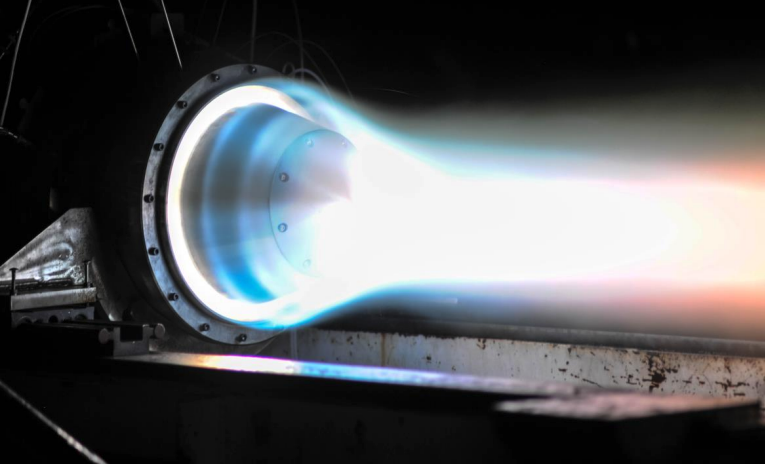
Aerojet Rocketdyne rotation detonation engine under testing.

Rotating detonation engines have been the subject of theory and speculation for decades, but have yet to cross the barrier between theory and practical application.

In theory, a rotating detonation engine promises to be much more efficient than traditional jet engines, potentially providing missile applications a serious boost in range and speed. That could also mean fielding smaller weapons capable of achieving the same speeds and ranges as today’s missiles.

In aircraft applications like jet fighters, rotation detonation engines could offer similar benefits to missiles in terms of range and speed, while potentially reducing maintenance requirements. Fighters, in particular, rely on afterburners, which effectively firehose fuel into the engine’s exhaust stream for added thrust, which, you can imagine, rapidly depletes fuel stores and reduces the fighter’s range. RDEs could potentially allow for a similar boost in thrust with a dramatically reduced fuel penalty.

But where this technology could be the most useful is in powering the Navy’s future non-nuclear surface vessels, providing increased power production, range, and speed while having a seriously beneficial impact on the Navy’s budgetary bottom line.

Related: The Air Force is eyeing groundbreaking new engines for the F-35

Harnessing the power of detonation

The concept behind rotation detonation engines dates back to the 1950s. In the United States, Arthur Nicholls, a professor emeritus of aerospace engineering at the University of Michigan, was among the first to attempt to develop a working RDE design.

In some ways, a Rotating Detonation Engine is an extension of the concept behind pulse detonation engines (PDEs), which are, in themselves, an extension of pulsejets. That might seem confusing (and maybe it is), but we’ll break it down.

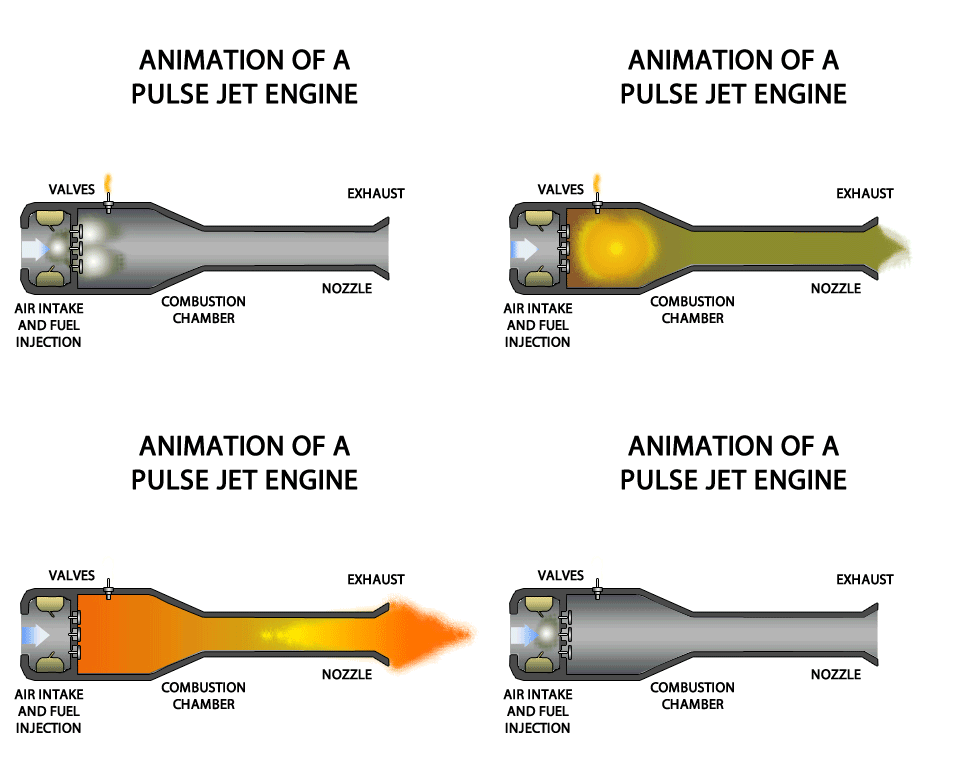
Pulsejet engines work by mixing air and fuel within a combustion chamber and then igniting the mixture to fire out of a nozzle in rapid pulses, rather than under consistent combustion like you might find in other jet engines.

In pulsejet engines, as in nearly all combustion engines, igniting and burning the air/fuel mixture is called deflagration, which basically means heating a substance until it burns away rapidly, but at subsonic speeds.

detonation engine

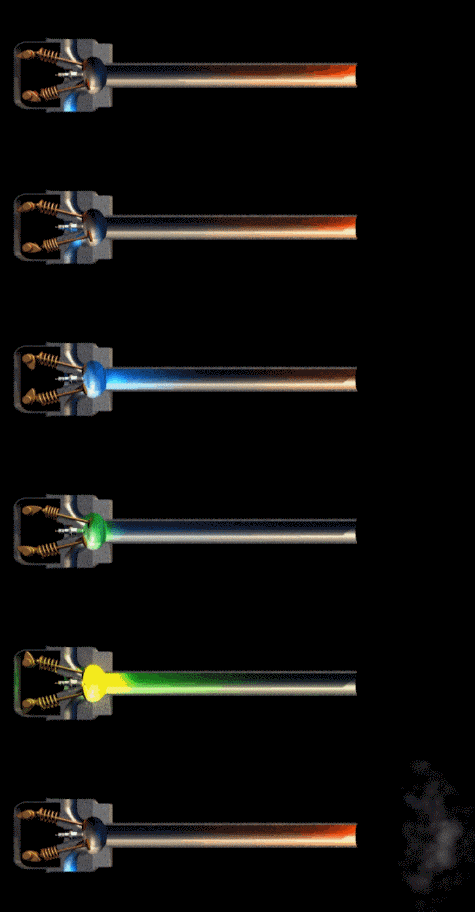
A pulse detonation engine works similarly, but instead of leveraging deflagration, it uses detonation. At a fundamental level, detonation is a lot like it sounds: an explosion.

While deflagration speaks to the ignition and subsonic burning of the air/fuel mixture, detonation is supersonic. When the air and fuel are mixed in a pulse detonation engine, they’re ignited, creating deflagration like in any other combustion engine. However, within the longer exhaust tube, a powerful pressure wave compresses the unburnt fuel ahead of the ignition, heating it above ignition temperature in what is known as the deflagration-to-detonation transition (DDT). In other words, rather than burning through the fuel rapidly, it detonates, producing more thrust from the same amount of fuel; an explosion, rather than a rapid burn.

“The detonation process is a more rapid and efficient extraction of energy from your fuel from a thermodynamic standpoint when compared to deflagration,” Dee Howard endowed professor of hypersonic and aerospace engineering, Dr. Chris Combs, told Sandboxx News.

The detonations still occur in pulses, like in a pulsejet, but a pulse detonation engine is capable of propelling a vehicle to higher speeds, believed to be around Mach 5. Because detonation releases more energy than deflagration, detonation engines are more efficient — producing more thrust with less fuel, allowing for lighter loads and greater ranges.

detonation engine
Pulse Detonation Engine animation courtesy of Fred Schauer (AFRL/PRTS)

The detonation shockwave travels significantly faster than the deflagration wave leveraged by today’s jet engines, Trimble explained: up to 2,000 meters per second (4,475 miles per hour) compared to 10 meters per second from deflagration.

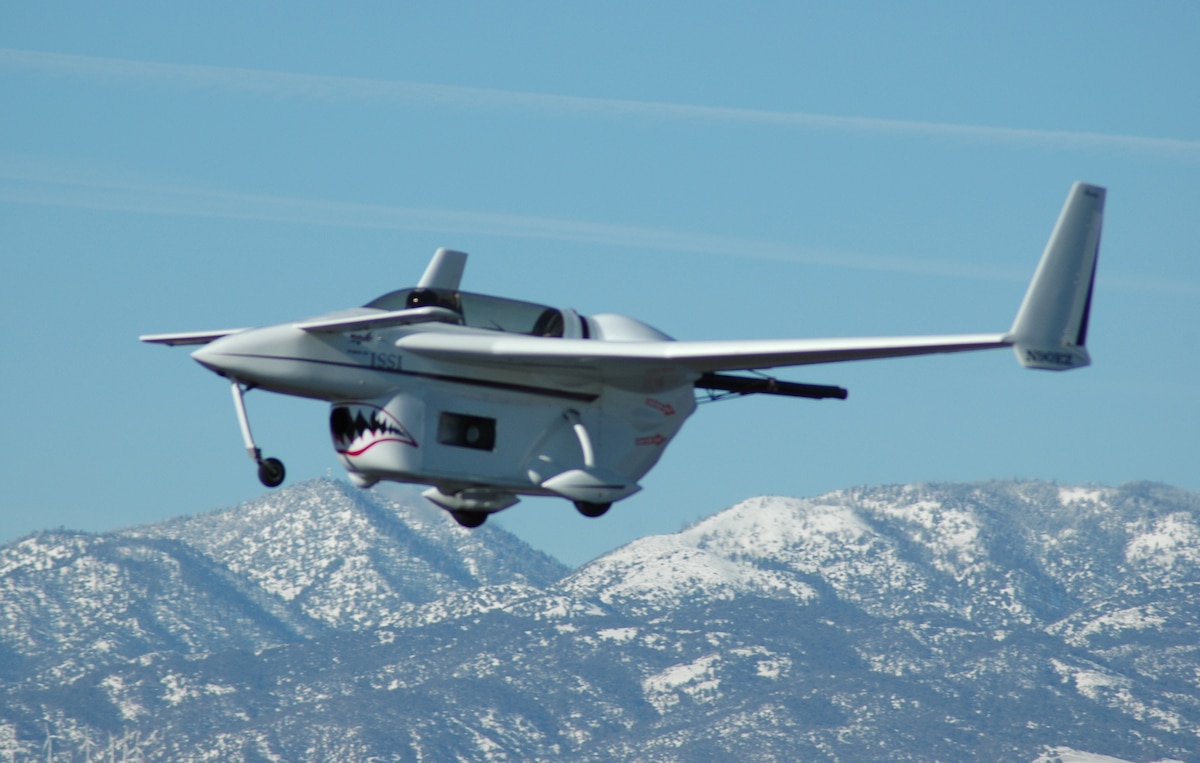
In May of 2008, the Air Force Research Laboratory made history by building the world’s first crewed pulse detonation-powered aircraft, using a Scaled Composites home-build plane called the Long-EZ. The unusual franken-plane managed a speed higher than 120 miles per hour during its test flight, with test pilot Pete Siebold at the stick, and reached altitudes between 60 and 100 feet.

detonation engine
The Long-EZ aircraft powered by a pulse detonation engine making its historic first flight. (Courtesy photo)

“This is a potential game-changer in terms of fuel efficiency,” The AFRL’s Propulsion Directorate’s Fred Schauer said of the PDE powering Long-EZ.

“For comparison, if we had operated this same engine with conventional combustion we would have made less than a third of the thrust for the same fuel burn. In comparison to traditional engines, fuel savings of 5 to 20 percent could be expected.”

The Air Force assessed at the time that improvements to their PDE engine could eventually propel aircraft to speeds beyond Mach 4, and higher if combined with other advanced propulsion systems like scramjets. A rotation detonation engine could be even more effective, but many within the academic and engineering communities questioned whether such an engine could ever actually be built.

Related: US announces successful tests of 3 hypersonic missiles in 2 weeks

The Rotation Detonation Engine emerges

A rotating detonation engine takes this concept to the next level. Rather than having the detonation wave travel out the back of the aircraft as propulsion, it travels around a circular channel within the engine itself.

Fuel and oxidizers are added to the channel through small holes, which are then struck and ignited by the rapidly circling detonation wave. The result is an engine that produces continuous thrust, rather than thrust in pulses, while still offering the improved efficiency of a detonation engine. Many rotation detonation engines have more than one detonation wave circling the chamber at the same time.

As Trimble explains, RDEs see pressure increase during detonation, whereas traditional jet engines see a total pressure loss during combustion, offering greater efficiency. In fact, rotation detonation engines are even more efficient than pulse detonation engines, which need the combustion chamber to be purged and refilled for each pulse.

“In theory, RDE is a bit like the leap from turbojets to turbofans in the 1960s, but for high-supersonic vehicles. It should give you a big jump in specific impulse (aka fuel efficiency), and if you can figure out how to package it in a way that doesn’t make things significantly heavier or less aerodynamic, you should be able to get a nice range boost out of it,” Trimble explained.

rotation detonation engine
Professor Kareem Ahmed, University of Central Florida

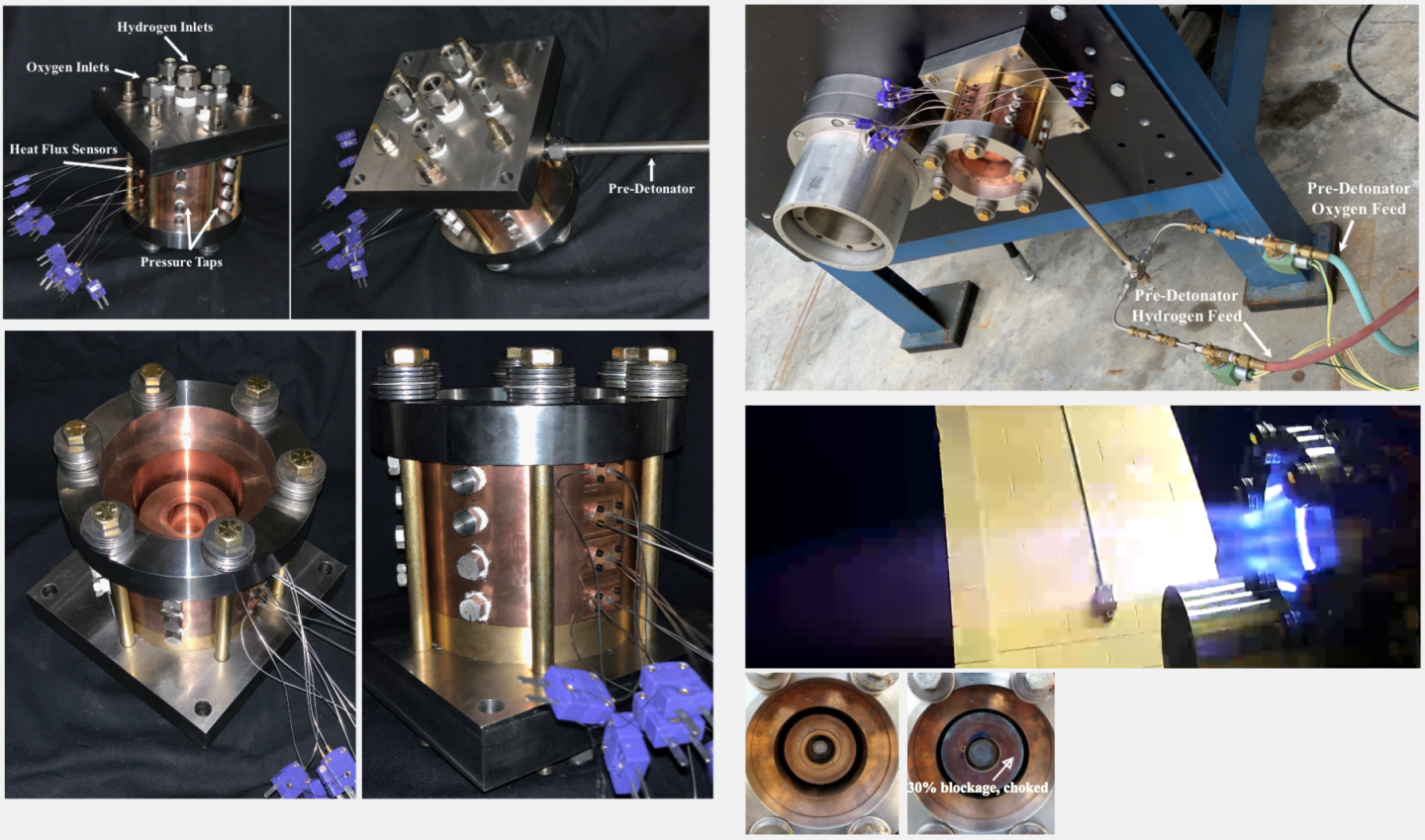
In 2020, a team out of the University of Central Florida, working with the Rotating Detonation Rocket Engine Program at the Air Force Research Laboratory, successfully built and tested the world’s first working rotation detonation engine that continued firing until its fuel was cut off, effectively proving the concept was possible. The three-inch copper test rig developed by the team successfully produced 200 pounds of thrust in laboratory conditions.

Since then, a number of other programs have followed suit, with noted engine manufacturer Pratt and Whitney among those leading the charge.

Related: How America almost got hypersonic aircraft decades ago

A new generation of high-speed, long-range weapons

RDE with vehicle concept
An RDE pictured integrated into the tail of a vehicle concept (U.S. Air Force/Air Force Research Laboratory via Aviation Week)

On July 18, DARPA released a Special Notice pertaining to their new Gambit Missile program, announcing a “Proposer’s Day” for firms to get more information about the effort and its aims. Within the notice, DARPA included a description of the program and its objectives, as well as their anticipated timeline, from inception to flight test.

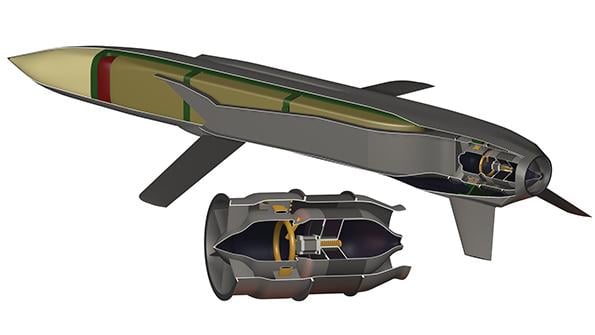
“The objective of the Gambit program is to develop and demonstrate a novel Rotating Detonation Engine (RDE) propulsion system that enables a mass-producible, low-cost, high-supersonic, long-range weapon for air-to-ground strike in an anti-access/area denial (A2AD) environment.”

The program will be conducted in two 18-month phases. The first will entail competitors completing their preliminary designs with some limited testing, while the second would finalize designs and culminate in full-scale flight tests of an RDE system.

While the release offers scant details on the overarching goals of Gambit, some of the language within the announcement point toward specific challenges America’s defense apparatus currently finds itself facing. The reference to Gambit’s use in an “anti-access/area denial (A2AD) environment” could pertain to anywhere American forces are squaring off against a near-peer adversary. But there’s one such environment that has been the focus of multiple Defense efforts in recent years: the 1,000-mile-plus area denial bubble extending from Chinese shores thanks to a growing array of anti-ship weapon systems.

America’s carrier-based fighters, the F-35C and F/A-18 Super Hornet, each have a combat radius of less than 650 miles, which would mean having to sail carriers into harm’s way to launch combat sorties without longer-range munitions.

The United States obviously has the capability of fielding air-launched missiles with significant range, but it isn’t as simple as mounting a massive rocket under the Super Hornet’s wing, as Trimble points out. The size of these weapons matters a great deal, which is why RDE engines, with their improved efficiency and smaller mass, could be a game changer.

“That is probably most useful for the US Navy, which needs to find a way to equip fighters with long-range, high-speed (Mach 4-6) cruise missiles that are small enough to squeeze onto an aircraft carrier’s weapons elevators and land back on the carrier under a fighter’s wing without slamming into the deck.”

But Gambit isn’t the first new weapon program to leverage rotation detonation engine technology. According to the Air Force Research Lab, RDE technology could make high-speed weapons much more affordable, which is of particular import following a recent Defense Department analysis that indicated the hypersonic (Mach 5+) weapons in development for the Air Force may cost as much as $106 million each.

Hypersonic ARRW Readied for Booster Flight - Air Force Magazine
Artist depiction of the Air Force and Lockheed Martin’s AGM-183A ARRW hypersonic boost-glide weapon.

According to a list of efforts supported by the Pentagon’s High-Performance Computing Modernization program in 2022, the Air Force Research Lab has begun development on at least three RDE weapons or demonstrators.

One aims to field a liquid-fueled rotating detonation scramjet that will power an air-to-surface missile that can be carried internally by 5th generation fighters. Another will leverage solid fuel for an air-to-air missile, and a third effort aims to develop a vehicle for freejet testing on the ground.

RDE technology could eventually also lead to smaller weapons that offer the same range and speed as today’s missiles, allowing stealth aircraft like the F-35 to carry more munitions inside their internal weapons bays. Likewise, missiles of the same size as today’s could fly further faster, which has far-reaching benefits in both air-to-air and air-to-surface operations.

Related: Why calling Russia’s Kinzhal a ‘hypersonic missile’ is a stretch

Rotation Detonation Engines could power fighters and even the Navy’s warships

Misawa test cell Airmen run F-16 engines > 7th Air Force > Article Display
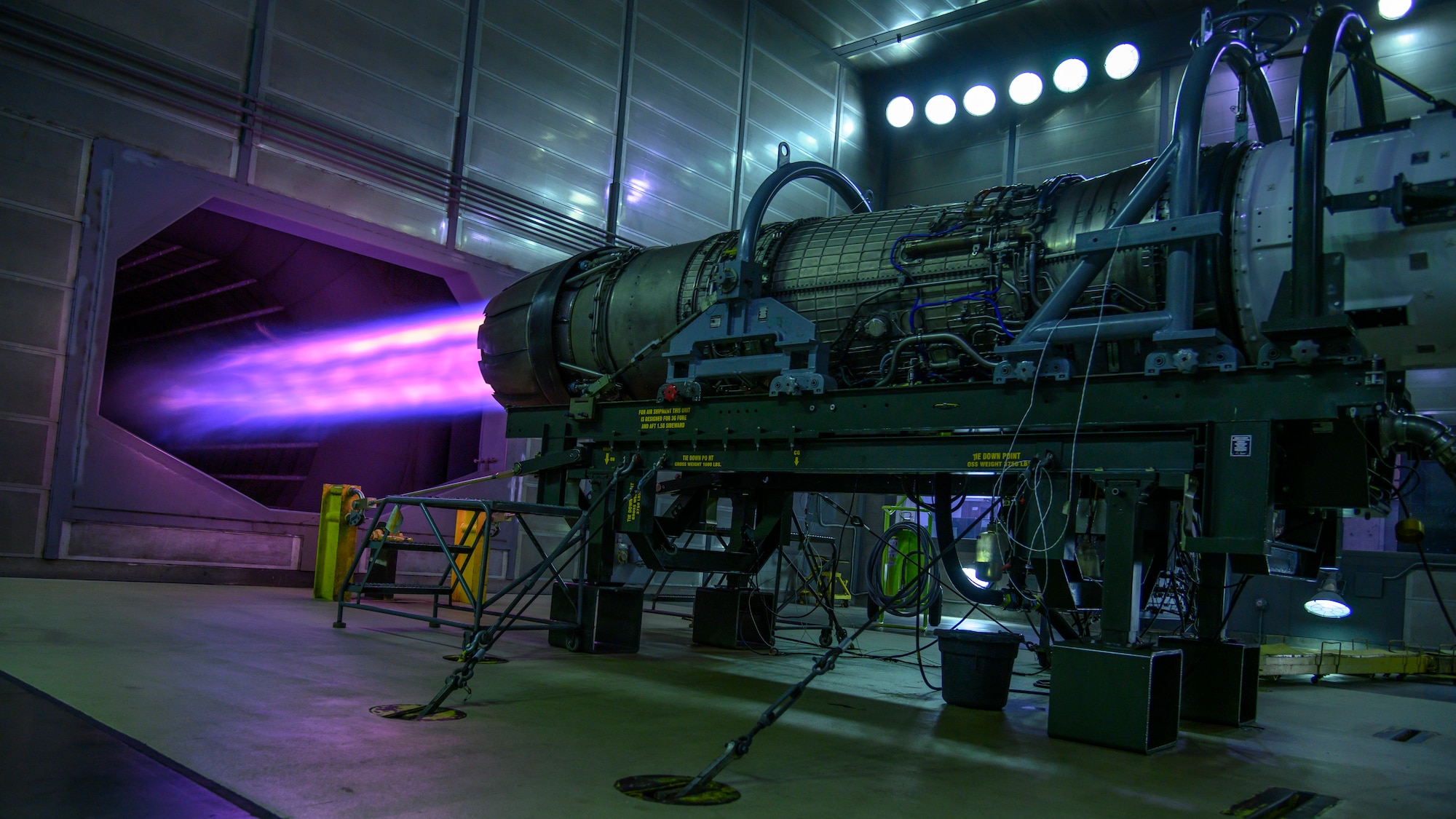
Testing an F-16 engine (U.S. Air Force photo)

Among the weapon-oriented programs being developed by the Air Force Research Laboratory is another rotation detonation engine enterprise that could offer America’s fighters a big boost in range and speed: an RDE that could be used in place of a fighter’s afterburner.

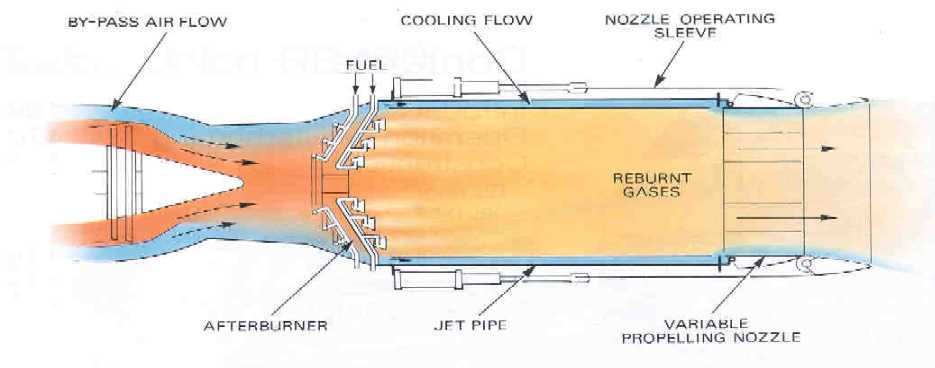
An afterburner effectively combines the remaining oxygen leaving the jet engine with more fuel by spraying fuel directly into the outflow of exhaust. Needless to say, this method of increasing thrust takes a heavy toll on the aircraft’s fuel stores, forcing pilots to choose between speed and range or loiter time.

Diagram courtesy of Purdue University

A rotation detonation engine afterburner could provide an increase in thrust while leveraging the design’s inherent efficiency, providing the same gains for less fuel expended.

In the longer term, air-breathing RDEs could even find their way into the fuselage of an aircraft as the primary means of propulsion. But not all of the potential applications for RDE’s are in the sky. One of the most promising may actually be out at sea.

While the Navy’s aircraft carriers and submarines are famously nuclear-powered, the rest of the fleet still runs on good old-fashioned F-76 marine diesel fuel — an estimated 86 million barrels of it in 2016 alone. So it may come as little surprise to you that the Navy has been very interested in this approach to high-efficiency propulsion. In fact, the Navy filed its own patent for a “rotary detonation engine” as far back as 1982.

The Arleigh Burke-class guided-missile destroyer USS Donald Cook (DDG 75) and USS Porter (DDG 78) conduct a connected replenishment with the USNS SUPPLY (T-AOE 6) to receive fuel and stores. (Photo by Royal Navy Photograher Dan Rosenbaum)

According to the Navy in 2012, rotation detonation engines could increase a warship’s thrust by 10% and reduce fuel consumption by 25%, giving them more speed and range for the fuel expended. In 2012, that kind of improvement was projected to result in savings of $300 to $400 million per year, which equates to $387 million to $516 million in today’s dollars.

The truth is, Rotation Detonation Engines could help fighters fly further, missiles fly faster, ships sail longer, and even rocket launches become cheaper. There aren’t many places in America’s defense apparatus this forward-reaching tech couldn’t benefit.

And while for many years the question surrounding RDEs was always if, increasingly, it now appears to be when.

Read more from Sandboxx News


hanson.stanford.edu

Rotating Detonation Engines


Rotating detonation engines (RDEs) are a promising technology for future propulsion and energy systems due to their high potential thermodynamic efficiencies and compact designs.

However, the development of these devices into robust, reliable systems requires continued experimentation. In the Hanson Research Group, we work with engine experts at the Naval Postgraduate School to support these experimentation efforts by developing laser sensors to measure H2O, CO2, CO, and temperature within their RDE combustors. The unique geometry of rotating detonation engine combustors led us to pioneer a single-ended sensor design, wherein laser light is both delivered and collected through the same window on the engine.

In combination with advanced diagnostic techniques that are able to overcome the intense vibration and thermal emission generated by the engine, our single-ended sensors provide crucial combustion data that will inform future rotating detonation engine designs.

A rotating detonation engine at the Naval Postgraduate School equipped with a single-ended laser sensor designed by the Hanson Research Group. The server rack (upper right) controls the lasers (lower right), which are connected to a fiber optic cable (center). Light from the fiber is delivered to and collected from the engine (lower left) by the detection assembly (upper left). Figure adapted from [4].

To learn more, check out some of our publications:

[1] Peng, W. Y., Goldenstein, C. S., Spearrin, R. M., Jeffries, J. B., Hanson, R. K., “Single-ended mid-infrared laser-absorption sensor for simultaneous in situ measurements of H2O, CO2, CO, and temperature in combustion flows,”

Applied Optics, Vol. 55, No. 33 (2016) pp. 9347–9359. DOI: 10.1364/ao.55.009347

[2] Peng, W. Y., Cassady, S. J., Strand, C. L., Goldenstein, C. S., Spearrin, R. M., Brophy, C. M., Jeffries, J. B., Hanson, R. K., “Single-ended mid-infrared laser-absorption sensor for time-resolved measurements of water concentration and temperature within the annulus of a rotating detonation engine,”

Proceedings of the Combustion Institute, Vol. 37, No. 2 (2019) pp. 1435–1443. DOI: 10.1016/j.proci.2018.05.021

[3] Cassady, S. J., Peng, W. Y., Strand, C. L., Dausen, D. F., Codoni, J. R., Brophy, C. M., Hanson, R. K., “Time-resolved, single-ended laser absorption thermometry and speciation in a H2/C2H4-fueled rotating detonation engine,”

Proceedings of the Combustion Institute, Vol. 38, No. 1 (2021) pp. 1719–1727. DOI: 10.1016/j.proci.2020.06.125

[4] Peng, W. Y., “Single-ended laser-based diagnostics for thermometry and speciation in detonation-driven combustors,”

Ph.D. Thesis, Stanford University (2019)


newatlas.com

World-first "impossible" rotating detonation engine fires up

By Loz Blain

A Florida team working with the US Air Force claims that it's built and tested an experimental model of a rotating detonation rocket engine, which uses spinning explosions inside a ring channel to create super-efficient thrust.

The vast majority of engines, of course, use combustion rather than detonation to achieve their output goals. Combustion is a relatively slow and controlled process resulting from the reaction between fuel and oxygen at high temperatures, and it's very well understood and mature as a technology.

Detonation, on the other hand, is fast and chaotic and much less predictable. An explosion instead of a burn, it is the massive discharge of energy you get when you break apart the chemical bonds holding an explosive molecule together by giving it a jolt of energy – either electrical or kinetic – in the form of a sufficiently powerful shockwave to destabilize those bonds. Detonation is excellent when you want to wreck stuff in bulk, and much harder to maintain precise control over.

But when you need to break the chains of the Earth's gravity and go to space, every gram of weight makes things that much harder and more expensive. Detonation releases significantly more energy from significantly less fuel mass than combustion, so for more than 60 years, rocket scientists have been working on the idea of a rotating detonation rocket as a potential way to cut down weight and add thrust.

Mechanically simple, the rotating detonation engine is dynamically very complex and requires precise timing and fuel delivery rates

Professor Kareem Ahmed, University of Central Florida

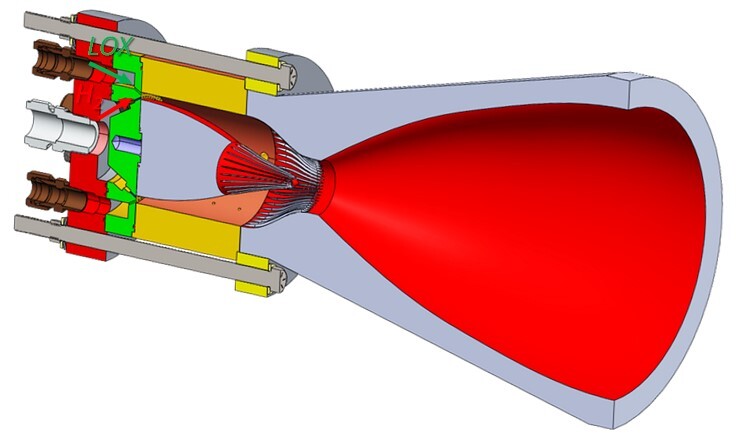
In essence, such a device starts with one cylinder inside another larger one, with a gap between them and some small holes or slits through which a detonation fuel mix can be pushed. Some form of ignition creates a detonation in that annular gap, which creates gases that are pushed out one end of the ring-shaped channel to produce thrust in the opposite direction. But it also creates a shockwave that propagates around the channel at around five times the speed of sound, and that shockwave can be used to ignite more detonations in a self-sustaining, rotating pattern if fuel is added in the right spots at the right times.

Pioneered by engineers at the University of Michigan in the 1950s, the rotating detonation engine is tantalizingly simple in a mechanical sense, but this self-propagating detonation wave has proven torturously difficult to achieve and sustain.

Until now, it seems. A team at the University of Central Florida, working alongside the Rotating Detonation Rocket Engine Program at the Air Force Research Laboratory, claims to have built and tested a working laboratory model. It's a 3-inch copper test rig using a mix of hydrogen and oxygen for fuel, which is the highest-performing rocket fuel for upper stage rocket engines.

"The study presents, for the first time, experimental evidence of a safe and functioning hydrogen and oxygen propellant detonation in a rotating detonation rocket engine," says Kareem Ahmed, an assistant professor in UCF's Department of Mechanical and Aerospace Engineering who led the research. "The detonation is sustained continuously until you cut off the fuel. We have tested up to 200 lbf, but the thrust increases linearly with the propellant mass flow."

The three-inch copper test rig has developed up to 200 lbf, but thrust will increase in a linear fashion as more fuel is added

Professor Kareem Ahmed, University of Central Florida

The secret, according to the researchers, was as simple as a tune-up.

"We have to tune the sizes of the jets releasing the propellants to enhance the mixing for a local hydrogen-oxygen mixture," Ahmed says. "So, when the rotating explosion comes by for this fresh mixture, it's still sustained. Because if you have your composition mixture slightly off, it will tend to deflagrate, or burn slowly instead of detonating."

"Just a few months prior, a number of US rocket engine experts had publicly declared that hydrogen-oxygen detonation engines were not possible," Ahmed tells New Atlas. "However, the paper presents experimental evidence and demonstrated without a doubt that detonation of oxygen and hydrogen are occurring within a rotating detonation rocket engine."

"These research results already are having repercussions across the international research community," says William Hargus, lead of the Air Force Research Laboratory's Rotating Detonation Rocket Engine Program, who is a co-author of the study. "Several projects are now re-examining hydrogen detonation combustion within rotating detonation rocket engines because of these results. I am very proud to be associated with this high-quality research."

Ahmed tells us this engine design is being evaluated as a possible replacement for Aerojet Rocketdyne's RL-10 rocket, which was first developed in 1962. Modern versions are still in production for the upper stages of Atlas V and Delta IV rockets, with further versions under development for the Exploration, OmegA and Vulcan rockets, but a proven rotating detonation rocket engine could be a real game-changer.

"The U.S. Air Force is targeting a rocket launch flight test by 2025," says Ahmed, "and we are contributing to achieving that goal."

While space propulsion is the key driver for this research, it also has potential terrestrial uses in other cases where high power and low fuel consumption could make a big difference. In 2012, the Naval Research Laboratory estimated that rotating detonation engines could save the Navy 15-20 percent off a ~US$2-billion annual fuel bill if they were retrofitted in place of the gas turbine engines that run over 100 of its large ships. They could also potentially be used in hypersonic and supersonic flights, or even electric power generation, and Ahmed tells us the design has potential as a booster stage engine as well, but it'd require a different type of propellant.

See a short slow-motion video of the rocket firing below.

Rotating Detonation Engine

The team has published their results in the journal Combustion and Flame.

Source: University of Central Florida


Synthetic Aperture Radar Drone Gets Interferometric Imaging | Hackaday

Synthetic Aperture Radar Drone Gets Interferometric Imaging | Hackaday Backyard Coherence: A €1,000 Drone SAR Achieves Repeat-Pass Interfero...