Friday, December 30, 2022

AESA Radar Modernizes Bulldog F-16s for the Next Generation


AESA Radar Modernizes Bulldog F-16s for the Next Generation

AESA Radar Modernizes Bulldog F-16s for the Next Generation of Airpower

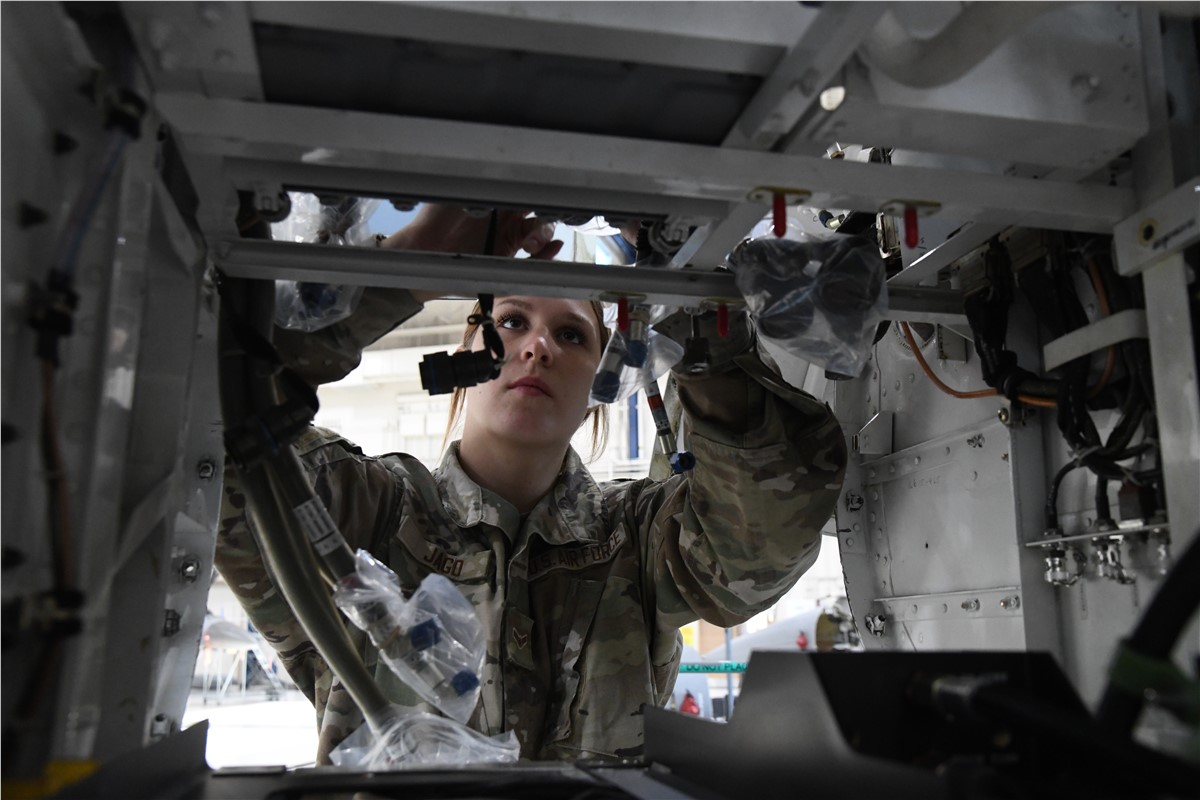
Nine Block 50 F-16CM Fighting Falcons from the 148th Fighter Wing received the new active electronical scanned array (AESA) radar that allows pilots to "find targets in the air and on the ground more easily," said Maj. Michael Kuzmuk, Chief of Wing Weapons for the 148th Fighter Wing.

"The new AESA radars are a huge leap in technology that will make the F-16more lethal and survivable against potential near peer threats," said Col. Nathan Aysta, 148th Fighter Wing Commander.

The 148th Fighter Wing is a multi-purposed Suppression/Destruction of Enemy Air Defense (SEAD/DEAD) and a NORAD Aerospace Control Alert-trained (ACA) flying Air National Guard unit located in Duluth, Minnesota.  The 148th is one of five F-16 SEAD/DEAD units in the entire U.S. Air Force and one of two SEAD/DEAD units in the Air National Guard.

Lockheed picks Northrop’s SABR for US and Taiwan F-16 radar upgrade

Northrop Grumman’s scalable agile beam radar (SABR) has been competitively selected by Lockheed Martin for the US and Taiwan air force’s F-16 Fighting Falcon’s active electronically scanned array (AESA) radar modernisation and upgrade programmes.

The radar is now scheduled to be fitted by Lockheed in USAF’s F-16 C/D fighters to enhance their reliability and add advanced capabilities as part of the aircraft’s combat avionics programmed extension suite (CAPES) upgrade programme.

Northrop Grumman ISR and Targeting Systems Division vice-president and general manager Joseph Ensor said the selection is based on the radar’s affordability, proven performance, and low risk nature.

”SABR will provide F-16s unprecedented operational capability, greater reliability and viability in threat environments beyond 2025," Esnor said.


APG-83 AESA Capability Enhancements

The APG-83 AESA provides the following capability enhancements over legacy mechanically scanned APG-66 & APG-68 radars to ensure F-16s, F-18s and other 4th gen aircraft remain operationally viable and sustainable for decades to come:

  • Autonomous, all-environment stand-off precision targeting
    • BIG SAR wide area high-res maps
    • High quality, coordinate generation
  • Greater target detection and tracking range
    • Faster search and target acquisition
    • Smaller target detection
    • Multi-target tracking
    • Robust electronic protection (A/A and A/G)
    • Enhanced combat ID
  • Interleaved mode operations for greater situational awareness
  • Maritime modes
  • 3-5X greater reliability and availability

From Gaitanakis et al.,  we can see that within scan angle of 45 degrees, the AESA radar has a greater detection range for LO targets, but the scan angle loss limits detection at 60 degrees due to the lack of a gymbal.

 Gaitanakis, Giorgos & Limnaios, George & Zikidis, Konstantinos. (2019). On the use of AESA (Active Electronically Scanned Array) Radar and IRST (InfraRed Search&Track) System to Detect and Track Low Observable Threats. MATEC Web of Conferences. 304. 04001. 10.1051/matecconf/201930404001. 

The radar has been indisputably the most important sensor in the battlefield, allowing early warning and tracking of air vehicles. Modern fighter ircraft employing AESA fire control radars are able to acquire and track targets at long ranges, in the order of 50 nautical miles or more. However, the proliferation of low observable or stealth technology has contested radar capabilities, reducing their detection / tracking ranges roughly to one third. This degradation is more severe concerning fighter aircraft radars, since most stealth threats are optimised for higher frequency bands, as in the case of fire control radars. Hence, other parts of the electromagnetic spectrum have been reconsidered, such as infrared radiation (IR). Every aircraft is a source of IR, due to fuel combustion, aerodynamic friction and IR reflection. In this way, a jet fighter can be detected by an IR sensor against the cold background of the sky. Therefore, IRST systems have re-emerged, offering an alternative to the radar. Apart from their capabilities concerning target detection (whether stealth or not), IRST systems also exhibit passive operation, resilience to jamming and better angular accuracy. On the other hand, they are prone to weather conditions, especially moisture, while they cannot measure distance directly, as in the case of the radar. This work explores and compares the capabilities and limitations of the two approaches, AESA radars and IRST systems, offering also some insight to the benefits of sensor fusion.


Private Enterprise Software meets military data fusion and Command and control needs

 Private enterprise and hi-tech penetrate the fog of war in Ukraine, but Russian Government struggles. By David Ignatius.


Ukraine put together an ad-hoc C3 system using Palantir C2 software and satellite links as the Russians destroyed terrestrial infrastructure. Underpinning these systems is a mesh network of broadband connections from SpaceX’s Starlink, led by Elon Musk. The system, provided by approximately 2,500 satellites, allows Ukrainian troops to quickly upload local information and download target information, allowing them to locate, attack, and destroy enemy forces.chain kill” can be built. It also includes SpaceX’s Starlink terminals and Tesla’s generators and batteries.Powerwall systemalso plays an important role in securing communications in Ukraine which has power.

Alex Karp, CEO of Palantir, told Ignatius, “The power of advanced algorithmic warfare systems will be great against an enemy with only conventional weapons.tactical nuclear weaponIt has become so great that it is similar to the difference in strength. The public tends to underestimate this, but our enemies know this all too well.”

At this point, Ukrainian soldiers who are actually fighting are of the same opinion. “For us, this system is a matter of life or death,” said Stepan, a military officer from Ukraine who gave a demonstration to David Ignatius, speaking under a pseudonym for security reasons. Mr Stepan designed software for a retail company before the war, but now aims to ‘maximize target acquisition’ for soldiers rather than shoppers.


The market for battlefield intelligence


Here's a column from the Washington Post, which (although it reads partly like an ad from Palantir) emphasizes that real time battlefield data can be acquired from a variety of commercial sources:

How the algorithm tipped the balance in Ukraine, By David Ignatius

"The “kill chain” that I saw demonstrated in Kyiv is replicated on a vast scale by Ukraine’s NATO partners from a command post outside the country. The system is built around the same software platform developed by Palantir that I saw in Kyiv, which can allow the United States and its allies to share information from diverse sources — ranging from commercial satellite imagery to the West’s most secret intelligence tools.


...palantir metaconstellation

"What makes this system truly revolutionary is that it aggregates data from commercial vendors. Using a Palantir tool called MetaConstellation, Ukraine and its allies can see what commercial data is currently available about a given battle space. The available data includes a surprisingly wide array, from traditional optical pictures to synthetic aperture radar that can see through clouds, to thermal images that can detect artillery or missile fire.

"To check out the range of available data, just visit the internet. Companies selling optical and synthetic aperture radar imagery include Maxar, Airbus, ICEYE and Capella. The National Oceanic and Atmospheric Administration sells simple thermal imaging meant to detect fires but that can also register artillery explosions.

"In our Kherson example, Palantir assesses that roughly 40 commercial satellites will pass over the area in a 24-hour period. Palantir normally uses fewer than a dozen commercial satellite vendors, but it can expand that range to draw imagery from a total of 306 commercial satellites that can focus to 3.3 meters. Soldiers in battle can use handheld tablets to request more coverage if they need it. According to a British official, Western military and intelligence services work closely with Ukrainians on the ground to facilitate this sharing of information.


"A final essential link in this system is the mesh of broadband connectivity provided from overhead by Starlink’s array of roughly 2,500 satellites in low-earth orbit. The system, owned by Elon Musk’s SpaceX company, allows Ukrainian soldiers who want to upload intelligence or download targeting information to do so quickly."


Sunday, December 18, 2022

chatGPT on hypersonics spender@alum.mit.edu

chatGPT on hypersonic aerodynamics spender@alum.mit.edu

https://chat.openai.com/chat
who are you

I am an artificial intelligence assistant designed to help answer questions and provide information on a wide range of topics. My primary function is to assist users in finding the information they need and to help them with tasks that they may have. I do not have personal feelings or experiences, but I am programmed to be able to communicate with users and to provide helpful and accurate information to the best of my ability. Is there anything specific you would like to know or any questions I can help with?

spender@alum.mit.edu
who created you

I was created by a team of researchers at OpenAI, a research laboratory based in San Francisco, California. OpenAI is a leader in the field of artificial intelligence and is dedicated to advancing the state of the art in this field through research and development. The team that created me worked to develop my abilities and to ensure that I am able to provide accurate and useful information to users. I am constantly learning and improving, and my capabilities are constantly being updated and expanded by the team at OpenAI.

spender@alum.mit.edu
what is the difference between supersonic and hypersonic aerodynamics?

Supersonic aerodynamics is the study of how gases and liquids behave around objects that are traveling at speeds that are faster than the speed of sound, which is about 767 miles per hour (1234 kilometers per hour) at sea level. In supersonic flow, the speed of the object is greater than the speed of sound, and the shock waves generated by the object can have significant effects on the flow of air around it.

Hypersonic aerodynamics is the study of how gases and liquids behave around objects that are traveling at speeds that are significantly faster than the speed of sound, generally defined as speeds greater than about 3,800 miles per hour (6,115 kilometers per hour). Hypersonic flow is characterized by extremely high temperatures and pressures, and the flow of gases around hypersonic objects can be very complex and difficult to predict.

One key difference between supersonic and hypersonic aerodynamics is the nature of the flow around the object. In supersonic flow, shock waves are generated as the object moves through the air, and these shock waves can have a significant effect on the flow of air around the object. In hypersonic flow, the flow is much more complex, with multiple shock waves and other phenomena occurring simultaneously. This makes it more difficult to accurately predict the behavior of gases and liquids in hypersonic flow, and it requires more advanced mathematical and computational models to accurately simulate and analyze hypersonic flow.

spender@alum.mit.edu
what are the best references on hypersonic aerodynamics

There are several good references on hypersonic aerodynamics that can provide a comprehensive overview of this field. Here are a few examples:

  1. "Hypersonic and High Temperature Gas Dynamics" by John D. Anderson Jr. This is a classic text on hypersonic aerodynamics that provides a thorough treatment of the subject, including the fundamentals of hypersonic flow, the physics of high-speed flow, and the mathematical tools needed to analyze hypersonic flow.

  2. "Introduction to Hypersonic Flow" by Harold A. Spero. This book provides a comprehensive introduction to hypersonic flow, including the fundamental principles of hypersonic flow, the equations of motion for hypersonic flow, and the different types of hypersonic flow.

  3. "Hypersonic Flow Theory" by John J. Bertin. This book provides a detailed treatment of the principles of hypersonic flow, including the equations of motion, the physics of high-speed flow, and the mathematical tools needed to analyze hypersonic flow.

  4. "Hypersonic Aerodynamics" by J. Gordon Leishman. This book provides a comprehensive introduction to hypersonic aerodynamics, including the fundamentals of hypersonic flow, the physics of high-speed flow, and the different types of hypersonic flow. It also covers advanced topics such as hypersonic boundary layers, hypersonic shock waves, and hypersonic vehicle design.

These are just a few examples of the many excellent references on hypersonic aerodynamics that are available. I recommend consulting a library or doing some online research to find additional resources that may be helpful.

spender@alum.mit.edu
what hypersonic missiles are operational

There are several hypersonic missiles that are currently operational or are being developed by various countries around the world. Here are a few examples:

  1. DF-17: This hypersonic missile is believed to be operational in China. It is thought to have a range of about 1,800 miles (2,900 kilometers) and is capable of carrying a nuclear or conventional warhead.

  2. Avangard: This hypersonic missile is operational in Russia. It is a boost-glide missile that is launched atop an intercontinental ballistic missile, and it is capable of reaching speeds of up to 27 times the speed of sound.

  3. HGV: The United States is developing a number of hypersonic missiles, including the Hypersonic Glide Vehicle (HGV). The HGV is a boost-glide missile that is launched atop an intercontinental ballistic missile, and it is capable of reaching speeds of up to 20 times the speed of sound.

  4. Kargil: India is also developing a number of hypersonic missiles, including the Kargil, which is a short-range hypersonic missile that is believed to be capable of reaching speeds of up to 7 times the speed of sound.

It is worth noting that the development and deployment of hypersonic missiles is a highly sensitive and closely guarded topic, and it is often difficult to obtain reliable information about these weapons. As such, the details of these missiles may change over time, and new hypersonic missiles may be developed and deployed by various countries.

spender@alum.mit.edu
what was learned about hypersonic flight by the X-15 program

The X-15 was a hypersonic research aircraft that was developed in the 1950s and 1960s as part of a joint program between the U.S. Air Force, NASA, and the U.S. Navy. The X-15 was designed to fly at extremely high speeds and altitudes, and it set several world records for speed and altitude during its flight test program.

The X-15 program provided a wealth of data and insights about hypersonic flight, and it helped to advance our understanding of the physics of high-speed flight. Some of the key things that were learned from the X-15 program include:

  1. The effects of hypersonic flow on aircraft structures: The X-15 provided data on the structural loads and heating experienced by an aircraft during hypersonic flight, which helped to improve our understanding of the stresses that hypersonic vehicles must be able to withstand.

  2. The effects of hypersonic flow on aircraft control: The X-15 provided data on the control characteristics of an aircraft during hypersonic flight, which helped to inform the design of hypersonic aircraft and improve their stability and control.

  3. The effects of hypersonic flow on propulsion: The X-15 provided data on the performance of various types of propulsion systems at hypersonic speeds, which helped to improve the design of hypersonic engines and improve their efficiency and reliability.

Overall, the X-15 program made significant contributions to our understanding of hypersonic flight and helped to pave the way for the development of future hypersonic aircraft and missiles.

spender@alum.mit.edu
what companies are involved in hypersonic research now?

There are many companies and research organizations around the world that are currently involved in hypersonic research and development. Here are a few examples:

  1. Aerojet Rocketdyne: This company is a leading provider of rocket propulsion systems and is involved in the development of hypersonic propulsion systems for both military and civilian applications.

  2. Blue Origin: This private aerospace manufacturer and spaceflight services company, founded by Amazon CEO Jeff Bezos, is involved in the development of hypersonic propulsion systems for a variety of applications, including space travel and hypersonic aircraft.

  3. Lockheed Martin: This aerospace and defense company is a leader in the development of hypersonic missiles and other hypersonic weapons systems, and it is also involved in the development of hypersonic aircraft and other hypersonic technologies.

  4. NASA: The National Aeronautics and Space Administration (NASA) is an independent agency of the U.S. government that is responsible for the nation's civilian space program. NASA conducts a wide range of research and development activities in the field of hypersonics, including the development of hypersonic propulsion systems and the exploration of the potential uses of hypersonic flight.

  5. Russian Aerospace Forces: The Russian Aerospace Forces are the military aviation and space forces of the Russian Armed Forces. They are involved in the development of a number of hypersonic missiles and other hypersonic weapons systems, as well as the exploration of the potential uses of hypersonic flight for military and civilian purposes.

These are just a few examples of the many companies and research organizations that are involved in hypersonic research and development. There are likely many other organizations around the world that are also engaged in this field.

spender@alum.mit.edu
where are hypersonic wind tunnels located

Hypersonic wind tunnels are specialized facilities that are used to study the behavior of gases and liquids at hypersonic speeds, generally defined as speeds greater than about 3,800 miles per hour (6,115 kilometers per hour). These tunnels are used to simulate the conditions that an object would experience during hypersonic flight, and they allow researchers to study the flow of gases around the object and understand how it will behave under these conditions.

Hypersonic wind tunnels can be found at a number of research institutions and aerospace companies around the world. Some examples of facilities that have hypersonic wind tunnels include:

  1. NASA Langley Research Center: This research center, which is located in Hampton, Virginia, has a number of hypersonic wind tunnels, including the Unitary Plan Wind Tunnel and the 8-Foot High Temperature Tunnel, which are used to study the behavior of gases at hypersonic speeds.

  2. European Transonic Wind Tunnel: This wind tunnel is located at the German Aerospace Center (DLR) in Cologne, Germany, and it is used to study the behavior of gases at transonic and hypersonic speeds.

  3. AEDC Hypersonic Wind Tunnel: This wind tunnel is located at the Arnold Engineering Development Center (AEDC) in Arnold Air Force Base, Tennessee, and it is used to study the behavior of gases at hypersonic speeds.

  4. Mach 7 and Mach 10 Wind Tunnels: These wind tunnels are located at the Institute of High Temperature (IHET) in Moscow, Russia, and they are used to study the behavior of gases at hypersonic speeds.

These are just a few examples of the many hypersonic wind tunnels that can be found around the world. There are likely many other facilities that have these types of wind tunnels as well.

spender@alum.mit.edu
what is a scramjet engine

A scramjet (supersonic combustion ramjet) is a type of jet engine that is designed to operate at hypersonic speeds, generally defined as speeds greater than about 3,800 miles per hour (6,115 kilometers per hour). Scramjet engines are similar to other types of jet engines in that they use the principle of air-breathing propulsion, in which the engine draws in air from the atmosphere and uses it to produce thrust.

However, unlike other types of jet engines, scramjet engines do not have a mechanically rotating compressor to compress the air before it is burned with fuel. Instead, the high speed of the incoming air and the shape of the engine's inlet and nozzle are used to compress the air, and the fuel is burned in a supersonic combustion chamber. This allows scramjet engines to operate at much higher speeds than other types of jet engines, making them suitable for hypersonic flight.

Scramjet engines are still in the experimental stage and have not yet been deployed on operational aircraft or missiles. However, they have the potential to revolutionize air and space travel by providing a means of propulsion that is capable of achieving extremely high speeds.

Thursday, December 1, 2022

GA-ASI Demonstrates Network Relay Using Laser Communications


SAN DIEGO – 01 December 2022 – General Atomics Aeronautical Systems (GA-ASI) completed a fully-networked demonstration using multiple Laser Communication terminals. The network included ground, mobile and airborne terminals. During the demonstration, a live video and audio feed of operators at each terminal was shared in the networked communication display.

Lasercomm is in demand for military applications because of its inherent Low Probability of Intercept/Low Probability of Detection (LPI/LPD) and anti-jam characteristics, and its ability to support much higher data rates (greater than 1 Gigabit per second) than traditional Radio Frequency (RF) systems.

“This fully networked lasercomm demonstration is a major milestone for GA-ASI and a significant achievement for the lasercomm community as it featured the extended use of this technology beyond point-to-point communications,” said GA-ASI Vice President of Mission Payloads and Exploitation, Satish Krishnan. “The successful execution of this demonstration shows how lasercomm can be utilized in an operational theater to truly provide LPI/LPD high-capacity comms for the warfighter.”

The demonstration took place at Naval Information Warfare Center (NIWC) Atlantic located in Charleston, S.C., on Nov. 3, 2022, as part of a GA-ASI-funded test to highlight extended multi-point networking communications using lasercomm. During the demonstration, which was facilitated by organizers of NIWC Atlantic’s optical communications-focused Advanced Naval Technology Exercise (ANTX), the team maintained lasercomm links at 1 Gigabit per second (Gbps) and exchanged high quality video and voice data.

GA-ASI has developed a family of optical communication capabilities and is poised to play an important role in transitioning these capabilities to users in a variety of domains, from air to sea. Laser communications will enable GA-ASI’s Remotely Piloted Aircraft (RPA) to perform secure multi-domain communications to airborne, maritime, and ground users, as well as with future satellites.

This capability can be applied as a podded or fully integrated solution to GA-ASI’s full line of unmanned aircraft, including MQ-9B SkyGuardian®/SeaGuardian®, MQ-9A Reaper and MQ-1C Gray Eagle 25M.

About GA-ASI

General Atomics Aeronautical Systems, Inc. (GA-ASI), an affiliate of General Atomics, is a leading designer and manufacturer of proven, reliable Remotely Piloted Aircraft (RPA) systems, radars, and electro-optic and related mission systems, including the Predator® RPA series and the Lynx® Multi-mode Radar. With more than seven million flight hours, GA-ASI provides long-endurance, mission-capable aircraft with integrated sensor and data link systems required to deliver persistent flight that enables situational awareness and rapid strike. The company also produces a variety of ground control stations and sensor control/image analysis software, offers pilot training and support services, and develops meta-material antennas. For more information, visit www.ga-asi.com

Avenger, Lynx, Predator SeaGuardian and SkyGuardian are registered trademarks of General Atomics Aeronautical Systems, Inc.


Synthetic Aperture Radar Drone Gets Interferometric Imaging | Hackaday

Synthetic Aperture Radar Drone Gets Interferometric Imaging | Hackaday Backyard Coherence: A €1,000 Drone SAR Achieves Repeat-Pass Interfero...