Friday, February 23, 2024

US Approves $75 Million Taiwan Tactical Data Link Upgrade


US Approves $75 Million Taiwan Tactical Data Link Upgrade

While it is to be competed, the ATDLSU program looks like a lock for Lockheed Martin, who had the original PoSheng program which upgraded all three services of Republic of China [Taiwan] (see video below), from 2003 to 2012. I worked on an Opnet full network model of the PoSheng network under CACI.

The Lockheed Martin Po Sheng team also included key companies throughout the United States. California-based companies include ViaSat located in Carlsbad and CACI International, Inc., Titan, Information Networking Systems, Inc., and Digital Wizards in the San Diego area. Other team members include Alion Science and Technology, Annapolis, Maryland; Veridian Engineering Group, Arlington, Virginia; and Austin, Texas-based Advance Programming Concepts, Inc., all of whom supported data link processing, developmental test, evaluation and network design.

I doubt they'll be able to pull the old team together, as ViaSat has sold off their tactical data link business to L3Harris.

thedefensepost.com

Inder Singh Bisht

The US State Department has approved the possible sale of the Advanced Tactical Data Link System Upgrade Planning and related equipment to Taiwan.

The estimated $75-million sale includes cross domain solutions, high assurance devices, GPS receivers, and communications equipment.

“The proposed sale will improve the recipient’s ability to meet current and future threats by enhancing communications and network security, and providing infrastructure to allow the secure flow of tactical information,” the Defense Security Cooperation Agency stated.

The principal contractor will be decided through a competitive process.

NATO Link-22 Upgrade

Washington last year decided to upgrade Taiwan’s Link 16 data link system to NATO’s Link-22, offering greater range and a direct connection to the US military.

Link-22 is a secure beyond-line-of-sight communications capability that interconnects “air, surface, subsurface, and ground-based tactical data systems,” Focus Taiwan wrote, citing head of Department of Strategic Planning Lee Shih-Chiang.

Chinese Sanctions US Firms

It comes as China sanctioned five US defense contractors last month in response to their arms sales to Taiwan, freezing their properties based in China.

The firms are BAE Systems Land and Armaments, AeroVironment, Viasat, Alliant Techsystems Operation, and Data Link Solutions

China 'Breathes Fire' As Taiwan Set To Acquire US-Led NATO's 'Most Advanced' Tactical Data Link System - Link 22

Parth Satam

In a significant military development that might affect how a clash between Taiwanese-American and Chinese forces pans out, Taiwan has announced it will acquire the North Atlantic Treaty Organization’s (NATO) Link 22 tactical data link systems. 

Lee Shih-Chiang, the head of the Republic of China’s Ministry of National Defense (MND) Department of Strategic Planning, made the statement at a meeting of the legislature’s Foreign Affairs and National Defense Committee. 

Data links are digital radio-based systems that interconnect multiple air and ground assets. They share each platform’s view and position and present a tactical battlefield picture. Core data regarding information and input can also be sent to multiple assets. 

Coalition militaries of various countries, like NATO, find particular utility for data links, like the predominant Link 16, which is common across nearly every American and European tactical and strategic fighting platform. 

Fallback When Chinese Jam Communications?

A report in Taipei Times said the People’s Liberation Army (PLA) is likely to jam Taiwanese radio communications through electronic warfare (EW).

Saying Link 22 “could prevent that” implies a scenario where Taiwanese fighters, ground command and control centers, and warships are not entirely cut off from each other. 

Broadly aware of the other’s position, weapons data, fuel, and the location of nearby PLA forces, they can receive further advanced information from American surveillance assets like the E-3 Sentry Airborne Early Warning (AEW), RC-135 Rivet Electronic Intelligence (ELINT) aircraft and RQ-4B Global Hawk strategic surveillance drones. 

Graphic representation of how a Link 16 functions. Source: BAE Systems

These aircraft would fly around the South and East China Seas, keeping a watch on the battlefield during a potential Taiwan crisis. 

How Advanced Is The Link 22?

The data linking and sharing are also markedly different and diverse than the Link 16 systems on some of the leading four and 4.5-generation fighters.

Link 16 merely transmits positional, fuel, and weapons payload data other fighters are carrying and some communication information in an omnidirectional fashion, spreading everywhere, with the transmission highly vulnerable to being intercepted. 

But using the Link-22 boasts greater anti-jamming capabilities and improves command efficiency while providing faster communications transmissions.  

Chieh Chung, an associate research fellow with the National Policy Foundation in Taipei, was quoted saying that Link 22 is a substantial advancement over Link 16. “It greatly strengthens anti-jamming capabilities and improves command efficiency while providing faster communications transmissions,” Chung said. 
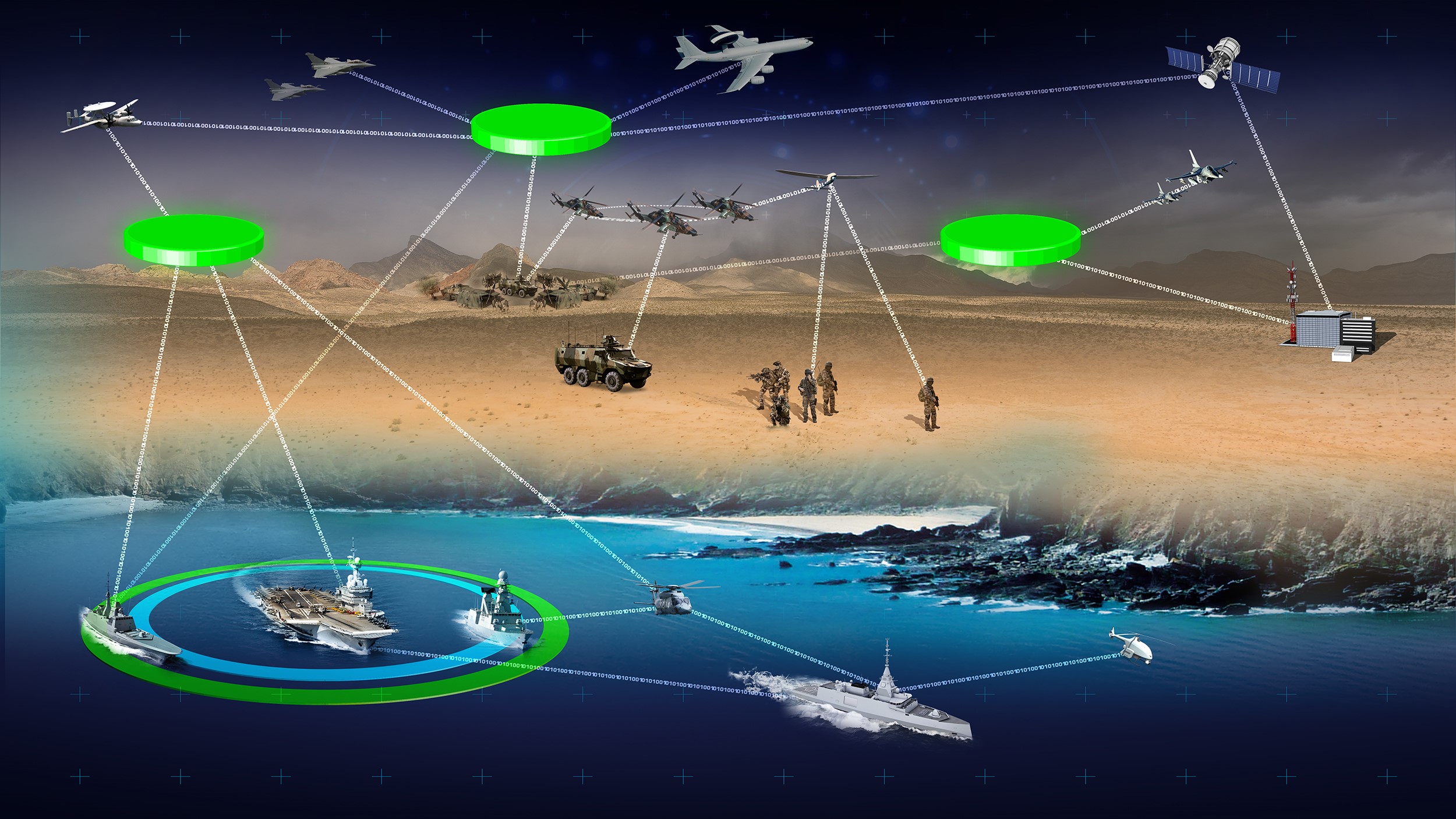
Link 22 Tactical Data Link

Taiwan’s own domestically developed data link system, built by the Chungshan Institute of Science and Technology (CIST), is very broadly based on the American Link 16 and meets many of its military’s needs. 

But Link 22 allows it to tap into US military data links directly, as the latter’s assets will surely see some level of participation in a conflict with China. 

Even if it is assumed the nature of US involvement would only be complementing and secondary – logistics, arms transfers, and providing surveillance and targeting as it does for Ukraine – having access to additional surveillance and battlespace information from superior US technology gives Taiwanese commanders many options. 

Su Tzu-yun, a research fellow at Taiwan’s Institute for National Defense and Security Research, further differentiated between the Link 16 and Link 22 systems, saying the latter uses high-frequency and [the former wide band] ultra-high frequency bands that can operate long distances without a satellite.

Link-22 features an automatic grouping function that can fully map out the positions of enemy and friendly forces via a common operational picture (COP), Su said.

China’s XS-3 and DTS-03 data links are already superior to Link 16. Hence Taiwan receiving the Link-22 gives it a massive edge in tactical situational awareness. 

The Link 22’s website describes it as “beyond the line of sight (BLOS) communications” and “gap less communication across 1000 nautical miles.” [via surface ground wave HF]

Seven specific NATO member nations are a part of the Link 22 project, including the US, UK, France, Canada, Germany, Italy, and Spain.

Developed as an improvement over the older Link 11 and meant to complement Link 16, the program enhanced data exchange and provided a new layered communications architecture. 

China Unhappy

China’s Foreign Ministry and other defense commentators slammed the development, saying such arms sales do not deter China’s position on Taiwan and that the actions are meant to encircle and provoke Beijing strategically. 

Reacting to the transfer of Link 22 and the first shipment of FIM-92 Stinger man-portable air defense (MANPAD) systems that arrived on the island, Foreign Ministry spokesperson Mao Ning called it an “extremely wrong and dangerous move.” 

The report in Global Times also quoted leading military expert Song Zhongping, who pointed out that the transfer of the Link 22 essentially proves the US would be commanding and directing Taiwanese operations. This implied they were less likely to take on the Chinese military frontally. 

“The man-portable air-defense system like the FIM-92 Stinger missile has proved its lethality in urban warfare…and once Taiwan authorities obtain the Link-22 system, it means that the island will be brought under the US combat command structure,” Song said. 

At a political level, the US agreeing to give Taiwan Link 22 means the North Atlantic Treaty Organization (NATO) leadership has fully consented and is on board.

This shouldn’t be a surprise as the bloc has been trying to make inroads into Asia by enhancing cooperation with Japan and adopting a hardline on China over Taiwan, calling it a future Ukraine. 


A Study on the Future Development Trend of Air Data Links​

in 國防大學空軍指揮參謀學院空權與國防學術研討會論文集 (Proceedings of the Air Power and National Defense Academic Seminar at the Air Force Command and Staff College, National Defense University), issue 2021/10, p.-60

​Title: III. Development and Application of CCP Data Link Systems​

Since the first Gulf War in 1991, the Chinese Communist Party (CCP) has been developing high-intensity data link systems using information technology. Drawing inspiration mainly from the U.S. military command system, which shifted from a "vertical" information acquisition and decision command to a "horizontal" level where all military units could obtain the same intelligence, the CCP recognized the importance of data link systems in the joint operations of the U.S. military. (see Note 16)

(I) Overview of Development​

The development of CCP data link systems began in the early 1980s with the HN-900 model as the initial system, initially used for tactical data processing on naval vessels and information exchange with external equipment. Due to the CCP's early push for digital informationization, the lack of integration in the research and development of the foundational design resulted from the varied needs and independent thinking of different military branches.

From the mid-1990s, the CCP established the HN-901, HN-902, and HN-903 data link systems, implementing technological and destructive capabilities in coordinated naval, air-to-air, and naval-to-land operations. Subsequent developments, such as the TJN-905 data link, marked the maturity of data link system development. During this time, the system could execute rapid responses and feedback between command centers, issuing operational commands and receiving battlefield information, establishing a complete data link system (see Figure 5).


1702080789616.png
Figure 5: CCP Operational Concept Diagram Source: Peng Pengfei et al., "Theory and Engineering of Command Information Systems" (Electronic Industry Press, Published in Beijing, Publisher: Peng Pengfei, Published in May 2020), Page 213.

(II) Current Capabilities​

In 2008, the CCP successfully developed the comprehensive data link and the H/TJN-906 broadband high-speed data link, aiming for a large capacity and high transmission rate. The success of this data link system signifies that CCP technology has officially moved towards the goals of large capacity and high transmission, with functionality and benefits comparable to the U.S. military's Link-16 data link. (see Note 17)

1702080823649.png

Figure 6: DTS-03 Data Link Terminal Source: "mobile01," 解放軍新一代三軍通用數據鏈系統 - Mobile01 (Retrieved on March 1, 2021).

After 2020, the CCP widely equipped the DTS-03 data link (see Figure 6), which includes various data link terminals that can be configured on different mobile platforms according to actual needs. In recent years, the CCP has completed the "XS-3" tactical broadband high-speed data link architecture. This system, compared to the DS-03, enhances cooperative engagement capability (CEC), increases the transmission rate to 2M/Sec, and can construct an information distribution system for air and ground combat units. It is suitable for fighter jets, bombers, drones, and simultaneously supports high-capacity information transmission for multiple network units with anti-jamming capabilities (see Note 18).

Chinese Warships Struggle to Meet New Command, Control And Communications Needs

By James C. Bussert
Signal February 2009

Evolutionary introduction of assets leads to different combat capabilities.

China may be building a navy that features some world-class technologies aboard new ships, but its large numbers and variety of naval and air weapons still are operated in isolated methods because of the lack of effective command, control and communications and datalinks. Of 494 Chinese navy ships, the only combatant warships with credible Level III command, control and communications are four imported Russian Sovremennyi guided missile destroyers, 11 new construction guided missile destroyers, four 054A guided missile frigates, two upgraded Luda-class destroyers and 12 submarines, including nuclear strategic ballistic missile submarines.

Even these 33 vessels are handicapped by limited shore or space satellite command, control and communications (C3) support and the lack of integrated structure, organization, training and experience. The absence of technical expertise by sailors results in some computers being used as typewriters, which inhibits command and control (C2) missions. As many as 90 percent of Chinese warships have an obsolete C3 capability—or none at all.

The People’s Liberation Army Navy (PLAN) has put together a core C3 shallow-water capability by datalinking new guided missile destroyers (DDGs) with new construction Houbei catamarans and 054A frigates (SIGNAL Magazine, May 2007). However, severe limitations remain for strategic or distant operations beyond coastal waters far away from nearby C3 shore support.

This is a recent problem. Traditionally, PLAN surface warships largely conducted coastal operations and functioned without coordination and tactical data sharing between ships or shore. Communications aboard old Luda destroyers and legacy frigates were adequate. But new construction missile destroyers and frigates are aimed at newer operation areas and missions that must employ aircraft and subsurface units. PLAN ships will be faced with new blue-water sea lines of communication protection or carrier battle group missions.

Three phases of evolution have taken PLAN warships from basic communications on a single platform to combined platform C3. The first phase involved simple communications. Each weapon was stand-alone, and each ship controlled only its internal sensors and weapons. One sensor to one weapon is a classic stovepipe system. The PLAN includes 62 mine warfare, 109 amphibious, 45 surveillance, 154 support and 32 auxiliary ships. A few large new construction vessels in this group, such as the 25,000-ton LPD 071, 21,000-ton to 37,000-ton oil replenishment ships, 10,000-ton Dajiang submarine tenders or 21,000-ton Yuonwang space event ships have respectable satellite and multiband C3, but they are not battle group warships. The 494 warships include 29 destroyers, 47 frigates, 63 submarines and 355 patrol boats. A baseline is the vintage Luda destroyers and early frigates that were the PLAN mainstay from 1960 to 1980. Luda and the Jianghu frigates both had seven external high frequency (HF) antennas. Jianghu frigate antennas varied from seven-foot to 32-foot whips. Later frigates increased to more modern sensors and weapons, but they still entailed stand-alone systems and ships.

The first Chinese-built ship with no imported equipment at all was the 10,000-ton freighter Fenquing in 1974, but for decades imported equipment or copies were common. Imported Decca surface search radars, Magnavox satellite communications and Redifon marine transmitters were on many PLAN warships from the 1980s on. In 1984, the PLAN paid $15 million for Seafox integrated communications from Marconi. A contract to have the United Kingdom provide a complete upgrade to Luda in 1982 fell through because of the $375 million cost. Instead, the Luda II refit DDG 105 added a helicopter hangar and three-dimensional (3D) radar in 1987. Luda DD 132 later replaced its 3D radar with a satellite navigation antenna, probably the Russian R-793 Pritsep GPS/GLONASS operating at 4-6 gigahertz. Other 1980s Luda refits added radars and weapons but no evident C3 systems.

Some impressive long-range cruises and distant operations occurred with phase one units. Examples include the PLAN seizing the Paracel Islands from Vietnam in the South China Sea in 1974, intercontinental ballistic missile test observation in the South Pacific in 1980, and more than 20 warships conducting large naval exercises in 1988-1989 coinciding with occupation of the Spratly Islands.

Phase two entailed various shipboard sensors, control and weapons being coordinated within a single platform. The Luda III upgrades and newer frigates typify this phase. A metric of increased C3 capability in the Jianghu upgrades is indicated with five antennas on Jianghu I, eight on the Jianghu II helicopter deck upgrade and 11 whip antennas on Jianghu III gun/surface-to-surface missile (SSM) fire control and electronic countermeasures upgrade. The last two Ludas launched in 1990-1992—DDGs 165 and 166—had the Luda III upgrades that included the Tavitac combat direction system (CDS) computer and Vega II weapon control computer from France. The CDS included the French Link W—a copy of Link 11—and imported communications. The new generation Luhu DDG 112 and 113 also had Tavitac CDS installed, although the Chinese designation ZKJ-4 was used.

Though not reported in Western open sources, China’s 716 Institute is believed to have developed a first-generation C2 system of unknown designation. The Chinese claim of “wide fleet distribution” hints that this system could predate the new post-1990 051 and 052 DDGs and was on newer 053H frigates and possibly updated Luda ships. The system had two computers and a display console. It featured a Pentium central processing unit with a Compact PCI bus and an FDDI high-speed local area network with a 100-megabyte Ethernet.

This technology somewhat dates the system. A crude Chinese-developed digital fire control system—designated Type 88—was displayed publicly in 1991, the year the first Type 88 was installed on a 542-ton Houjian fast attack craft. It interfaces with gun, radar, electro-optic sensors, PL-9 surface-to-air missile and electronic warfare systems. The Houjian has no sonar or antisubmarine warfare weapons onboard. The Type 88 consists primarily of buttons and toggle-switch technology with four plug-in cards on the lower chassis.

The first of four new 1,700-ton Jiangwei frigates also was launched in 1991, and they were credited with the first computerized weapon control system, designated CCS-3 in references. It was more complex than the Type 88 because it had a datalink compared to the Type 88 point-to-point architecture. The datalink probably was the Chinese ISBC-900 series bus. Another metric to identify level II vessels is if they have a combat information center (CIC) in the architecture. The first PLAN warship claiming a CIC was the Luhai.

China’s military is backfitting low frequency (LF), very high frequency (VHF) and ultrahigh frequency (UHF) communications and upgrading existing systems to digital technology. This is achieved through the use of Western imports and indigenous radio production plants. Existing South Fleet 053H frigates are adding HN-900 two-way datalinks similar to Link 11. FF 563 and 553 added satellite communications and HN-900 for C3 but retained old HY-2 SSMs and guns. The Eastern Fleet FF 513 received the less-capable one-way HN-900 datalink.

PLAN ships and modern J-10A and J-11 aircraft use the 1553B databus for their datalinks. The PCI bus card is manufactured by Chengdu Enpht Technology Company under the name EP-H6273. Protocol chips run from 512 kilobits up to 64 megabits. The 1553B chassis and slots, named ACE 1553, are manufactured by Beijing Shenzhou Feihang Company. The first Type Houbei catamaran missile boat was launched in 2004, and 20 had appeared by 2008 (SIGNAL Magazine, December 2007). They may be replacements for the aged Hegu (Osa) and Huangfeng (Komar) boats, but that may not be true. They all have Marine Corps paint, which indicates an amphibious support role such as fire support for landings. A high automation level is hinted at by a crew of only 12, compared to a crew of 26 on earlier, similar-size Huangfeng missile boats. With only five- and seven-foot HF whips on the bridge and no satellite communications radomes, it is surprising to see an HN-900 datalink to the DDG between the four SSM cells.

Examples of shore commands controlling tactical units include the 2001 J-8 interception of the U.S. Navy EP-3 off of Hainan and the 1994 Han SSN and 1996 Song diesel boat interception of the Kitty Hawk carrier battle groups in the Sea of Japan. The use of Chinese satellites for reconnaissance, navigation and communications is likely in coastal waters, but GPS and GLONASS would be required for distant operations.

Phase three of the evolution is for major PLAN warships to have C3 with other platforms, including aircraft and other surface ships. The PLAN warships with obvious phase three capabilities are the four modern new construction DDG classes. The Sovremenny 956EM DDGs certainly are the best C3 warships in the PLAN. The next indigenous nominees are the 052C Aegis DDGs 170 and 171, and the newest 051C DDGs 115 and 116 with the S-300 air defense 30N6E1 phased array radar and SA-N-6 vertical launch surface-to-air missiles. All of these types of ships were launched in 2006.

The 956EM warships imported in 1999 had the Russian Sapfir-U combat systems and associated datalinks and communications—Bell Crown datalink and two Light Bulb video datalinks for SSMs. Fore and aft mast yardarms mount four 200-1300-megahertz UHF dipole antennas. Twelve HF whips and a 45-foot-tall MF antenna were on the aft helicopter deck. LF wire bundles extend from the forward to the aft yardarm and then down to the O-2 deck.

In 1998, Neptune exported upgraded Buran-5ke automated communication complexes to Russian customers, and this would have been on the 956EM. In 2001, Russia exported the first four Band Stand radar/datalink systems to Jiangnan Shipyard in Shanghai for the new 052B DDGs. The Mineral-3 datalink and radar operates in the I band with a 30-kilometer range. The Mineral-3 can detect up to 200 contacts and designate nine as targets for SS-N-9 or SS-N-22 SSMs. China developed the HN-900 tactical datalink transmitter that has appeared on all modern 051 and 052 DDGs, 053H guided missile frigates (FFGs) and 022 catamarans, and it has been backfitted to a few Luda DDGs.

The two 052C DDGs reportedly are the initial ships for the second-generation JY10G Chinese multimission information processing system. The JY10G uses land-ship and air radar inputs to integrate with other sensor sources and weapon systems. Reports that this system also is on the Houbei SWATH missile boats probably are not credible because the boats do not even have satellite communication radomes.

China’s Beijing Readsoft Technology Corporation has copied the MIL-STD 1553B databus under the designation GJB289A. It first appeared on People’s Liberation Army Air Force (PLAAF) J-8 and J-11 aircraft and later on the naval J-10A and on the weapon system aboard the 052C. The 051 and 052 DDGs, as well as other warships, probably will follow suit. The most valuable Russian imports—956EM DDGs, Su-30 long-range fighters and Kilo 636 diesel submarines—provide proven interplatform datalinks that China can copy or try to emulate on its own indigenous platforms. Additionally, that will enable joint Russian-China naval operations with common datalinks.

Russian/Chinese cooperation includes military geopositioning satellites. The new generation-2 of the Chinese Beidou satellite navigation system will be compatible with the Russian GLONASS. The modern PLAN shipboard Dong Zhong Dong satellite communication system is designated AKD3000 and operates at 14 gigahertz in the Ku band frequency, and it consists of 0.6-meter, 0.8-meter and 1.2-meter diameter antenna variants. Lack of high-definition digital reconnaissance satellites hampers command, control, communications and intelligence mission accomplishment, and a lack of military navigation satellites inhibits many datalinks for target position information. It is known that PLAAF Su-27s must rely on voice communications, and Su-30 MKKs have the TSK-2 datalink, but it is not on PLAN units. The newest Su-30 MK2 naval fighter aircraft exported to China have a digital TSIMSS-1 communication system. The 052B and 052C destroyers and the J-10A fighters will have datalinks similar to the Russian AT-2M, which itself is a copy of the U.S. Navy Link 16.

Submarines are the most challenging command link platforms. Strategic or tactical communications with submerged submarines primarily come from shore very low frequency (VLF) stations. Russia built LF stations at three fleet headquarters by 1976. China’s first VLF site was Lushun in 1965, and its most recent was an extremely high power site at Yulin submarine base on Hainan in 1982. The twelve Kilo diesel submarines’ digital CDS MVU-110EM and communications suite of R-625 UHF, R-680 VHF/HF to R-683 LF receiver covered all bands. Target designation for submarine-launched 3M-54E anti-surface-ship missiles can be possible by datalinks on 956EM, Su-30 fighters, helicopters and naval command aircraft. Russian Mi-24 helicopters, which are PLAN assets on warships, have Landaish analog mission computers to provide targeting data via a PK-025 datalink. Russian-provided naval air units had RSIU-5 VHF radios, which are on PLAN surface warships.

Some auxiliaries (AGI) and non-SSM ships now carry a Light Bulb antenna, indicating a functional change from a missile datalink to a high-capacity communication link similar to a Link 16. The main PLAN shore C3 commands are located at the North Fleet (Qingdao), East Fleet (Ningbo) and South Fleet (Guangzhou) headquarters with main control from the PLA Central Command in Beijing. Information integration for large DDG and naval shore commands use PIII ruggedized computers with VxWorks or Windows NT operating systems, 100-megabyte Ethernet and large, multipurpose video monitors.

James C. Bussert is employed at the Naval Surface Warfare Center, Dahlgren, Virginia, where he works on surface-ship antisubmarine fire control systems.


U.S. Releases Advanced Tactical Data Link System Upgrade

Wendell Minnick

Share

23 February 2024 (Friday)

By Wendell Minnick (Whiskey Mike) 顏文德

TAIPEI - The below is a press release with edification in brackets:

(Arlington, Virginia, February 22, 2024)

The US-Taiwan Business Council today welcomed the announcement of a possible Foreign Military Sale to Taiwan of Advanced Tactical Data Link System Upgrade Planning and related equipment at an estimated total cost of US$75 million.  The Defense Security Cooperation Agency (DSCA) delivered the required certification notifying Congress of the proposed Taiwan arms sale on February 21, 2024.

The published Congressional Notification (transmittal number 24-09) is for FMS Cross Domain Solutions (CDS) [The FMS CDS is a means of information assurance that provide the ability to manually or automatically access or transfer information between two or more differing security domains.  FMS CDS devices are integrated systems of hardware and software that enable the transfer of information among otherwise incompatible security domains or levels of classification.  They also enable filtering of unauthorized messages and malicious files and, in order to protect both U.S Classified Military Intelligence (CMI) and FMS customer systems, networks and data], High Assurance devices; Global Positioning System (GPS) receivers, communications equipment, requirements analysis, engineering, technical services, and other related elements of logistics and program support.

Council President Rupert Hammond-Chambers commented, “We welcome this ongoing normalized and regularized arms sales process. But we again see a focus on sustainment, with little or no consideration of the broader challenges that Taiwan is facing - including blockade and interdiction scenarios, along with grey zone activities.  We echo incoming Indo-Pacific Commander Samuel J. Paparo’s recent U.S. Senate testimony, where he said that ‘If we’re just planning for an invasion, we’re leaving a wide range of military options unplanned for.’ ”

“The asymmetric approach is one piece of the puzzle, not the whole puzzle, and the Administration needs to broaden its approach. Our security assistance should include capabilities allowing Taiwan to respond to all its challenges, not just the threat of an invasion.  In May 2022, we commented on security assistance focused solely on a D-Day-style attack by PLA forces, citing its shortcomings.  We have consistently noted this point in previous comments on recent arms sales, which have focused almost exclusively on munitions and sustainment.”

Hammond-Chambers added, “The ongoing issues surrounding Kinmen call for a robust Taiwan coast guard that can patrol its territorial waters.  Training and interoperability should be the primary goals, along with accelerating the expansion and modernization of the Taiwan Coast Guard fleet.  Transferring existing Sentinel Class U.S. Coast Guard boats to Taiwan - while replacing the U.S. inventory with newer boats - could be one way to accomplish that.  There is precedent for this sort of ship transfer, and ongoing allocation of U.S. financial resources could absorb costs.

Blockade scenarios require anti-submarine vessels and helicopters, with larger ships required to patrol Taiwan's territorial waters.  Taiwan could build such ships in domestic yards, while sourcing subsystems internationally.  In the face of China's relentless grey zone pressure, Taiwan's burgeoning fighter fleet - which will top 200 advanced F-16s by the end of 2026 – also requires support aircraft.”

Hammond-Chamber concluded by saying “The U.S. appears to be dismissing these other challenges for now, potentially creating current and future vulnerabilities for Taiwan.”

Subscribe to China In Arms - Podcast and Newsletter

China and Taiwan military and intelligence issues. 

China opens fire on Lockheed for arming up Taiwan

Jeff Pao

China has vowed to sanction Lockheed Martin, the world’s and America’s largest defense contractor, for a fifth time after Washington approved on December 16 a US$300 million arms deal that will link Taiwan’s tactical information system with that of NATO allies.

The new system will help improve Taiwan’s command, control, communications and computer (C4) capabilities and enhance operational readiness to meet current and future threats, according to the Pentagon’s Defense Security Cooperation Agency.

The arms sale was the 12th to Taiwan since US President Joe Biden took office in January 2021. 

Beijing has fired four rounds of countermeasures against Lockheed since July 2020, including placing it on an “unreliable entities list,” ordering the defense firm to pay fines equivalent to twice the amount of its arms sales to Taiwan in recent years, and banning the company’s executives and staff from entering China. 

After the US government approved Lockheed and Northrop Grumman’s arms sale to Taiwan on August 24 this year, both companies were sanctioned by Beijing on September 15, though the Chinese government did not specify the terms of the curbs at the time.

“It is true that both Lockheed and Northrop Grumman do not have a lot of direct businesses in China. But it does not mean that our sanctions against them are meaningless,” a Shaanxi-based writer using the pen name “Qiaofeng” says in an article. “Their affiliated companies are involved in many fields such as aircraft, energy and electronics in China.”

The writer says the curbs send a message to the international community that China opposes all forms of foreign interference and has the determination to safeguard its sovereignty and territorial integrity.

He says that by sanctioning the US defense contractors, China can set an example for upholding international fairness and justice amid the United States’ blatant violation of international rules.

Lockheed Martin is in China’s crosshairs over arms sales to Taiwan. Photo: Asia Times Files / AFP / Mandel Ngan

Military operations

Two Chinese weather balloons were seen crossing the sensitive median line of the Taiwan Strait on December 17, the days after the arms sale announcement, according to the Defense Ministry in Taipei.

“The Chinese communists’ frequent military operations around Taiwan present a serious threat to us,” said the island’s Ministry of National Defense. 

The ministry said the new tactical information system will help Taiwan improve its battlefield awareness. It said it expects the sale to “take effect” in one month. 

A source told Reuters that Taiwan’s existing Syun A system, which has been in service for more than a decade, cannot easily interface with non-US equipment such as locally made fighter jets. The source said the joint warfare capabilities of Taiwan’s C4 system are inadequate.

The Syun An system is reportedly unable to integrate data from the long-range early-warning radar system situated in the island’s northern mountains.

The system’s downgraded Link 16 tactical data network is also incompatible with non-US equipment, including Taiwan’s Indigenous Defense Fighters, French-made La Fayette-class frigates and Mirage 2000 fighters. Link 16 is a standardized military tactical data link network used by the US and NATO allies.

“China will take resolute and strong measures to safeguard its sovereignty and territorial integrity and take countermeasures against relevant companies involved in arms sales to Taiwan,” said Wang Wenbin, a Chinese Foreign Ministry spokesperson. 

“The Taiwan question is entirely China’s internal affair that should not be affected by any foreign interference,” he said. “No matter how many weapons the US provides to the Taiwan region, it will neither change the historic course of China’s reunification, nor weaken the Chinese people’s firm will in safeguarding our national sovereignty and territorial integrity.”

He said the recent US arms sale to Taiwan seriously undermines China’s sovereignty and security interests, harms peace and stability across the Taiwan Strait and sends a wrong message to separatist forces seeking “Taiwan independence.” 

“China deplores and strongly opposes this and has made solemn démarches to the US side,” Wang said. 

‘Dangerous’ fighter jet intercepts

The Taiwan Strait balloon incidents come about a month after Chinese President Xi Jinping and US President Joe Biden met in San Francisco on November 15 and agreed to increase communications. 

The two leaders had an in-depth exchange of views on strategic and overarching issues critical to the direction of China-US relations and on major issues affecting world peace and development. But the leaders reached no new agreements on Taiwan-related issues, according to reports. 

US President Joe Biden and Chinese President Xi Jinping greet each other as they hold their first direct meeting in a year in November in San Francisco. Picture: YouTube Screengrab

Biden reiterated that Washington’s “one-China” policy has not changed and that the US opposes any unilateral changes to the status quo from either side of the Taiwan Strait.

Xi reportedly told the US to stop supporting Taiwanese independence and halt arms sales to the self-governing island, which Beijing considers a renegade province that must be “reunified” with the mainland. The US side said it will continue to support Taiwan’s defense.

Admiral John Aquilino, head of US Indo-Pacific Command, told the media on December 18 that China’s “dangerous” fighter jet intercepts against US aircraft seem to have stopped since the Xi-Biden summit, which he characterized as an “incredibly positive outcome” if sustained. 

However, China’s People’s Liberation Army (PLA) continues to launch warplanes across the median line of the Taiwan Strait on a daily basis.

 Follow Jeff Pao on Twitter at @jeffpao3


Lockheed Martin Announces Taiwan PoSheng Program Team


Lockheed Martin has submitted a proposal for the Taiwan Po Sheng program, which provides for the integration of Taiwanese air, ship, ground, and command and control assets using a joint command, control, communication, computer, intelligence, surveillance and reconnaissance (C4ISR) system enabled by tactical data links. Translated "broad victory," the program has a potential value of $3.9 billion and is managed under a foreign military sales case by the U.S. Navy C4I and Space Program Executive Office based in San Diego, California. An award is expected this summer.

Lockheed Martin Naval Electronics & Surveillance Systems (NE&SS) is the Po Sheng team prime integrator and will bring together the vast capabilities of the Lockheed Martin Corporation, including a business unit in Taiwan. Also on the team is MiTAC, a prominent IT and communication system integration company in Taiwan that will provide in-country efforts including integrated logistics support.

The Lockheed Martin Po Sheng team also includes key companies throughout the United States. California-based companies include ViaSat located in Carlsbad and CACI International, Inc., Titan, Information Networking Systems, Inc., and Digital Wizards in the San Diego area. Other team members include Alion Science and Technology, Annapolis, Maryland; Veridian Engineering Group, Arlington, Virginia; and Austin, Texas-based Advance Programming Concepts, Inc., all of whom will support data link processing, developmental test, evaluation and network design.

"This comprehensive team will participate on strategic sea, land, and air integrated product teams working cohesively to deliver to our customer a best- value Po Sheng solution," commented John McNellis, president of Lockheed Martin NE&SS Tactical Systems. "The Lockheed Martin Po Sheng team would perform much of its work in the San Diego area causing a positive impact on the business community," added McNellis.

Headquartered in Bethesda, Maryland, Lockheed Martin is a global enterprise principally engaged in the research, design, development, manufacture, and integration of advanced technology systems products and services. A leader in C4I, airborne surveillance systems integration, and the design, development, packaging, and production of ruggedized Commercial Off- The-Shelf (COTS)-based computer systems, Tactical Systems is one of five major lines of business within the Lockheed Martin NE&SS business segment.

For additional information, visit our Web site: http://www.lockheedmartin.com/minn

SOURCE: Lockheed Martin

China spies on Taiwan's US-Made Defenses

Eloise Lee - Mar 22, 2012, 10:57 AM PDT

Patriot

The Patriot missile defense system tracks and destroys aerial threats.
flikr/Morning Calm News

A Taiwan Air Force Captain is the fourth confirmed person to be caught spying for China within the last two years, reported the Associated Press.

The espionage from within Taiwanese ranks focused on the nation's missile defense and communications systems built with sensitive U.S. technology.

Capt. Chiang was based in the north of Taiwan where the military houses their Lockheed Martin and Raytheon-supplied Patriot missiles along with the island's early warning radar system.

In addition, local media reports translated by the AFP in Taipei said that a retired Taiwanese agent from the Ministry of Justice Investigation Bureau is in police custody for allegedly luring his colleagues to China under the pretext of traveling or doing business. They were then forcibly detained and interrogated on sensitive information, said the Chinese-language United Daily News.

Inside information on Taiwan serves China's long-standing resolve to take back the nation by military force if necessary. The successfully modern island off the southeast coast of China remains independent and resistant to reunification with the mainland since a civil war 63 years ago.

Last year, the Taiwanese army's head of communications and information was also arrested on the charge of spying for China. Taiwanese news reported that Maj. Gen. Lo Hsieh-che was recruited by a Chinese female spy in Bangkok while he was stationed in Thailand. He gave strategic secrets to Beijing and has now been sentenced to life in prison. 

The Taiwan defense ministry said at the time that the Maj. Gen. was unlikely to have had access to U.S.-related intelligence. However, as a high-ranking officer he had documents regarding the purchase of the Po Sheng command and control system from American defense contractor Lockheed Martin.

The Po Sheng provides branches of the Taiwanese forces with a shared communication network that is crucial for coordinating military action.

In the event that China launches an attack on Taiwan for not ceding its independence, which China views as rebellious, the Chinese would want to know how to make their target as vulnerable as possible.

Having access to data on Taiwan's radar-enabled missile defenses and communications system would give China a crippling upper hand, as gaining control of the electromagnetic spectrum is a major asset in modern warfare.


Wednesday, February 21, 2024

New VLEO Satellite Can See You with 10 cm Resolution


Albedo raises $35 million for commercial very low Earth orbit constellation

Debra Werner

 
Albedo plans to obtain 10-centimeter-resolution visual imagery and two-meter thermal imagery from satellites operating in very low Earth orbit. Credit: Albedo

SAN FRANCISCO – Albedo raised $35 million to build and launch its first high-resolution Earth-imagery satellite.

The Series A-1 investment round, led by Standard Investments, brings the Earth-observation startup’s total funding to $97 million.

The investments announced Jan. 23 will accelerate deployment of Albedo’s very low Earth orbit (VLEO) constellation. Albedo aims to “ultimately prove out and proliferate the world’s first high-resolution VLEO platform,” Albedo CEO Topher Haddad told SpaceNews by email.

10 centimeter resolution

Since Albedo was founded in 2020, the company has developed a platform to collect optical imagery with a native resolution of 10 centimeters per pixel and two-meter thermal imagery. Similar resolution is obtained by aircraft and classified reconnaissance satellites.

Albedo aims to provide commercial and defense customers with on-demand, high frequency coverage. 

“As geopolitical tensions rise and we approach an irreversible climate change tipping point, the need for innovative dual-use technologies is crucial in sustaining a safe global environment,” Haddad said in a statement.

VLEO “will open up a wide variety of exciting opportunities around enhanced imagery and data collection, which is a key unmet challenge in modernizing industry and infrastructure,” Ben Sampson, Standard Investments managing director, said in a statement. In connection with the investment, Sampson is joining Albedo’s board of directors.

New and existing investors

New Albedo investors include Booz Allen Ventures, Cubit Capital and Bill Perkins. Existing investors contributing to the round include Breakthrough Energy Ventures, Shield Capital, Initialized Capital, Y Combinator, Giant Step Capital and Republic Capital.

Albedo is one of five commercial startups working with the National Reconnaissance Office. Under an agreement announced in December, the NRO will examine Albedo’s technical, business and cybersecurity plans. Once Albedo begins collecting space data, the NRO will evaluate its data products.

In preparation for launching its first satellite in 2025, Albedo expanded its staff. The company also established a facility in Broomfield, Colorado, large enough to build three or four satellites simultaneously.

Albedo has won two Small Business Innovation Research contracts valued at a $1.25 million apiece.

Debra Werner is a correspondent for SpaceNews based in San Francisco. Debra earned a bachelor’s degree in communications from the University of California, Berkeley, and a master’s degree in Journalism from Northwestern University. She...

Alarming New Satellite Can Spy on Individual People: 

futurism.com

Maggie Harrison Dupré

"We should definitely be worried."

As surveillance tools advance in both function and ubiquity, an up-and-coming satellite venture company raises an important question: how much of our privacy are we willing to trade for the promise of safety?

A startup called Albedo Space https://albedo.com/ is building low-orbit satellites that are able to zoom in on individual humans down on Earth, The New York Times reports. The venture's cofounders say the satellites won't be equipped with identification-ready facial recognition technology, but they will be able to image people — a massive step forward in satellite-abetted surveillance that could seemingly realize some long-held privacy fears. After all, as far as technological Eyes of Saurons could go, a fleet of all-seeing orbital cameras — which according to the NYT have already inked multiple US defense contracts and garnered over $100 million in funding — feels pretty on the nose.

"This is a giant camera in the sky for any government to use at any time without our knowledge," Jennifer Lynch, general counsel of the Electronic Frontier Foundation, told the NYT. "We should definitely be worried."

Weighing Costs

As the NYT notes, Albedo's founders have paid lip service to the privacy concerns for some time now. In a February 2021 post to the forum Hacker News, for instance, Albedo co-founder and CEO Topher Haddad told a concerned netizen that "we are acutely aware of the privacy implications and potential for abuse/misuse."

This seems to be the company line, given that Haddad told the NYT for its 2024 report that "we're acutely aware of the privacy implications." So, acute awareness: check!

Speaking to the NYT, Albedo seemingly took the "but we're saving lives!" line of reasoning, emphasizing that its satellites — which are due to orbit as low as 100 miles off Earth's surface — could be used for purposes like helping authorities map disaster zones. Albedo's website also lists infrastructure monitoring and urban planning as possible applications for the tech, in addition — of course — to a few "defense [and] intelligence" use cases.

While some experts, according to the NYT, agree that the satellites could feasibly be helpful in some scenarios, the privacy concerns are palpable nonetheless. The thought of a tool like this in the hands of a government keen on moral policing, for example, or authorities seeking to crack down on protests, is frightening.

In spite of any benefits, surveillance technology almost always comes at a cost. Per the NYT, Albedo plans to launch its first satellite in 2025, and ultimately hopes to host a fleet of over 20 individual crafts. If and when Albedo's vision comes to pass, the public may well find out just how high its price is.

"It's taking us one step closer," Harvard astrophysicist Jonathan McDowell told the NYT, "to a Big-Brother-is-watching kind of world."

More on surveillance: The NYPD Says It's Going to Spy on Labor Day Parties Using Drones


Meet Evologics, the German company developing submarine drones that network using sound


Meet EvoLogics, developing sub drones that pass data with sound - Defense One

EvoLogics GmbH is a private high-tech enterprise with headquarters in Berlin, Germany. The company designs and manufactures underwater information and communication systems, as well as hydroacoustic sensors. Its core values are rooted in bionic concepts that combine state of the art engineering with the best ideas found in nature.

EvoLogics was launched in 2000 with a small group of scientists and R&D experts, aiming to develop innovative technologies for maritime and offshore industries. To solve the common problems of transmitting data underwater, the team turned to dolphins - the ocean’s ’talking nation’ - known to use a wide variety of acoustic signals to efficiently communicate in the most challenging underwater conditions. The resulting EvoLogics S2C spread-spectrum communication technology grew into a whole ‘ecosystem’ of products that now includes several series of underwater acoustic modems, underwater positioning systems (USBL, LBL, SBL), networking protocols and developer frameworks, as well as novel robotic solutions.

 
Lauren C. Williams

SAN DIEGO—A flash of fiery reddish orange caught my eye as I was speed-walking through WEST 2024, the Navy’s annual IT conference: what looked like a cute little drone boat a tad bigger than a toddler’s walker, and some matching red-orange baubles.

Francisco Bustamante, EvoLogics’ director of operations and sales, explained that it was a suite of tech, including a surface drone and nodes to build a WiFi network underwater. 

D1: This is a data network that uses audio?

BUSTAMANTE: We started working with different products for underwater data transmission. That was one of the key technologies that we developed because there was basically no solution. Wi-Fi doesn't work. You can use optical systems, but they are also limited to the turbidity. So for any long-range communication, you need acoustic systems. 

You can use this as a technology to enable the operation of unmanned underwater vehicles, or even for manned vehicles...to position them underwater, and to transmit data to the surface.

Now that we have these enabling technologies, we have moved to other concepts. We are developing autonomous vehicles for different survey applications. We started with a survey vehicle for the surface, which is a sonar boat. It can perform different missions depending on what payload sensors that it has. We have single-beam and multi-beam echo sounders for water depth. And we have front-looking sonar and sidescan sonar to do, basically, object detection. 

The object detection we have included technologies with AI. In order to automate, we work with pre-trained datasets. And then the vehicle can look specifically for certain types of objects, for example, in assisting a police force looking for missing persons in water bodies or for finding mines in shallow waters, coastal areas, and so on.

So you’ve developed a surface vehicle and underwater connectivity. Next, is an unmanned underwater vehicle this year?

Yes, this vehicle can also carry different payloads and support survey missions. But the advantage being that it can also navigate closer to the floor, seafloor. And also it can obtain better resolution of the images or even, with support of the cameras, can go and look at some specific items that have been found. The important thing is that you always have a limitation in terms of communication underwater, even with our technology—and any technology basically—you have limited bandwidth. So you cannot be sending video and streaming on YouTube.

What kind of data can you send?

Text messages or text files. We can even send images like pictures, but single frames. So in that case, it's important that the systems—and this is something we have focused a lot on—that the systems can work autonomously and have enough intelligence [so] if the vehicle detects obstacles, that it's capable of avoiding them, if the vehicle detects objects of interest that it will communicate that information in a reduced way in terms of data size, but still giving the operator the opportunity to maybe change the mission and return to that point to have a closer look. 

Any detection that is made by the vehicle is already geotagged. So any further inspection—for example, sending a diver—can be much more easy, easily done, than if there was only a detection without knowing where it was.

What is the range of the surface vehicle, the underwater vehicle, and the underwater communication network?

The surface vehicle can travel up to 40 kilometers (about 25 miles) on one battery load. Normally, it's not going to travel that distance linearly. It searches [in] a grid pattern, so it covers a certain area. But that's basically the linear distance it can travel. 

This vehicle can also do about the same distance: about 40 kilometers underwater. This vehicle is relatively small, so it's about one-meter-10 [centimeters] or so, so it's very, very compact. And the idea is that you can easily deploy it. But on the other hand, we have the capability, thanks to the communication and the positioning, to operate multiple vehicles at the same time in coordination, so that you can act as swarms and cover a larger area in less time.

We have prepared a toolset that allows us to configure different solutions depending on the customer needs. For example, for port security, we can have different surface vehicles, underwater vehicles, sensor stations, that can then as a whole, create a detection network that can be used to prevent, for example, any kind of foreign vehicle that is in the area, or divers and so on, this can be configured in flexible ways depending on the requirements.

So the network that goes along with it covers that whole 25 miles?

The acoustic devices will have different ranges, depending on the frequencies that we're using. The longest range is up to seven miles, so 10 kilometers, with the lowest-frequency devices.  Medium range is 3.5 kilometers. And then we have high-frequency devices that can do up to one kilometer. But they can work, also, in network configuration. You can place multiple nodes in a larger area and they can communicate among themselves, transmit the data doing relay chains, or mesh networks in order to get the relevant information to the surface.

Is there open architecture so a customer like the U.S. Coast Guard could use systems they already have?

We have implemented the JANUS acoustic standards, which was developed by NATO, the CMRE Center for Maritime Research and Experimentation. And this has already been implemented in our modems. So it's a feature that we can deliver out commercially. We also are participants in the SWiG—Subsea Wireless Group—acoustic standard. They are part of the oil and gas industry...they have already developed a standard based on JANUS, but they are working on the next-generation standards to increase the bandwidth available and so on. So these standards will also be supported by our modem so that we can interact with any other modems that support basically the two available standards at the moment. Moving forward we will always be supporting the standards. 

In terms of open architecture, we have some interesting developer options built into our devices. We have a sandbox, this provides a virtual environment to the user, which allows them to run their own applications in our system. With this, they also get lower-level access to some of the modem features including the medium access control and can be used for testing networking features, and networking protocols. 

We also have a SDM—software-defined modem—which allows the users to basically play with any arbitrary waveform. If another company has some waveforms that they use for their own communication purposes, and they prefer to use that, they can use our modem as hardware.

Are you working with the U.S. military yet?

We have sold some products—in particular the modems so far; they are developing some projects. So hopefully we'll hear from them soon if their experimentation is successful.

What are your plans for the rest of this year?

Very important is the launch of the quatrain autonomous vehicle with the first project pilot customers, where we will be testing the capabilities basically to the limit. 

We are participating in the REPMUS exercise in Portugal in September with NATO to test different scenarios with them, in which we will also be testing and presenting the interoperability of all the components into one combined and comprehensive system that is also able to provide the data in the formats that is needed for the mission control by NATO. So this will be happening in September, and we hope that it will be very successful and will lead to new ideas and further development projects for us.


Bionic Solutions for Underwater Communication

By Maria Pleskach

Bionic Solutions for Underwater Communication

EvoLogics GmbH, Germany

EvoLogics GmbH is a private high-tech enterprise with headquarters in Berlin, Germany. The company designs and manufactures underwater information and communication systems, as well as hydroacoustic sensors. Its core values are rooted in bionic concepts that combine state of the art engineering with the best ideas found in nature.

EvoLogics was launched in 2000 with a small group of scientists and R&D experts, aiming to develop innovative technologies for maritime and offshore industries. To solve the common problems of transmitting data underwater, the team turned to dolphins - the ocean’s ’talking nation’ - known to use a wide variety of acoustic signals to efficiently communicate in the most challenging underwater conditions. The resulting EvoLogics S2C spread-spectrum communication technology grew into a whole ‘ecosystem’ of products that now includes several series of underwater acoustic modems, underwater positioning systems (USBL, LBL, SBL), networking protocols and developer frameworks, as well as novel robotic solutions.

EvoLogics Today

In 2016, EvoLogics remains a close-knit team of 32 employees. The company’s main business is solutions for underwater communication, positioning, navigation and monitoring applications. EvoLogics S2C R and S2C M lines of underwater acoustic modems and positioning systems cater to various scenarios and provide a high degree of customisation as is shown in Figure 1.

To offer cutting-edge technology, research and innovation have been an essential part of the EvoLogics DNA since the company’s inception - the company is an active collaborator of several EU-funded R&D projects and encourages academic efforts of the employees. EvoLogics’ range of hardware and software developer solutions includes an open-source framework for underwater networking and targets scientists and researchers worldwide.

Current development is focused on intelligent integrated solutions extending the capabilities beyond communication and positioning into telecommunication centres and robotics.

Commercial Products

EvoLogics exports to international markets both directly and through its established distribution network. The company’s key clients are offshore companies, fisheries, commercial service providers, state- and privately-funded research facilities and universities.

EvoLogics bestsellers are underwater acoustic modems that provide a highly reliable bidirectional data link along with acoustic positioning, broadcasting and networking. Applications range from retrieving data from subsea sensors and navigating unmanned underwater vehicles to deploying complex underwater sensor networks for monitoring and exploration. USBL and LBL positioning systems, coupled with EvoLogics positioning software (SiNAPS), are gaining popularity among the clients, see Figure 2.

EviNS (the EvoLogics intelligent Networking Software) is the company’s framework for developing, testing, debugging and implementing underwater acoustic network protocols and customer-specific applications. Besides seamless integration with EvoLogics underwater modem hardware, EviNS is fully compatible with EvoLogics modem emulator (available as an online service and as a hardware box) that makes it possible to work with a virtual network of underwater acoustic modems, significantly reducing time and cost for network protocol development.

EvoLogics is active in marine robotics - its communication technology is implemented in the company’s unmanned surface vehicle, the Sonobot. Available as a commercial product since 2011, the Sonobot was initially developed as an easy-to-deploy bathymetric survey vehicle for inland and harbour waters. Equipped with EvoLogics S2C-technology echo sounder, the vehicle has since been tested for LBL baseline calibration and mini-ROV deployment (Figure 3).

Research and Development

EvoLogics’ ongoing R&D efforts focus on underwater acoustic communication and positioning for distributed underwater networks.

EvoLogics is part of the SWARMs (Smart and Networking Underwater Robots in Cooperation Meshes), an EU project focused on cooperative operation of unmanned underwater vehicles. Project collaborators aim to design a set of unified software and hardware components that will allow integrated operation of different UUVs, linked into a multimedia sensor network for various automated missions.

Another important project is WiMUST (Widely scalable Mobile Underwater Sonar Technology), where collaborators focus on engineering an intelligent distributed underwater array of marine robots for seismic acoustic surveys.

One of EvoLogics’ recent R&D efforts in robotics is the BOSS (Bionic Observation and Survey System) project, a joint research effort, supported by the German Federal Ministry for Economic Affairs and Energy (BMWi). BOSS’s goal is to create a powerful and flexible underwater exploration and monitoring system, particularly suitable to access hard-to-reach or yet unexplored areas with its unique functional properties.

Deployed in the target area for observation and survey, the BOSS system is a self-coordinating swarm of autonomous underwater vehicles (AUVs), all linked into a multimedia sensor network with the latest communication and navigation technologies. The AUV is the project’s core innovation - engineered and built at EvoLogics, the experimental bionic vehicle is modelled after a Manta ray and can move through the water by wing-like movements of its “pectoral fins”.

View on the Future

The EvoLogics philosophy of constant innovation defines the company’s key directions for future development.

The team is working on expanding the functionality of EvoLogics underwater acoustic modems and positioning systems, and is soon to introduce atomic clock integration that will allow synchronisation with unprecedented accuracy. Constantly improving cost and time efficiency is the goal set for future hardware and software upgrades of the main product lines.

Underwater ’internet of things’, allowing for intelligent cooperation between various vehicles and sensors, is the concept that guides EvoLogics’ research and development team working on underwater networking protocols, a rapidly evolving field gaining momentum worldwide (Figure 4).

More Information

www.evologics.de


Tuesday, February 20, 2024

CNO Franchetti: Navy Exploring Robotics Rating as Unmanned Systems Expand

Chief of Naval Operations Adm. Lisa Franchetti speaks at the AFCEA International and U.S. Naval Institute West 2024 conference in San Diego, Calif., Feb. 13, 2024.

Summary of Keynote Address

Addressing Global Security Demands through Advanced Capabilities and Partnerships

The 34th annual collaboration between the U.S. Naval Institute and AFCEA International focuses on acquisition and readiness to meet global security demands. Notable challenges include conflicts in Russia, Ukraine, the Gaza Strip, Iran's activity in the Middle East, and tensions between China and Taiwan. Admiral Lisa Franchetti, the 33rd Chief of Naval Operations, emphasizes the importance of harnessing technology, adapting to new challenges, and working together to maintain the Navy's position as the world's most powerful navy.

Redefining conflict through technological breakthroughs:

The Navy recognizes the urgency to integrate and adopt new technologies, such as artificial intelligence, unmanned platforms, directed energy, and hypersonic missiles, that are redefining conflict and reshaping warfare. To draw parallels from history, the Navy reflects on the 1930s and 1970s – decades of challenging security environments and a changing character of war – to strategize and navigate the current dynamic landscape. In the 1930s, leaders shifted from a platform-centric strategy to an integrated naval force, while in the 1970s, they recognized the need for new capabilities to contest sea control globally. 

In response, the Navy is taking a similar approach today by viewing everything through a warfighting lens, investing in disruptive systems, exploring manned-unmanned teaming, bolstering fleetwide connectivity, and emphasizing the importance of people as the true strategic advantage. This urgent call to action requires unity of effort, a strong sense of resolve, and the integration of disruptive and emerging technologies to ensure the Navy remains the world's preeminent naval force.

Improving Sailors' Living and Working Conditions:

Admiral Franchetti highlights a priority for the navy the importance of addressing sailors' living and working conditions as a key initiative. This includes improving barracks with new furnishings, free Wi-Fi, and better cooking facilities, as well as addressing issues with parking and access to medical and mental health care. The overall goal is to provide a better quality of life for sailors, enabling them to recharge and focus on their work. 

Additionally, the Navy is working on hiring more mental health providers, setting up wellness centers, and encouraging leaders to connect with their teams to understand and address their needs. In the context of the Navy's broader goals, Admiral Franchetti emphasizes the importance of a hybrid manned-unmanned Fleet and sets a realistic timeline for its implementation. This includes prototyping, experimentation, procurement, and operation of unmanned platforms, as well as the development of necessary infrastructure and networks. 

The Navy is also focusing on partnering with allies and partners to advance unmanned technology. Admiral Franchetti acknowledges the challenges in recruiting and retention, emphasizing the need to retain high-quality sailors and address "sea blindness" by communicating the Navy's mission and value effectively. Lastly, Admiral Franchetti explains how NAV's mission and ship maintenance support the foundation pillar in the America's War Fighting Navy priorities, specifically by establishing guidelines for shipyard maintenance that will help ensure platforms are serviced efficiently and effectively.

CNO Franchetti: Navy Exploring Robotics Rating as Unmanned Systems Expand - USNI News

news.usni.org

Heather Mongilio

SAN DIEGO – A new robotics rating is likely coming to the Navy, the sea service’s top leader said on Tuesday.

The Navy is exploring the option of a robotics rating in order to build a team that would be responsible for the Navy’s unmanned platforms, Adm. Lisa Franchetti said during her keynote speech at the West 2024 conference, cohosted by AFCEA and the U.S. Naval Institute.

The sea service wants “a team who has the reps and sets in sensors, platform autonomy, and mission autonomy programs … and can provide input in machine learning feedback processes,” Franchetti said in her speech.

Although Franchetti previewed the forthcoming rating, little information is available about what the rating will look like.

A spokesperson with the Office of the Chief of Naval Personnel said that the Navy is still exploring the rating and nothing is yet official.

It is unclear where the robotics rating will fall. The Navy’s unmanned program is under Naval Air Systems Command.

The possibility of a robotics rating comes as the Pentagon writ-large is planning to expand its stable of unmanned systems in the near term.

A prime focus of the Defense Department in the near term is the Replicator initiative, the creation of a swarm of unmanned vehicles to solve specific battle problems the U.S. faces over the next few years. The first major challenge will be to disrupt the amphibious invasion of Taiwan by China using a combination of lethal unmanned surface and aerial vehicles.

In the longer term, the Navy is set to field a fleet of medium and large unmanned surface vehicles that will add sensors and magazine capacity of the fleet. The service is also expanding its unmanned aerial portfolio to include the MQ-25A Stingray refueling tanker, which will be the first unmanned aircraft to operate from a U.S. aircraft carrier.

The Navy is also working with robotic systems as part of its emerging mine countermeasures systems both expeditonary and part of its Littoral Combat Ship.

Franchetti said the new rating could be part of the future manned and unmanned teaming for the future fleet using examples of the unmanned systems tests with systems in U.S. 5th Fleet in the Middle East and U.S. 4th Fleet in the Caribbean.

“Unmanned systems have enormous potential to multiply our combat power by complementing our existing fleet of ships, submarines, and aircraft through manned-unmanned teaming,” she said.
“Especially in areas like maritime surveillance and reconnaissance, mine countermeasure operations, seabed exploration and carrier air wing support.”


Illuminating the Future: The Rising Role of Laser Free Space Optical Communication (FSO) – International Defense Security & Technology

NASA's Optical Communications Program: A Breakthrough in High Broadband Technology

NASA's optical communications program, led by Don Cornwall, has experienced significant advancements in the last few years. After decades of attempts and cancellations in free-space optical communications programs, NASA has finally surpassed the threshold, enabling the development of viable laser systems for operations. The primary driver for this shift is the need for higher bandwidth to accommodate the increasing data from space instruments. For instance, transmitting a 30-centimeter resolution Google map of the Martian surface at one bit per pixel using the best RF system would take nine years. However, with optical communications, the same task could be accomplished in just nine weeks. 


The Lunar Laser Communications Demonstration (LLCD) mission, led by MIT Lincoln Laboratory and NASA, was a significant milestone. The Lunar Atmosphere and Dust Environment Explorer (LADEE) spacecraft, approximately a meter and a half tall and a meter in diameter, was used for this mission. In October 2013, LADEE established a laser link back to a ground station on Earth, setting download and upload speed records of 600 megabits per second and 20 megabits per second, respectively. This high-performance laser communication system, operating at a distance of 400,000 kilometers, is comparable to streaming 30 HDTV channels. Despite the considerable improvement, optical communications have a major challenge: narrow beams. The six-kilometer beam from the moon to Earth requires precise pointing, which is difficult to achieve over such great distances. The LADEE spacecraft utilized an innovative system that measured micro-vibrations and compensated for them, ensuring the beam remained on target. This breakthrough technology is crucial for demonstrating the viability of optical communications as a practical technology for space exploration.

NASA, along with international partners, is making significant strides in deep-space and near-Earth optical communications. The Lunar Laser Communication Demonstration (LLCD) marked a successful optical communication mission to the moon, influencing naysayers at NASA to pursue further advancements. 

NASA's advancements in deep-space and near-Earth optical communications 

The next step is the Deep-Space Optical Communications project, aiming to build a terminal for Mars with anticipated data rates of 250 megabits per second. This project requires more powerful laser transmitters and advanced disturbance isolation systems due to the greater range loss. 

In the realm of near-Earth optical communications, NASA demonstrated 50 megabits per second from low-Earth orbit with the OPALS mission, while the Optical Communication and Sensor Demonstration (OCS D) CubeSat mission launched to low-Earth-orbit in early December 2017, the OCSD mission is addressing two cross-cutting capabilities of value to many future small spacecraft missions: high-speed optical transmission of data and small spacecraft proximity operations. The OCSD project is developing and leveraging technologies that consist of a low power laser communication system, proximity sensors, and a compact water- based propulsion system to enable the demonstration of technology firsts in these two areas.

Additionally, NASA's Laser Communications Relay Demonstration, a geostationary satellite relay mission, payload is hosted aboard the U.S. Department of Defense’s Space Test Program Satellite 6 (STPSat-6). After launch Dec. 7, 2021, engineers at LCRD’s mission operations center in Las Cruces, New Mexico, turned the payload on and prepared it to start transmitting data over infrared lasers. Until its first user is launched, LCRD will practice sending test data to and from its ground stations. This test data will be sent up through radio frequency signals from the mission operations center and then the LCRD spacecraft will reply over optical signals. This test data will include spacecraft health data; tracking, telemetry, and command data; and sample user data to ensure LCRD is properly operating.

Illuminating the Future: The Rising Role of Laser Free Space Optical Communication (FSO) – International Defense Security & Technology

idstch.com

Rajesh Uppal

Introduction

In an era where data reigns supreme and connectivity is vital, innovative technologies are reshaping how we communicate, especially beyond our planet’s boundaries. Laser Free Space Optical (FSO) communication, a transformative method of transmitting data using laser light, is rapidly emerging as a game-changer for a multitude of applications. From lunar missions to remote areas on Earth, FSO technology is revolutionizing communication in ways we could only dream of. In this article, we’ll delve into the growing importance and diverse applications of FSO technology.

Optical Wireless Communications (OWC), or Free-Space Optical Communication (FSO)

Broadband Internet access, providing high-speed connectivity with a minimum data transfer rate of 256 Kbit/s, remains unavailable in numerous regions, presenting a significant challenge in today’s world. In areas like densely populated urban environments, where the installation of optical fiber infrastructure incurs substantial costs, wireless Internet access has become increasingly popular.

While microwave-based data transfer technology has advantages such as direct transmission through space without signal bending and the ability to bypass the ionosphere, maintaining microwave links in large cities has grown challenging due to radio frequency saturation, susceptibility to interference, and data security concerns. High license fees for frequency bands and worries about potential health effects have also limited their widespread use.

To address the growing demand for faster and more efficient data transfer while mitigating these limitations, Optical Wireless Communications (OWC), also known as Free-Space Optical Communication (FSO), has emerged as a promising alternative. FSO is a wireless optical communication technology that utilizes open space to transmit data between two points without obstructing the line of sight.

Unlike optical fiber communication, FSO operates through an unguided channel, such as the atmosphere or vacuum in space. This technology harnesses visible and infrared light for data transmission, offering advantages such as high bandwidth, rapid deployment, low power consumption, and cost-effective transmission. It is particularly valuable in scenarios where laying optical fiber is impractical or unfeasible. Nonetheless, FSO links are sensitive to atmospheric conditions, such as snow, fog, and rain, which can scatter and absorb signals, leading to attenuation and limiting their range and capacity. Despite these challenges, FSO technology has matured, with successful demonstrations and operational applications, including SILEX, GOLD, LADEE, and the European Data Relay System (EDRS), marking a new era in laser-based communication.

Free-space optical communication (FSO) is a method of transmitting optical signals from one location to another through the Earth’s atmosphere or the vacuum of space. FSO relies on the Line-of-Sight principle, requiring an unobstructed path between the transmitter and receiver for effective communication.

In FSO, data transmission occurs via a wireless medium using modulated near-infrared light beams, typically with wavelengths between 800 nm and 1700 nm, as the carrier wave. At the transmitter, input data is converted into a modulated electrical signal that controls the intensity of the laser light by manipulating the laser current. The transmitter’s telescope focuses this modulated laser beam towards the receiver’s telescope. The optical signal travels through the medium and is received by the receiver’s telescope. A photodetector at the receiver then converts the optical signal back into an electrical signal, which is subsequently demodulated to retrieve the transmitted data. To eliminate background solar radiation, an optical filter is employed at the receiver.

FSO links are straightforward in construction, typically consisting of two identical heads that enable duplex data transmission. These heads are directly connected to computers or telecommunications networks. The optical radiation source can vary, including light-emitting diodes (LEDs), semiconductor lasers, or vertical-cavity surface-emitting lasers (VCSELs). LEDs and semiconductor lasers are suitable for short-distance wireless optical links, such as indoor applications, while VCSELs are preferred for longer-distance FSO links due to their increased power and faster transmission speeds. Lasers, with their coherent light beams, high-frequency modulation capabilities, and low beam divergence, are the preferred light sources for advanced FSO applications.

FSO technology can be categorized into four main sub-types: terrestrial, non-terrestrial (or aerial), space, and deep-space. Terrestrial FSO links are used for communication between buildings. Non-terrestrial FSO links encompass connections between the ground and unmanned aerial vehicles (UAVs), ground-to-high altitude platform systems (HAPSs), and HAPS-to-HAPS links. Space FSO includes ground-to-satellite, satellite-to-ground, and satellite-to-satellite links, with the latter often referred to as laser inter-satellite links (ISLs). Finally, deep-space FSO involves communication between Earth and spacecraft in deep space, such as the Galileo mission.

Free Space Optical Communication

Challenges of FSO technology

There are a few challenges that need to be addressed before FSO technology can be widely used for interplanetary communication:

  • Atmospheric conditions: FSO communication can be affected by atmospheric conditions, such as clouds and fog. Researchers are developing new techniques to mitigate the effects of atmospheric conditions on FSO communication.
  • Pointing and tracking: FSO communication requires precise pointing and tracking of the transmitter and receiver. Researchers are developing new pointing and tracking technologies for FSO communication.
  • Cost: FSO communication systems can be expensive to develop and deploy. Researchers are working to reduce the cost of FSO communication systems.

Researchers are developing a number of techniques to mitigate the effects of atmospheric conditions on FSO communication, including:

  • Adaptive optics: Adaptive optics systems can be used to compensate for atmospheric turbulence, which can degrade the quality of FSO signals. Adaptive optics systems use deformable mirrors to correct for the distortions caused by atmospheric turbulence.
  • Diversity techniques: Diversity techniques involve using multiple FSO links to transmit the same data. This can help to improve the reliability of FSO communication by reducing the effects of atmospheric conditions. For example, if one FSO link is affected by fog, the other links may still be able to transmit data successfully.
  • Coding techniques: Coding techniques can be used to reduce the errors caused by atmospheric conditions. Coding techniques involve adding redundancy to the transmitted data so that the receiver can correct for errors.

In addition to these techniques, researchers are also developing new FSO system designs that are more resistant to atmospheric conditions. For example, researchers are developing FSO systems that use shorter wavelengths of light, which are less affected by atmospheric conditions.

Growing employment of laser free space optical communication (FSO)

The adoption of Laser Free Space Optical Communication (FSO) is gaining momentum across various sectors, including both military and civilian applications. This technology is being harnessed for a wide range of purposes, from terrestrial short-range systems to high-data-rate communication in aircraft, satellites, unmanned aerial vehicles (UAVs), and high-altitude platforms (HAPs). It’s even being explored for near-space and deep-space missions, allowing for efficient data transmission over vast distances.

One of the key advantages of laser-based FSO is its ability to transmit data using tightly focused beams of light, thanks to laser wavelengths that are significantly shorter than radio waves. This precision minimizes wasted energy during transmission and enables the use of smaller antennas for both ground and space receivers, ultimately reducing satellite size and mass. The technology’s potential is vast, providing gigabit Ethernet access for enterprise networks, supporting bandwidth-intensive applications like medical imaging and HDTV, and serving as a last-mile connectivity solution for residential access.

FSO technology is finding applications in various sectors, including telecommunications, disaster recovery, and temporary installations. It offers rapid point-to-point communication deployment in environments where laying fiber or using radio communications is impractical. Furthermore, the miniaturization of optical communication systems is opening up opportunities for small satellites, including CubeSats, which can provide internet connectivity to remote regions without the need for costly cabling infrastructure. Laser communications are also central to plans for satellite constellations that promise global internet coverage. In summary, FSO is a versatile and promising technology with broad applications, making it a significant player in modern communication systems.

Optical LAN and Short-Range Laser Communications:

Beyond aircraft and maritime applications, FSO technology is finding its place in terrestrial communication networks. Companies like Northern Storm and Mostcom have developed the NS10G system, capable of providing 10 gigabit throughput over short distances (up to 1 km) at a fraction of the cost of traditional fiber installations. This technology eliminates the need for physical cables, offering flexibility and security in various outdoor applications.

Other startups like Cablefree and Lightpointe offer wireless optical communication solutions that cater to enterprise networks. FSO technology not only reduces costs but also enhances security, making it an attractive option for organizations looking to connect buildings or campuses without the constraints of fiber or public networks.

Short-range Laser communications have found valuable applications in scenarios where obstacles like rivers or roads make laying traditional fiber optic cables impractical. For instance, Northern Storm, a U.S.-based enterprise, has collaborated with Mostcom in Eastern Europe to develop the NS10G system. This system offers a 10 gigabit-per-second throughput over distances of up to 1 kilometer at a cost that is only a quarter of the price of installing a 10 gigabit fiber line.

This technology employs optical transmitters and receivers to transmit data through the air, eliminating the need for physical cables. One of the key advantages of Free-Space Optical (FSO) communication is its compatibility with equipment from various vendors and its independence from security software upgrades. British startup Cablefree offers an array of FSO solutions for high-performance wireless connectivity, boasting a maximum network transmission capacity of 10Gbps, which is used in various outdoor applications.

Leveraging FSO for intra-enterprise networking offers several benefits, including cost savings by avoiding fees associated with leased lines and fiber cables, making it particularly advantageous for larger enterprises. FSO is more secure than transmitting data over public networks and enables the simultaneous transmission of multiple gigabytes of data. Lightpointe, a U.S.-based startup, specializes in point-to-point radio-based FSO technology, offering wireless bridge solutions that connect buildings and organizations at high speeds without the need for traditional fiber lines or reliance on public network infrastructure. This not only results in lower monthly costs but also enhances network security.

Collinear’s Backhaul Innovation:

As communication infrastructure evolves towards 5G and beyond, efficient data transmission within networks becomes crucial. Collinear, a U.S.-based startup, offers a robust and highly scalable backhaul architecture, including Hybrid Free Space Optic (HFSO) and wireless radio frequencies. These technologies optimize data transmission, enabling real-time communication and cost-efficient data transfer, which is essential for smart city applications.

The Power of Laser FSO Communication

Laser FSO communication is gaining traction in both military and civilian sectors, offering a versatile solution for a wide range of applications:

  1. Enhancing Space Communication: NASA has recognized the potential of laser FSO communication to revolutionize space communication. Unlike traditional radio waves, laser beams offer higher bandwidth and directional transmission. For example, a typical optical signal from Mars spreads over just a fraction of the United States, drastically reducing energy waste. This efficiency translates into smaller antennas, lighter spacecraft, and faster data transmission. With laser FSO, NASA aims to shorten data transmission times, ensuring real-time communication with spacecraft on Mars and beyond.
  2. Groundbreaking Data Rates: FSO technology boasts unprecedented data transfer speeds. With laser beams traveling at the speed of light, it’s possible to transmit vast amounts of data in a matter of seconds. This capability is a game-changer for missions requiring rapid data exchange, such as Mars rovers, lunar bases, and Earth-orbiting satellites. The reduced latency opens up new horizons for real-time decision-making and collaboration in space exploration.
  3. Secure and Undetectable Communication: Security is paramount in both civilian and military applications. Laser FSO communication offers a higher level of security compared to traditional radio frequency systems. Laser beams can be precisely focused, minimizing the risk of interception. This feature makes FSO ideal for transmitting sensitive data, including military communications and confidential government messages.
  4. Terrestrial Applications: The benefits of FSO technology are not confined to space; they extend to terrestrial applications as well. In scenarios where traditional communication infrastructure is challenging to deploy, such as rural areas or disaster-stricken regions, FSO can quickly establish secure point-to-point links. It’s also gaining ground in cellular networks, disaster recovery, and last-mile connectivity.
  5. Unmanned Aircraft Systems (UASs): FSO is becoming a crucial technology for advanced UASs operating at low altitudes. These unmanned aircraft require high-bandwidth data transfer over long distances, making FSO a perfect fit. It enables quick and secure communication links, even in challenging environments.
  6. CubeSats and Miniaturized Spacecraft: As space missions become more diverse and miniature satellites like CubeSats gain popularity, FSO technology is adapting. Compact and lightweight FSO systems can be integrated into these small spacecraft, enabling high-speed data exchange and connectivity.
  7. Global Internet Connectivity: Companies like Facebook are exploring FSO technology to deliver internet connectivity to remote and underserved regions. Solar-powered drones and low-orbit satellites equipped with FSO systems can beam internet signals with incredible speed and efficiency. This approach has the potential to bridge the digital divide and connect billions of people worldwide.
  8. World Record in Data Transmission: Laser FSO technology has set remarkable records. In one instance, ADVA and the German Aerospace Center (DLR) achieved a data transmission rate of 13.16Tbit/s over a distance of 10.45km, a vital step toward providing high-speed broadband to rural areas.
  9. European Data Relay System (EDRS): The European Space Agency (ESA) and Airbus Defence and Space are developing the EDRS, a laser communication system aimed at creating a global network of laser-enabled satellites. These satellites, like Sentinel 1A and 1B, are equipped with Laser Communication Terminals (LCTs) to facilitate high-speed data exchange.
  10. Global Constellations: Companies like SpaceX are planning vast satellite constellations to provide global internet coverage. Laser FSO communication will be essential for interconnecting these satellites and creating a seamless canopy of internet access for the world.

Laser communication from satellites

Laser communication from satellites is paving the way for revolutionary advancements in global internet connectivity. Free Space Optics (FSO) terminals, due to their compact size and lower resource requirements, offer a promising solution for satellite platforms. They reduce satellite launching and deployment costs significantly compared to Radio Frequency (RF) links, particularly over inter-satellite distances, as they require smaller antenna diameters and less onboard power and mass.

Recent developments in laser communication technology are exemplified by the Aerospace demonstration using low-Earth-orbiting CubeSats, AeroCube-7B and AeroCube-7C, achieving data transmission rates of 100 Mbps—50 times higher than traditional satellite communication systems of similar size. These systems leverage free-space laser communication, offering enhanced data rates and security in a compact form. The use of hard-mounted lasers, precise attitude control systems, and water-based propulsion for proximity maneuvers exemplifies the innovation in satellite-based laser communication.

Moreover, major tech players like Facebook are exploring the use of solar-powered aircraft and low-orbit satellites to expand internet access to remote regions. This initiative includes the development of a laser communications system capable of beaming data over long distances, greatly improving data transfer speed. In some scenarios, solar-powered high-altitude drones will use FSO links to provide internet connectivity to suburban areas, while Low Earth Orbit (LEO) and Geostationary Earth Orbit (GEO) satellites will use FSO to deliver internet access to regions where deploying drones is impractical. For example, Project Loon in collaboration with AP State FiberNet is deploying thousands of FSOC links to connect rural and remote areas in India, significantly expanding broadband access and providing cost-effective solutions to bridge the digital divide.

Intersatellite Laser links

Many companies are embarking on satellite constellation projects with a vision to utilize laser communications for intersatellite links, creating expansive global networks that can provide internet coverage to remote areas on Earth.

Commercially, the increasing recognition of the significance of laser communications in establishing efficient space backbone connectivity has driven companies like SpaceX to conduct trials of laser intersatellite links between prototype satellites. SpaceX’s ambitious constellation project, which plans to deploy nearly 12,000 satellites, highlights the importance of laser communications in future space networks. In low Earth orbit networks, each satellite is equipped with four laser communications terminals, facilitating connections within and between satellite planes. Additionally, localized meshed networks of drones or high-altitude platforms in the upper atmosphere are forming mini-constellations, enabling rapid response and emergency communication restoration in disaster-stricken areas.

One notable instance of this technology’s effectiveness occurred during the 2019 earthquake in Peru and Ecuador, where a network of solar-powered air balloons equipped with antennae quickly restored cellphone connectivity to the affected region. As the technology continues to prove successful, it is estimated that approximately 700 communication nano/microsatellites will be launched over the next five years. These satellites will play a crucial role in supporting the rapidly expanding Internet of Things and machine-to-machine communication market. Current optical communications systems for small satellite applications can achieve data rates of about 10 Gb/s, with a terminal weight of approximately 5 kg and power consumption of around 50 W.

Europe

Europe’s Global Laser Communications System is taking shape with the installation of the OSIRIS laser communication system on the International Space Station’s Bartolomeo platform. Developed through collaboration between Airbus Defence and Space, DLR (German Aerospace Center), and Tesat-Spacecom GmbH & Co. KG, the OSIRIS system aims to provide high-capacity space-to-ground laser communication, offering a data rate of 10 Gbps over a range of approximately 1,500 km. This initiative is part of the broader vision to expand the European Data Relay System (EDRS) into a global laser communications network by 2020, with the goal of establishing it as an international standard.

In 2014, ESA and Airbus successfully tested the EDRS system by connecting Sentinel 1A, a Low Earth Orbit (LEO) satellite, with the Alphasat satellite in Geostationary Earth Orbit (GEO) via Laser Communication Terminals (LCTs). This test demonstrated the capability to transmit images from LEO to GEO and back to Earth, with Tesat’s LCT showcasing a point-to-point data transfer range of approximately 28,000 miles at a transfer rate of 5 Gigabits per second. With the increasing number of Sentinel satellites and their growing data volumes, laser communication becomes a crucial technology to support data-intensive missions, and it has potential applications in various sectors, including unmanned aerial vehicles (UAVs) for real-time secure communications. General Atomics, Spezialtechnik, is among the companies planning to leverage EDRS laser communications for their UAVs in the near future, aiming to enhance their data transmission capabilities.

World record in free-space optical communications

In May 2018, ADVA, in collaboration with the German Aerospace Center (DLR), achieved a groundbreaking world record in free-space laser communications. The experiment simulated a ground-to-geostationary satellite connection and successfully transmitted a remarkable 13.16 terabits per second (Tbit/s) of data over a distance of 10.45 kilometers. This remarkable achievement represents a significant step toward bringing high-speed broadband access to rural and underserved areas.

The demonstration involved establishing a laser link between a ground station in Weilheim, Germany, and a simulated satellite positioned over 10 kilometers away on Mount Hohenpeißenberg. This remarkable data rate, approximately eight times higher than DLR’s previous record, illustrates the potential of ADVA’s technology, including their QuadFlex™ line cards. These components supported advanced modulation techniques, allowing each wavelength to carry 200 Gbit/s of payload data using dual-polarization 16QAM and robust soft-decision forward error correction. Despite challenging atmospheric turbulence conditions similar to those experienced between ground and geostationary satellites, the ADVA FSP 3000 CloudConnect™ platform effectively managed extreme data transport requirements.

DLR’s contribution was instrumental in developing the free-space terminal technology that facilitated this achievement, involving the transmission of fast-varying, distorted wavefronts into a fiber with a cross-section smaller than a human hair. This world record serves DLR’s broader goal of making high-speed internet access accessible in remote regions through affordable satellite links. This endeavor aligns with DLR’s mission to bridge the digital divide by connecting underserved areas to the internet at high data rates, demonstrating the feasibility of such connections via laser links to geostationary satellites as part of the DLR THRUST project.

Free-Space Optical Communication by the German Aerospace Center:

Researchers at the Institute of Communication and Navigation, German Aerospace Center, have achieved impressive 1 Gbps free-space optical (FSO) communication links between aircraft and ground stations, a breakthrough with various practical applications. This high-speed data transmission technology, which utilizes high-resolution sensor systems, is particularly valuable for disaster management, natural event monitoring, and traffic observation.

The system they’ve developed comprises several key components. First, there’s the optical transmitter, known as the Free-space Experimental Laser Terminal II (FELT II), which is installed on a Do228 aircraft. FELT II includes a two-stage tracking system, an inertial measurement unit for velocity and orientation measurements, an optical bench located inside the aircraft’s cabin, and a dome-shaped assembly positioned beneath the cabin.

On the ground side, they have designed a transportable optical ground station (TOGS) to receive the data. TOGS features a pneumatically deployable Ritchey-Chrétien-Cassegrain telescope with a main mirror diameter of 60 cm. It’s equipped with an optical tracking system, dual-antenna global positioning system, and an inclination sensor to determine its own location and heading accurately.

The system developed by this team consists of several key components:

  1. Free-Space Experimental Laser Terminal II (FELT II): An optical transmitter installed in an aircraft (Do228) equipped with a two-stage tracking system and an inertial measurement unit to determine velocity and orientation. The optical bench is located inside the aircraft’s cabin, with a dome-shaped assembly below.
  2. Transportable Optical Ground Station (TOGS): Designed for data reception, TOGS features a pneumatically deployable Ritchey-Chrétien-Cassegrain telescope with a main mirror diameter of 60cm. TOGS is equipped with an optical tracking system, dual-antenna global positioning system, and an inclination sensor for location and heading determination. It also includes supports for station leveling.

This achievement enables ultrafast information transfer, making it ideal for data-intensive operations that rely on high-resolution sensor systems, such as disaster management, natural event monitoring, and traffic observation.

General Atomics Aeronautical Systems’ Laser Airborne Communication:

In October 2022, General Atomics Aeronautical Systems, Inc. (GA-ASI) achieved a significant milestone by successfully demonstrating air-to-air laser communication between two King Air aircraft equipped with Laser Airborne Communication (LAC) terminals. Laser communication offers advantages such as Low Probability of Intercept/Low Probability of Detection (LPI/LPD) and anti-jam capabilities, making it highly desirable for military applications. During the test flight, the team achieved a data transfer rate of 1.0 Gigabits per second (Gbps), exchanging real-time navigation, video, and voice data.

GA-ASI envisions expanding this technology to other platforms, including unmanned aircraft, maritime vessels, and space systems, which could greatly enhance communication capabilities across various domains.

High-Bandwidth Maritime Communications by Johns Hopkins University Applied Physics Laboratory (APL):

In 2017, the Johns Hopkins University Applied Physics Laboratory (APL) made significant strides in high-bandwidth FSO communications, particularly in the challenging maritime environment. APL’s technology demonstrated the capability to achieve data rates of up to 10 gigabits per second (Gbps) between two moving ships, proving its operational utility. This achievement opens the door to various maritime applications, including voice communication, data transport, and video streaming.

APL’s system overcame several challenges, including sea spray and fog, showcasing its resilience in adverse conditions. The successful testing on the Sea Hunter, an autonomous unmanned vessel, further highlighted the adaptability of FSO technology.

GA-ASI successfully performs air-to-air laser communication demonstration

In October 2022, General Atomics Aeronautical Systems, Inc. (GA-ASI) achieved a significant milestone by successfully completing an air-to-air laser communication demonstration. This demonstration involved GA-ASI’s Laser Airborne Communication (LAC) terminals integrated onto two King Air aircraft owned by the company. Laser communication is highly desirable for military applications due to its Low Probability of Intercept/Low Probability of Detection (LPI/LPD) and anti-jam capabilities, which support much higher data rates compared to radio frequency systems.

According to Satish Krishnan, GA-ASI’s Vice President of Mission Payloads & Exploitation, this air-to-air demonstration was a major success and a critical milestone for the company’s Lasercom development team. It opens the door to future opportunities for demonstrating crosslinks between aircraft and various other platforms, including unmanned aircraft, maritime vessels, and space systems.

The flight test took place in segregated airspace near Yuma, Arizona, with the aircraft departing from Montgomery Field in Kearney Mesa, California, on September 26, 2022. During the test, the team maintained a stable link at a speed of 1.0 Gigabits per second (Gbps) and successfully exchanged various types of data, including real-time navigation, video, and voice data.

GA-ASI has developed a family of optical communication capabilities, and it is expected to play a vital role in transitioning these capabilities to users across different domains, including air and sea. Laser communications hold the potential to enable Remotely Piloted Aircraft (RPA) produced by GA-ASI to conduct beyond-line-of-sight communications for airborne, maritime, and ground users who also rely on optical communications. This technology can be applied as a podded solution to GA-ASI’s full range of unmanned aircraft, including the MQ-9B SkyGuardian®/SeaGuardian®, MQ-9A Reaper, and MQ-1C Gray Eagle 25M.

APL Demonstrates High-Bandwidth Communications Capability at Sea

In 2017, the Johns Hopkins University Applied Physics Laboratory (APL) successfully demonstrated a high-bandwidth free-space optical (FSO) communications system between two moving ships, showcasing the operational utility of FSO technology in the maritime environment. The development of this technology was essential for naval platforms to maintain effective communication in reduced radio frequency (RF) or emission control conditions while preserving tactical advantages and situational awareness.

Juan Juarez, the technical lead for the project, highlighted APL’s achievement as the first organization to operate such a high-capacity optical communications capability, delivering speeds of up to 10 gigabits per second on board ships at sea and in challenging near-shore environments. This technology provided a compelling alternative to conventional RF and microwave communications, offering secure high data rates outside the traditional RF spectrum.

APL’s FSO system addressed previous limitations in FSO technology, such as system mobility, link range, and data rate, especially near water. During testing, APL achieved significant milestones, including over 14 hours of link-up time, even in challenging conditions with 4- to 6-foot high seas. The system demonstrated error-free data transport at ranges greater than 25 kilometers, voice communications at greater than 35 kilometers, and chat messaging up to 45 kilometers within the line of sight.

Additionally, Vice Adm. Nora Tyson, commander of U.S. 3rd Fleet, participated in a video teleconference over the optical link, marking a historic moment. The FSO technology proved its resilience even in adverse weather conditions typical of the San Diego area, including fog and haze, with links extending over 10 kilometers achieved during foggy periods.

During the second week of testing, APL installed the hardware on the Sea Hunter, an autonomous continuous trail unmanned vessel (ACTUV) developed by DARPA and the Office of Naval Research. The successful demonstration included multiple links between the Sea Hunter and the M/V Merlin, both navigating in challenging conditions with sea spray and marine layer fog. Despite these challenges, the FSO equipment achieved data rates as high as 7.5 gigabits over a link between the two vessels, demonstrating the technology’s robustness and potential for maritime applications.

Recent Breakthroughs in Free space optical technology

Aircision’s high-power laser

Aircision has developed a high-power laser that can transmit data over distances of up to 100 kilometers. This laser is being used in a number of commercial and military applications, including FSO communication.

Aircision’s laser is based on a new type of fiber optic technology that can generate much higher power levels than traditional lasers. This makes it possible to transmit data over longer distances and through more challenging atmospheric conditions.

Aircision’s laser is already being used in a number of commercial applications, such as providing high-speed internet access to remote areas. It is also being used in a number of military applications, such as providing secure communication between ground forces and aircraft.

Boston Micromachines’ adaptive optics system

Boston Micromachines has developed an adaptive optics system for FSO communication. This system can compensate for atmospheric turbulence, which can improve the data rate and reliability of FSO communication.

Boston Micromachines’ adaptive optics system uses a deformable mirror to correct for the distortions caused by atmospheric turbulence. The system can be used to improve the performance of FSO communication systems in a variety of conditions, including cloudy and foggy weather.

Boston Micromachines’ adaptive optics system is still in its early stages of commercialization, but it has the potential to revolutionize the way we use FSO communication.

QinetiQ’s quantum FSO system

QinetiQ has developed a quantum FSO system that uses the principles of quantum mechanics to improve the security and reliability of communication. This system is still in its early stages of development, but it has the potential to revolutionize FSO communication.

QinetiQ’s quantum FSO system uses quantum entanglement to create a secure and tamper-proof communication channel. The system is also able to detect and correct errors in the transmitted data.

QinetiQ’s quantum FSO system is still in its early stages of development, but it has the potential to revolutionize the way we use FSO communication. Quantum FSO could be used to provide secure communication for a variety of applications, including military, government, and financial services.

Market Growth and Future Prospects:

The Free Space Optics (FSO) market is poised for significant growth, projected to reach USD 47.5 billion by 2027, with a CAGR of 34.1% from 2022. FSO technology addresses various networking scenarios, including outdoor wireless access, enterprise connectivity, military applications, and more. It offers advantages such as low initial investment, easy installation, and immunity to RF interference, making it an attractive choice for diverse applications.

Innovations like optical angular momentum, which uses twisted photons for transmission, promise even higher bandwidths and increased security. The visible light communication (VLC) market is also on the rise, driven by faster data transfer, RF spectrum bandwidth limitations, and energy efficiency.

The FSO market is segmented by components, applications, and regions. Transmitters, crucial for their simplicity and robustness, are expected to be the fastest-growing segment. In terms of applications, defense holds a significant share due to FSO’s secure, high-bandwidth capabilities, with applications extending to military bases, ship-to-ship communications, and more.

North America currently dominates the FSO market, with a strong presence in aerospace and defense. However, the Asia-Pacific region is experiencing rapid growth, driven by increasing technological innovation and government investments in connectivity and technology.

Key players in the FSO market include Lightpointe Communications, FSONA Networks Corp., and Panasonic Corp., among others. These companies continuously innovate and collaborate to expand their product portfolios and drive market growth.

In conclusion, Free-Space Optical technology is poised to transform aircraft to ground communications, maritime connectivity, and terrestrial networks. With its high bandwidth, security, and adaptability to adverse conditions, FSO technology is at the forefront of modern communication solutions, propelling us into a new era of high-speed data transmission and connectivity.

Market growth

The Global Free Space Optics (FSO) or Optical Wireless Market is projected to grow from USD 4.4 billion in 2022 to USD 47.5 billion by 2027 at a CAGR value of 34.1% from 2022 to 2027. Free Space Optics (FSO) Communication Market size is  led by its wide range of usability in several networking scenarios such as Outdoor Wireless Access, Storage Area Networks(SAN), enterprise connectivity, last-mile access, bridging WAN access, Metro-Network Extensions, and military access.

The requirement of low initial investment, easy installation features, and no use of fibers provide advantages over the traditional optical systems, supporting the free space optics communication market demand. The rapid increase in the need for digital connectivity in the commercial & residential sectors is fueling the market. Today, 4.62 billion people utilize the internet, accounting for 58.4 percent of the world’s population. The market is being propelled forward by the increasing usage of FSO to connect Local Area Networks (LANs), Metropolitan Area Networks (MANs), provide backhaul network connectivity for mobile wireless networks, and interactions using optical fibers. The requirement for high bandwidth and the growing use of free optics in military applications are driving the industry. In wireless optical communication technology, the transmission of information from point to point is done using a highly narrow beam, which ensures the security of the information being transferred.

The free space optics communication market is witnessing significant growth owing to the increasing innovation in the technology and communication sector. The recent development in the FSO communication market includes the introduction of optical angular momentum, which uses twisted photons for transmission. Twisted photons can carry additional information resulting in much higher-bandwidth communications technology. This technology is immune to radio frequency interference and uses less power for transmission. In comparison to other remote transmission innovations or RF, information transmitted through free space optics is considered to be more secure.

Factors driving the growth of the FSO market include last-mile connectivity, no licensing, and alternative solution to overburdened RF technology for outdoor networking. The visible light communication (VLC) market is expected to grow from USD 2.56 billion in 2018 to USD 75.00 billion by 2023, at a CAGR of 96.57% between 2018 and 2023. Major factors driving this growth are faster and safer data transfer, RF spectrum bandwidth crunch, and less energy consumption.

Free Space Optics (FSO) Market: By Component

The market is segmented into transmitter, receiver, modulator, and demodulator based on the components. The transmitter segment is expected to be the fastest-growing segment in the free space optics (FSO) market from 2022 to 2027. Transmitters are preferred over other components because they are technically simple, include no mechanical components, and require very little maintenance. They are also immune to turbulence that causes segment growth.

Free Space Optics (FSO) Market: By Application

Disaster recovery, defense, healthcare, security, and others are the segmentations based on the application. The defense segment is expected to hold a larger share as compared to other segments. FSO is the next step in connecting to the internet for the military, as it can deliver low-cost, large-bandwidth, elevated, and highly secure in space and within the troposphere. In comparison with current Radio Frequency (RF) systems, this is being researched and investigated for applications and technical utilities in both civil and military domain systems. Its immense advantages include security level, improved data prices, fast infrastructure, no necessity for licensed spectrum, best costs, and ease of operation.

A surge in demand for high bandwidth and increasing application of free space optical technology in military environments is strongly driving the growth of the free space optics market. Bandwidth usage is experiencing unprecedented growth and the demand for bandwidth is not likely to slow down in the coming years. Free space optical communication is a viable solution for various military applications and the most promising military environments where FSO technology can be used include military bases, in between bases where bases are co-located within 2-4 km of one another, ship to shore communications, and ship to ship communications. In addition to these factors, the incorporation of free space optics in 3G and 4G networks is triggering the market growth. Furthermore, quicker time to market and reduced costs associated with free space optics technology is boosting the market growth. The conjoint effect of all these drivers is thus set to bolster the growth of the global free space optics (FSO) communication market during the forecast period.

Free Space Optics (FSO) Market: By Region

As per the geographical analysis, the free space optics (FSO) market can be classified into North America (the United States, Canada, and Mexico), Asia Pacific (India, China, Japan, Malaysia, Singapore, and the Rest of Asia Pacific), Europe (Germany, United Kingdom, Italy, France, Spain, Netherlands, and Rest of Europe), Middle East & Africa (Saudi Arabia, United Arab Emirates, and Rest of the Middle East & Africa) and Central & South America (Brazil, Argentina, and Rest of Central and South America).

North America (the United States, Canada, and Mexico) will have a dominant share in the free space optics (FSO) market from 2022 to 2027.  In North America, free space optics (FSO) is widely used in the aerospace and defense industries. The presence of existing research facilities in Western Europe and Eastern Europe is likely to help the free space industry flourish growth in this region.

Moreover, the Asia-Pacific region is expected to be the fastest-growing segment in the free space optics (FSO) market during the forecast period. The region’s growing population, rising acceptance of sophisticated technologies and IoT, increased R&D expenditure, and early adoption of innovative and sophisticated technology. Furthermore, continuing connectivity facilitation and renovations along with the government’s rising investments are fuelling market expansion.

Rapid technological advancements in this region and increasing innovation in the communication & technology sector in India and China are supporting the market growth. Moreover, the collaboration of federal space entities, such as National Aeronautics & Space Administration (NASA) and European Space Agency (ESA), as an expansion of the space communication network is likely to propel the growth of the FSO communication market.

Players operating in the free space optics communication market include Lightpointe Communications, Inc., FSONA Networks Corp., Plaintree Systems Inc., Wireless Excellence Ltd., Trimble Hungary Kft., Koninklijke Philips N.V., General Electric Co., Bytelight, Inc. (AAcuity Brand’s Company), ADVA Optical Networking SE and Panasonic Corp. Anova Technologies, General Electronics, Fujitsu Ltd., Harris Corporation, Wireless Excellence Ltd., Lightbee Corp., Trimble Hungary, and Outstanding Technology among others are the major players in the free space optics (FSO) market.

Conclusion

As we continue to push the boundaries of communication, Laser Free Space Optical technology emerges as a beacon of hope for fast, secure, and efficient data transfer. From Mars missions to remote terrestrial locations, FSO technology is reshaping how we connect and collaborate, ushering in a new era of connectivity and possibilities. Whether it’s bridging the digital divide, advancing space exploration, or providing disaster recovery solutions, the future is undoubtedly illuminated by the brilliance of Laser FSO communication.

 .

References and Resources also include:

https://www.jhuapl.edu/PressRelease/170824b

https://www.ga.com/ga-asi-demonstrates-air-to-air-laser-communications


Synthetic Aperture Radar Drone Gets Interferometric Imaging | Hackaday

Synthetic Aperture Radar Drone Gets Interferometric Imaging | Hackaday Backyard Coherence: A €1,000 Drone SAR Achieves Repeat-Pass Interfero...