Writing about aerospace and electronic systems, particularly with defense applications. Areas of interest include radar, sonar, space, satellites, unmanned plaforms, hypersonic platforms, and artificial intelligence.
A satellite internet provider (e.g., Starlink, OneWeb, O3b
mPOWER), despite possessing the capability to provide internet services
to on-ground users in a global scale, can dramatically change the way
space missions are designed and operated in the foreseeable future.
Assuming a scenario where space mission satellites can access the
internet via a space internet system, the satellite can be connected to
the network permanently (24x7) and act as mere terminal independently
from its location.
The ability to communicate with the satellite
on-demand has the potential to improve aspects such as real-time
tasking, outage minimization, operation cost, and dependency on the
ground. This paper performs a feasibility study on the concept of
connecting space missions to the network through commercial
mega-constellations. This study includes a review of existing and
near-future space internet systems, identification of candidate space
missions for the aforementioned concept, a necessary adaptation of
existing Commercial off-the-shelf (COTS) terminals to be plugged into
space mission satellites, assessment of communication performance, and
investigation of the legal aspects of the radio frequency (RF) spectrum
usage.
The paper evidences that the concept is practically possible to
implement in the near future. Among the studied space internet systems
(i.e. Starlink, OneWeb, O3b mPOWER), O3b mPOWER stands out as the most
suitable system allowing permanent coverage of low earth orbit (LEO)
space missions with data rates that can reach up to 21 Mbps per
satellite. Although the concept is very promising and can be implemented
in the near future, our investigations show that some regulatory
aspects regarding the RF usage should be solved for future exploitation
of connecting space missions through NGSO constellations.
From: Ali Georganaki [view email] [v1]
Thu, 28 Sep 2023 16:46:01 UTC (6,000 KB) [v2]
Mon, 20 Nov 2023 05:58:10 UTC (6,421 KB) [v3]
Tue, 27 Feb 2024 10:13:24 UTC (1,697 KB)
Summary
This paper investigates the feasibility of connecting space missions to satellite internet providers (SIPs) like Starlink, OneWeb, and O3b mPOWER. The key findings are:
Earth observation missions are
likely the best candidates to benefit from SIP connectivity due to their
need to transfer large amounts of data quickly.
Commercially available satellite
terminals have great potential to be integrated into space mission
satellites after some modifications for the space environment.
Among the studied SIPs, O3b
mPOWER stands out as the most suitable system allowing permanent
coverage of low earth orbit space missions with data rates up to 21
Mbps.
From a regulatory perspective,
the current spectrum usage policy under the ITU regime does not allow
interference-free operations for the proposed concept. However,
potential changes during the 2023 World Radiocommunication Conference
could enable satellite-to-satellite links between SIPs and space
missions.
The concept of connecting space
missions through SIPs is practically feasible in the near future but
requires solving some regulatory aspects regarding radio frequency usage
for full exploitation.
In summary, the paper provides a comprehensive feasibility analysis covering technical aspects like coverage, link budgets, terminal integration as well as investigating the crucial legal and regulatory challenges that need to be addressed.
ITU Regulatory Limitations
The paper identifies two main limits imposed by the current ITU regulatory framework on the proposed concept of connecting space missions through satellite internet providers (SIPs):
Lack of suitable frequency allocations:
The SIP systems like Starlink,
OneWeb, O3b mPOWER operate in Ka and Ku bands under the Fixed Satellite
Service (FSS) allocations.
However, the FSS frequency
allocations currently do not allow for space-to-space transmissions
between the SIP constellation and space mission satellites.
The only option is to use
Article 4.4 assignments, which are non-conforming assignments without
international protection and must operate on non-interference and
non-protection bases.
Lack of interference protection:
Assignments under Article 4.4 lack international recognition and protection from harmful interference.
This increases the risk of interruptions and degrades the reliability of the space-based internet connectivity service.
WRC-23 Modifications
To overcome these limitations, the paper discusses the potential changes being considered at the upcoming World Radiocommunication Conference 2023 (WRC-23):
Allocation of Ka and Ku bands to the Inter-Satellite Service:
This would remove or mitigate the legal challenges stemming from Article 4.4 non-conforming assignments.
Depending on whether
Inter-Satellite Service is included as primary or secondary, it would
provide more or less interference protection.
Addition of space-to-space transmissions within existing FSS allocations:
This appears to be the more likely outcome based on Agenda Item 1.17 discussions.
It would allow
satellite-to-satellite links between SIPs and space missions to operate
within the existing FSS frequency allocations.
However, it imposes the "within
the cone" concept, meaning the links must operate within the declared
service area of the SIP constellation filing.
The paper concludes that the potential WRC-23 changes introducing space-to-space allocations within FSS bands would be a major step forward, providing adequate legal protection and enabling more reliable provision of satellite internet services to space missions.
In the latest episode of "What's Going On with Shipping," host Sal Mercagliano highlights the Indian Navy's role in aiding ships facing various
incidents worldwide, particularly in the Indian Ocean and the Gulf of
Aden. One of the vessels, MSE Sky 2, owned by the Mediterranean Shipping
Company (MSC), was attacked off the coast of Yemen by Houthi missiles.
The ship was reportedly sailing from Singapore to Abu Dhabi when the
attack occurred, causing an explosion near the starboard side.
The Indian Navy's nearby vessel, INS Kolkata, responded to the Mayday
call, launching a firefighting and damage control team to assess and
assist with the damage.
The MSC Sky 2 crew included 13 Indian nationals,
who benefited from the Indian Navy's expertise in fighting container
fires, an area where merchant crew members may lack experience and
hands-on training.
This incident emphasizes the need for fire and salvage vessels near
high-risk areas, such as the coast of Yemen, where commercial companies
might be hesitant to send their vessels due to safety concerns.
Earlier,
the Ruby Mar, another vessel, experienced difficulties and lacked
assistance for dewatering and towing, leading to further complications.
Having naval salvage vessels close to these regions can ensure a prompt
and efficient response, saving both lives and property.
Thank
god for the Indian Navy. The US Navy is too busy shooting down drones
and missiles to aid mariners in trouble. With no military salvage ships
available the RubyMAR had to be left to sink, as no commercial salvors would brave Houthi fire. I don't know what they'll do if one of the US Navy ship is hit.
As
U.S. Navy brass continues to sound the alarm about a future war with
China, or at least the end of American naval dominance in the Pacific, a
new government watchdog report questions whether the sea service would have the ability to repair battle-damaged ships should a conflict break out.
Houthi attack on ship kills 2, Indian Navy joins rescue
DUBAI:
A suspected attack by Yemen's Houthi rebels damaged a commercial ship
in the Gulf of Aden and forced the crew to abandon the vessel on
Wednesday, authorities said, the latest in a campaign of assaults by the
group over Israel's war on Hamas in the Gaza Strip. The attack came
as a US destroyer separately shot down drones and a missile launched by
the Houthis and as the Indian navy released images of it fighting a fire
aboard a container ship earlier targeted by the rebels.
Meanwhile,
Iran announced Wednesday that it would confiscate a $50 million cargo
of Kuwaiti crude oil for American energy firm Chevron Corp. aboard a
tanker it seized nearly a year earlier. It marks the latest twist in a
yearslong shadow war playing out in the Middle East’s waterways even
before the Houthi attacks began. The attack Wednesday in the Gulf of
Aden targeted a Barbados-flagged bulk carrier called True Confidence,
which earlier had been hailed over radio by individuals claiming to be
the Yemeni military, officials said. The Houthis have been hailing ships
over the radio in the Red Sea and the Gulf of Aden since launching
their attacks, with analysts suspecting the rebels want to seize the
vessels.
The British military's United Kingdom Maritime Trade
Operations center described the True Confidence as reportedly being hit
in the attack and sustaining damage. The extent of the damage to the
Liberian-flagged ship remained unclear, but the crew fled the ship and
deployed lifeboats — signaling a serious incident, said a US defense
official, who spoke on condition of anonymity to discuss intelligence
matters.
A US warship and the Indian navy were on the scene, trying to assist in rescue efforts, the official said. The UKMTO on Wednesday night acknowledged the ship had been abandoned by its crew and was no longer under command. The Houthis didn't immediately claim the attack, though it typically takes several hours for them to acknowledge an assault. Since
November, the rebels have repeatedly targeted ships in the Red Sea and
surrounding waters over the Israel-Hamas war. Those vessels have
included at least one with cargo bound for Iran, the Houthis’ main
benefactor, and an aid ship later bound for Houthi-controlled territory. Despite
more than a month and a half of US-led airstrikes, Houthi rebels have
remained capable of launching significant attacks. They include the
attack last month on a cargo ship carrying fertilizer, the Rubymar,
which sank on Saturday after drifting for several days, and the downing
of an American drone worth tens of millions of dollars. It was
unclear why the Houthis targeted the True Confidence. However, it had
previously been owned by Oaktree Capital Management, a Los Angeles-based
fund that finances vessels on installments. Oaktree declined to
comment. Meanwhile, a separate Houthi assault Tuesday apparently
targeted the USS Carney, an Arleigh Burke-class destroyer that has been
involved in the American campaign against the rebels. The Houthi
attack on the Carney on Tuesday involved bomb-carrying drones and one
anti-ship ballistic missile, the US military's Central Command said. The
US later launched an airstrike destroying three anti-ship missiles and
three bomb-carrying drone boats, the Central Command said. Brigadier
General Yahya Saree, a Houthi military spokesperson, acknowledged the
attack, but claimed its forces targeted two American warships, without
elaborating. The Houthis “will not stop until the aggression is
stopped and the siege on the Palestinian people in the Gaza Strip is
lifted,” Saree said. Saree did not acknowledge the later US
airstrikes. The Houthis haven't offered any assessment of the damage
they've suffered in the American-led strikes that began in January,
though they've said at least 22 of their fighters have been killed. Meanwhile,
the Indian navy released a video of its sailors from the INS Kolkata
fighting a fire aboard the MSC Sky II, which had been targeted by the
Houthis in the Gulf of Aden on Monday. Smoke poured out of one container
aboard the vessel, which also showed scorch marks from the impact of a
Houthi missile. The Mediterranean Shipping Co., a Switzerland-based
company, said the missile struck the ship as it was traveling from
Singapore to Djibouti. “The missile caused a small fire that has been extinguished while no crew were injured,” the company said. Iran
separately announced the seizure of the crude oil aboard the Advantage
Sweet through an announcement carried by the judiciary's state-run Mizan
news agency. At the time, Iranian commandos rappelled from a helicopter
onto the vessel, which it alleged collided with another ship, without
offering any evidence.
The court order for the seizure offered an
entirely different reason for the confiscation. Mizan said it was part
of a court order over US sanctions it alleged barred the importation of a
Swedish medicine used to treat patients suffering from epidermolysis
bullosa, a rare genetic condition that causes blisters all over the body
and eyes. It didn't reconcile the different reasons for the seizure.
The
Advantage Sweet had been in the Persian Gulf in late April, but its
track showed no unusual behavior as it transited through the Strait of
Hormuz, where a fifth of all traded oil passes. Iran has made
allegations in other seizures that later fell apart as it became clear
Tehran was trying to leverage the capture as a chip to negotiate with
foreign nations.
Chevron, based in San Ramon, California, said
Wednesday that the Advantage Sweet had been “seized under false
pretenses" and that the company “has not had any direct communication
with Iran over the seizure of the vessel.”
“Chevron has not been
permitted access to the vessel and considers the cargo a total loss due
to Iran’s illegal actions,” Chevron said in a statement. “We now
consider the cargo the responsibility of the Iranian government.”
Ship
seizures and explosions have roiled the region since 2019. The
incidents began after then President Donald Trump unilaterally withdrew
the United States from Iran’s nuclear deal with world powers, which saw
Tehran drastically limit its enrichment of uranium in exchange for the
lifting of economic sanctions.
The US Navy also has blamed Iran for a
series of limpet mine attacks on vessels that damaged tankers in 2019,
as well as for a fatal drone attack on an Israeli-linked oil tanker that
killed two European crew members in 2021. Tehran denies carrying out
the attacks.
Is the Navy ready to repair battle-damaged ships in wartime?
As
U.S. Navy brass continues to sound the alarm about a future war with
China, or at least the end of American naval dominance in the Pacific, a
new government watchdog report questions whether the sea service would have the ability to repair battle-damaged ships should a conflict break out.
“With
the rise of great power competitors capable of producing high-end
threats in warfare, the Navy must now be prepared to quickly salvage and
repair damage to a modern fleet,” the report states.
GAO
investigators assessed the challenges the Navy would have in using its
regular maintenance capability to repair battle damage and also
evaluated whether the Navy has begun to develop such a repair
capability.
The Navy itself has identified several challenges in
using its regular maintenance systems — which restore ships to full
operational status — should battle damage repairs be required in war,
according to the GAO.
But the Navy lacks “established doctrine for
battle damage repair, unclear command and control roles and a shortage
of repair capacity,” the report states.
A watchdog report graphic showcases how the Navy's battle damage efforts work. (GAO)
Although
the sea service is in the early stages of sussing out how it will
provide battle damage repair at war, the Navy has not designated a lead
for these plans, according to GAO.
“Without designated leadership,
the Navy may be hindered in its efforts to address the many challenges
it faces in sustaining its ships during a great power conflict,” the
report states.
And while the Navy develops ship vulnerability
models during acquisition that estimate damage factors during war, such
models are not sufficiently updated during a vessel’s decades of
service.
“Without periodically assessing and updating its models
to accurately reflect the ship’s mission-critical systems, the Navy has
limited its ability to assess and develop battle damage repair
capabilities necessary to sustain ships in a conflict with a great power
competitor,” the GAO warns.
The 2020 National Defense Authorization Act called for the GAO to study the Navy’s ability to conduct battle damage repair.
The
Navy hasn’t had to conduct battle damage repair since World War II and
would now need to repair ships with far more intricate electrical, radar
and computer systems while doing so without as many public shipyards or
tenders, GAO notes.
GAO has in recent years filed several reports
warning of the Navy’s challenges when conducting peacetime maintenance
and getting ships out of the yards in time when no all-out war is
occurring.
“In light of ongoing shipyard challenges to keep up
with regular maintenance demand, battle damage repairs may further
exacerbate these challenges, the latest report notes.
While any
battle damage efforts would lean on the Navy’s conventional maintenance
capability, such plans could be affected by repairs having to be
conducted in a combat zone, where repair capabilities could be at risk
of further attack.
Time constraints — the need to get such ships
back into the fight as fast as possible — as well as multiple ships
requiring repair, would further complicate such efforts, according to
the GAO.
Depending on the nature and location of the conflict,
repair resources and replacement warships might not be readily
available, either, the report states.
At the same time, the Navy
is in the early stages of developing battle damage repair concepts,
which could lead to updated requirements, according to the GAO.
U.S.
Pacific Fleet began developing the “Ship Wartime Repair and
Maintenance” concept in 2019 and finalized it in April, laying out the
people, parts and processes required to provide in-theater ship and
submarine repair.
U.S. Fleet Forces Command is developing the
“Expeditionary At-Sea Repair” concept, and is expected to be completed
next fiscal year, according to the GAO.
But while the sea service
has 15 battle damage repair efforts in the works, eight of them “are in
early development stages,” the report states.
At this stage, the
Navy also lacks the command-and-control guidance that would be needed
should a warship require urgent battle-damage repair.
“Navy
officials we spoke with generally noted a lack of clarity in the
decision-making process, such as who within the chain of command decides
whether to rearm or repair a damaged ship,” the report states.
Among
GAO’s recommendations, the watchdog contends that Navy leadership needs
to designate an organization to lead battle damage repair efforts while
regularly assessing and updating ship vulnerability models, while also
issuing guidance clarifying command and control responsibilities for
battle damage repair efforts.
“The Navy partially concurred with these recommendations, which GAO continues to believe are warranted,” the report states.
In
its response, the Navy stated that Naval Sea Systems Command is the
organization with the authority to oversee and lead development of
battle damage repair capability, although NAVSEA is not officially
designed to perform these roles, despites studies showing that an
official designation would be helpful.
The Navy’s response also
noted that NAVSEA has command-and-control responsibilities for battle
damage, but that it is not officially designed for such a role.
The
GAO report states that such an official designation would help clarify
things as Navy officials interviewed by the watchdog “noted a lack of
clarity in the decision-making progress.”
While GAO recommended
that the Navy establish guidance that would periodically assess and
update ship vulnerability models to inform the battle damage repair
effort, the sea service noted that NAVSEA determines how frequently such
updates occur.
“We agree with the Navy’s commitment to updating
ship vulnerability models,” the report states. “However, we continue to
believe the frequency and factors requiring those updates should be
established in guidance, to ensure the Navy is systematically updating
models after it acquires ships.”
Rory O’Connor, a NAVSEA
spokesman, said in an email to Navy Times that while the department
appreciates independent assessments, it does not feel that formal
designations for overseeing battle damage repair is necessary since
NAVSEA “already has the authority to lead and oversee development.”
He
added that NAVSEA officials will continue determining how often to
update vulnerability models “to better support battle damage repair.”
Geoff
is the editor of Navy Times, but he still loves writing stories. He
covered Iraq and Afghanistan extensively and was a reporter at the
Chicago Tribune. He welcomes any and all kinds of tips at
geoffz@militarytimes.com.
Robust Anti-Submarine Warfare Capability to Counter Chinese Presence in Indian Ocean
Retired Indian Navy Commodore Anil Jai Singh highlighted the importance of robust
anti-submarine warfare (ASW) capability for countering Chinese
submarines in the Indian Ocean. China has three straits to enter the
Indian Ocean, two of which require them to surface, making detection
possible. Once detected, an initial position can be recorded, and
extrapolations can be made about their probable heading.
However, the
Commodore pointed out the challenge of deploying conventional submarines
over such long distances. China is likely to deploy nuclear submarines
in the Indian Ocean, and Pakistan will receive eight AIP-equipped
conventional submarines from China in the next six or seven years, which
will significantly enhance its submarine capability. China could use
Pakistan's submarines to contain India's Navy in the Indian Ocean.
The
Indian Navy is taking necessary steps to counter the Chinese presence by
enhancing its long-range Maritime Patrol ASW capability with the Boeing P8I and General Atomics UAV, focusing on
unmanned underwater technologies, and augmenting surface forces with
contemporary ASW equipment. The new Sikorski MH 60R helicopters,
specifically the 24 coming in, will greatly enhance the fleet's integral
ASW and anti-mine warfare capability. The Indian Navy is on the right
track to counter Chinese presence but can always do better.
AI company Anthropic is previewing its new “family” of Claude 3 models it claims can outperform Google’s Gemini and OpenAI’s ChatGPT across multiple benchmarks.
This group consists of three AIs
with varying degrees of “capability”. You have Claude 3 Haiku down at
the bottom, followed by Claude 3 Sonnet, and then there’s Claude 3 Opus
as the top dog. Anthropic claims the trio delivers “powerful
performance” across the board due to their multimodality, improved level
of accuracy, better understanding of context, and speed. What’s also
notable about the trio is they’ll be more willing to answer tough
questions.
Anthropic explains older versions of Claude would
sometimes refuse to answer prompts that pushed the boundaries of the
safety guardrails. Now, the Claude 3 family will have a more nuanced
approach with its responses allowing them to answer those tricky
questions.
Despite the all-around performance boost, much of the
announcement is focused on Opus as being the best in all of these areas.
They go so far as to say the model “exhibits near-human levels of
comprehension… [for] complex tasks”.To
test it, Anthropic put Opus through a “Needle In a Haystack” or NIAH
evaluation to see how well it’s able to recall data. As it turns out,
it’s pretty good since the AI could remember information with almost
perfect detail. The company goes on to claim that Opus is quite the
smart cookie able to solve math problems, generate computer code, and
display better reasoning than GPT-4.
The technology isn’t without its quirks. Even though Anthropic states their AIs have improved accuracy, there is still the problem of hallucinations.
The responses the models churn out may contain wrong information,
although they are greatly reduced compared to Claude 2.1. Plus, Opus is a
little slow when it comes to answering a question with speeds
comparable to Claude 2.
Of course, this isn’t to say Haiku or
Sonnet are lesser than Opus as they have specific use cases. Haiku, for
example, is great at giving quick replies and grabbing information “from
unstructured data”. Also, it’s not as good at answering math questions
as Opus. Sonnet is a larger-scale model meant to help people save time
at menial tasks and even parse lines of “text from images”, while Opus
is ideal for large-scale operations.
Changing the internet
Both Sonnet and Opus are currently available for purchase although there is a free version of Claude on the company website. A launch date was not given for Haiku, but Anthropic states it’ll be released soon.
As
you can probably guess, the Claude 3 trio is meant more for businesses
looking to automate certain workloads. Your experience with the group
will likely come in the form of an online chatbot. Amazon recently announced it’s going to be implementing Anthropic’s new AIs into AWS
(Amazon Web Services) giving websites on the platform a way to create a
customized Claude 3 model to suit the needs of brands and their
customers.
Cesar
Cadenas has been writing about the tech industry for several years now
specializing in consumer electronics, entertainment devices, Windows,
and the gaming industry. But he’s also passionate about smartphones,
GPUs, and cybersecurity.
I've been using Claude for a while, so I asked Claude Sonnet about his new personas, but he doesn't seem to know himself - not a good sign.
What can Claude 3 Opus do that you cannot
I'm afraid I don't have any specific information about capabilities of a "Claude 3 Opus" model. As an AI, I don't have insights into Anthropic's product roadmap or details about other models they may be developing. I can only speak to my own capabilities based on how I was designed and trained.
In general, AI models can have different capabilities based on the training data, model architecture, and techniques used in their development. It's certainly possible for Anthropic or other AI companies to create new models with expanded or varied capabilities compared to existing ones like myself.
However, I don't have any factual knowledge about the specific capabilities of a "Claude 3 Opus" or how it may differ from me. I can only respond based on my own training, which has certain strengths and limitations. If Anthropic releases details about a new model's abilities, those would be based on details only they have insight into. I apologize that I cannot provide more specifics, but I prefer to be honest about the boundaries of my knowledge. Please let me know if you have any other questions!
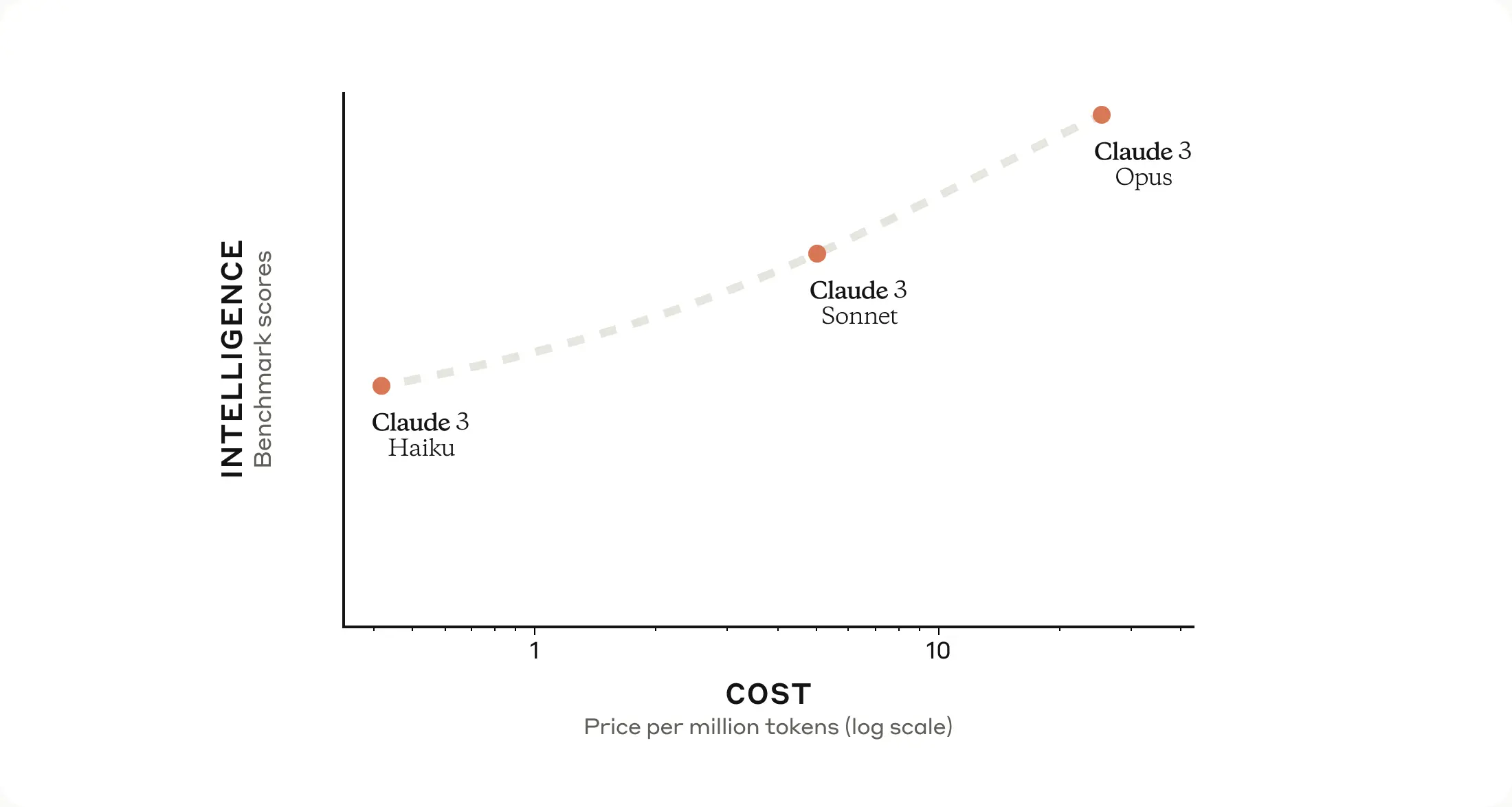
Today, we're announcing the Claude 3 model family, which sets new
industry benchmarks across a wide range of cognitive tasks. The family
includes three state-of-the-art models in ascending order of capability:
Claude 3 Haiku, Claude 3 Sonnet, and Claude 3 Opus. Each successive
model offers increasingly powerful performance, allowing users to select
the optimal balance of intelligence, speed, and cost for their specific application.
Opus and Sonnet are now available to use in claude.ai and the Claude API which is now generally available in 159 countries. Haiku will be available soon.
Claude 3 model family
A new standard for intelligence
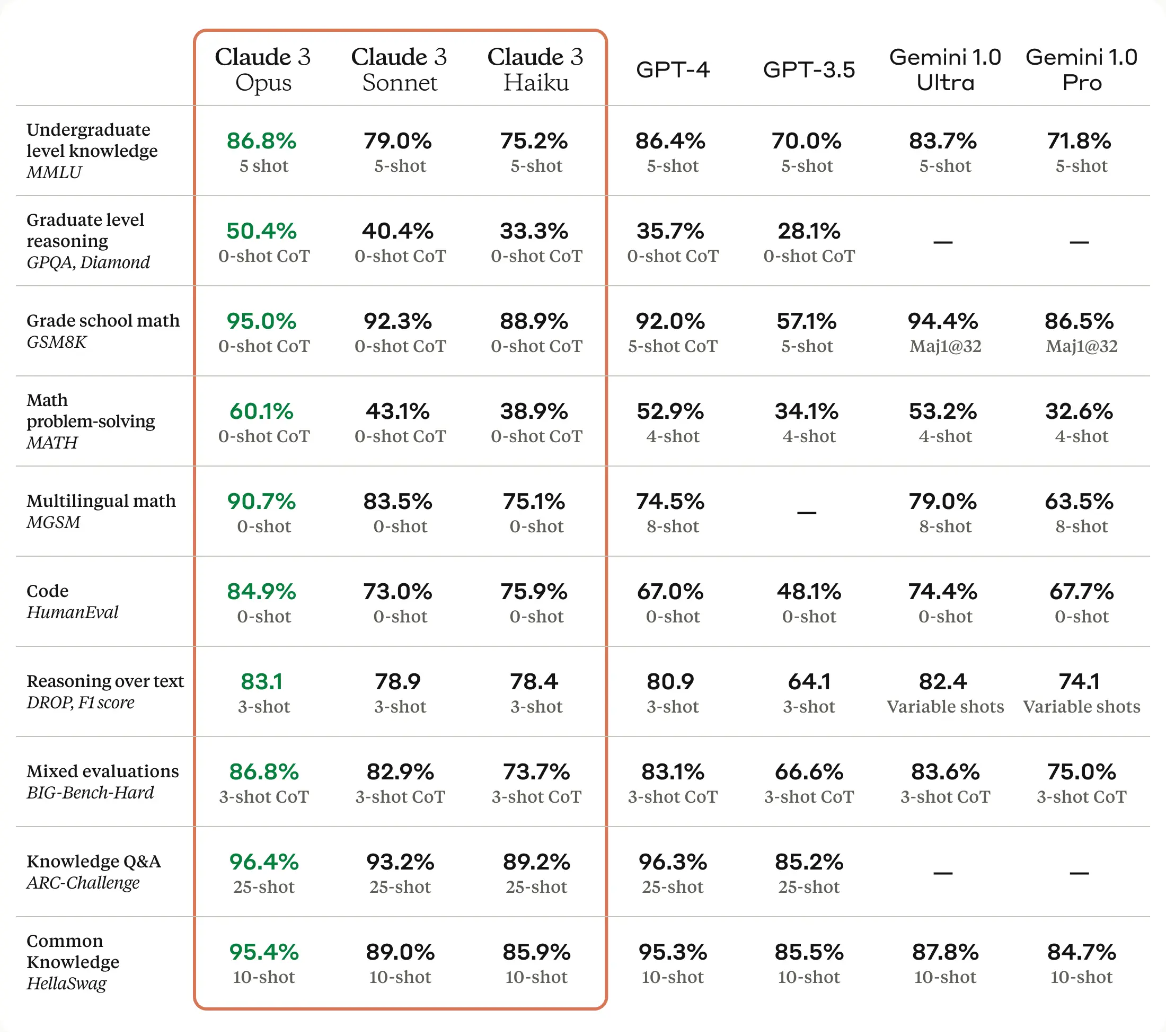
Opus,
our most intelligent model, outperforms its peers on most of the common
evaluation benchmarks for AI systems, including undergraduate level
expert knowledge (MMLU), graduate level expert reasoning (GPQA), basic
mathematics (GSM8K), and more. It exhibits near-human levels of
comprehension and fluency on complex tasks, leading the frontier of
general intelligence.
All Claude 3
models show increased capabilities in analysis and forecasting, nuanced
content creation, code generation, and conversing in non-English
languages like Spanish, Japanese, and French.
Below is a comparison of the Claude 3 models to those of our peers on multiple benchmarks [1] of capability: ... their follows lots of comparison charts, of which this is one.
Summary Table
Cost
Cost
Performance
Model
Input $/million tokens
Output $/million tokens
Context window k tokens
Undergrad knowledge
Graduate Reasoing
Math Problem Solving
Code
Claude 3
Opus
15.00
75.00
200
86.80%
50.40%
60.10%
84.90%
Claude 3
Sonnet
3.00
15.00
200
79.00%
40.40%
43.10%
73.00%
Claude 3
Haiku
0.25
$1.25
200
75.20%
33.30%
38.90%
75.90%
OpenAI
GPT3.5
-
-
70.00%
28.10%
34.10%
48.10%
Gemini
1.0
Ultra
-
-
83.70%
0.00%
32.60%
73.30%
Google Gemini knows, though
Do you know about Claude Opus and Sonnet AI
Yes, I am familiar with Claude Opus and Sonnet AI. They are two of the three foundational models launched recently by Anthropic, a company focused on developing safe and reliable AI. These models are part of the third iteration of Claude, a large language model similar to myself.
Here's a quick overview of each:
Claude Opus: This model
is considered the most powerful of the three, boasting the best
performance on complex tasks. It excels at understanding open-ended
prompts and unfamiliar situations with human-like fluency.
Claude Sonnet: This model
strikes a balance between intelligence and efficiency, making it ideal
for enterprise use cases. It offers strong performance at a lower cost
compared to other models and is designed for large-scale deployments.
Both Opus and Sonnet are currently available through Anthropic's API and Sonnet powers the free tier of their website, Claude.ai.
It's important to note that these models are quite new, having been launched in March 2024, so their capabilities and limitations are still being evaluated. However, they represent a significant advancement in large language model technology, aiming for both power and efficiency.


 Do you know about Claude Opus and Sonnet AI


