Friday, October 22, 2021

Insurance Considerations Amid Increased Use Of Drones - Law360

Insurance Considerations Amid Increased Use Of Drones - Law360

law360.com

Insurance Considerations Amid Increased Use Of Drones - Law360

Logged in as: spender@alum.mit.edu

By Marialuisa Gallozzi, Laura Beth Cohen and Sean Bender October 22, 2021, 4:07 PM EDT

Law360 (October 22, 2021, 4:07 PM EDT) --

From remote delivery to spraying disinfectant to surveillance, the COVID-19 pandemic spurred innovative new uses for unmanned aerial vehicles, or UAVs, more commonly known as drones.

During the same period, the Federal Aviation Administration completed some key regulatory initiatives to integrate drones into commerce while promoting public safety. We discuss below the new functions, new regulations and new risks of drone technology.

New Uses

Remote-controlled flight is an old idea. The U.S. Army began testing radio-controlled pilotless airplanes in 1917, just 16 years after the Wright brothers' first flight. By some estimates, the U.S. Department of Defense's drone procurement budget will approach $100 billion by the end of the decade.[1] The FAA estimates that there are currently 1.7 million active recreational and commercial drones, a figure it expects to grow to 2.31 million by 2024.[2]

The insurance industry also was an early adopter of UAV technology. Since 2018, insurers have accounted for almost 20% of commercial drone use, relying on drones to reach areas otherwise inaccessible to claim adjusters.[3] When COVID-19 halted many other commercial operations, drones allowed insurers to continue adjusting claims.

The pandemic spurred new and expanded drone uses. Drone deliveries increased dramatically in the early weeks of the pandemic, as quarantined customers placed orders for baby food, coffee and — of course — toilet paper. Students received library books via drone delivery. Drones also have been used to deliver human organs for research, as roving internal home security cameras, and as a way for homebuyers to tour listings.

CVS Pharmacy Inc. began using drones to deliver prescription drugs to residents of a Florida retirement community. Pandemic-specific uses included the delivery of personal protective equipment to rural areas and testing of temperature-controlled drone delivery for vaccines.

Governments and public health agencies also increased their use of drones in efforts to slow the spread of COVID-19. Several nations used drones to monitor compliance with shelter-in-place orders. China repurposed agricultural drones to spray disinfectant across public areas and used drones with infrared cameras to scan crowds for symptomatic individuals.

The rise of drones also has led to the rise of a parallel anti-drone industry, which markets tools to detect, track, jam and even destroy unwanted UAVs.

In 2018, a choreographed light show in Hong Kong was disrupted when almost half of the show's drones plummeted into Victoria Harbour.[4] The drone light show that illuminated then President-elect Joe Biden's victory speech on Nov. 7, 2020, fortunately escaped such a fate. Officials in Hong Kong blamed a powerful GPS jamming signal. U.S. law prohibits the use of most signal-jammers and GPS-spoofers by private persons.[5]

While the pandemic has spurred new uses for drones, it also has highlighted the challenges of regulating those uses, navigating those regulations, and scaling up from discrete headline-making pilot projects.

New Regulations

Regulators have been working to integrate both commercial and recreational UAVs into national airspace since the 2012 FAA Modernization and Reform Act. The FAA's most significant rulemaking to date occurred in 2016, when it provided the first legal framework for commercial drone operations, including by limiting drone operations to:

  • Elevations under 400 feet and speeds below 100 miles per hour;
  • Areas within the operator's line of sight;
  • Daytime use; and
  • Areas away from other aircraft, nonparticipating individuals, stadiums, sporting events and emergency response efforts.

The regulations also provided a licensing process allowing pilots to seek waivers of one or more of these restrictions. The FAA has also taken steps to regulate recreational drone use.

In the midst of the pandemic, the FAA issued two key final rules at the end of 2020. The first rule requires remote identification, referred to as a digital license plate, and the second rule permits certain operations over people.

Remote ID is the ability of a drone in flight to provide identification and location information that can be received by other parties.

According to the FAA:

Remote ID will provide information about drones in flight, such as the identity, location, and altitude of the drone and its control station or take-off location. Authorized individuals from public safety organizations may request identity of the drone's owner from the FAA. [It] helps the FAA, law enforcement, and other federal agencies find the control station when a drone appears to be flying in an unsafe manner or where it is not allowed to fly.[6]

The compliance date is Sept. 16, 2023.

The second rule released in December 2020 was the "Operation of Unmanned Aircraft Systems Over People" final rule.[7] It allows routine operations over people and at night under certain circumstances without requiring specific waivers from the FAA.

In January 2021, the FAA "approved the first fully automated commercial drone flights, granting a small Massachusetts-based company permission to operate drones without hands-on piloting or direct observation by human controllers or observers."[8]

Several state and local governments also regulate drone use, but these rules have faced legal challenges in large part because of their conflict with the federal rules. Additionally, several states have banned flights over infrastructure assets like pipelines and flights over prisons due to concerns about delivery of contraband.[9]

Several media organizations are currently challenging a Texas law banning surveillance by commercial UAVs, and restricting flights over critical infrastructure facilities at a height below 400 feet.

Because federal law prohibits flights above 400 feet, the Texas statute effectively prohibits all flights over these facilities. Plaintiffs in National Press Photographers Association v. McCraw, pending in the U.S. District Court for the Western District of Texas, argue that the statute violates the First Amendment and is preempted by FAA rules.[10]

New Risks

For all their advantages, drones create real risks for their owners, operators and the public. Although the FAA does not require UAV owners and operators to carry drone-specific insurance, some states do. We examine below how different types of insurance might respond to certain drone-related risks.

Third-Party Bodily Injury and Property Damage

One of the earliest drone-related lawsuits resulted from an incident in which a wedding photographer in California was sued after a drone hit a guest, causing her to lose vision in one eye. In the ensuing 2018 insurance coverage case, Philadelphia Indemnity Insurance Co. v. Hollycal Production Inc., the commercial general liability insurer sought a declaration of noncoverage.

The U.S. District Court for the Central District of California granted summary judgment for the insurer based on the policy's aircraft exclusion; however, the policy did not define the term aircraft, and the insured did not oppose the insurer's summary judgment motion, so the court may not have had the opportunity to consider the coverage arguments in depth.[11]

Similarly, Caesars Palace casino also was sued for bodily injuries when a drone used in a Fourth of July fireworks show crashed into the crowd and injured several spectators.[12]

Drones may also cause third-party property damage. In 2019, the National Transportation Safety Board received multiple incident reports describing aircraft damage following a drone collision, including damage to a helicopter in flight.[13]

In January 2020, a University of Iowa research drone crashed into a mobile home park as it approached a municipal airport. In addition to the third-party liability, the loss to the owner and operator was estimated at $300,000.[14]

General liability insurers have begun to address these exposures with specific endorsements. Many commercial general liability insurers now include specific drone or "unmanned aircraft" exclusions, which were first issued by the Insurance Services Office Inc. — now Verisk Analytics Inc. — in 2014. The endorsement excludes bodily injury, property damage, personal injury and advertising injury "arising out of the ownership, maintenance, use or entrustment to others of any aircraft that is an 'unmanned aircraft."[15]

At about the same time, the Insurance Services Office also began offering endorsements covering drone operations. In addition, multiple insurers offer products designed for drone risks.

Privacy Torts

Drone-related threats to privacy have triggered other claims. For example, in October 2020, Prince Harry and Meghan, the Duchess of Sussex obtained a favorable settlement of a lawsuit alleging that pictures of their son Archie taken by a drone-mounted camera invaded their privacy. Such business torts are commonly covered by the personal injury component of a general liability policy.

For drones used in specific business pursuits — for example, newsgathering activities — a media liability policy that covers liability arising from the insured's collection of information, including videotaping or recording, may provide coverage. Insureds who use drones in their media operations should be on the lookout for any exclusions or other provisions limiting the devices or equipment through which information is collected.

Professional Liability, and Errors and Omissions

If a company is using drones as part of its operations, it should consider professional liability insurance or errors and omissions insurance. The insurance industry itself provides a good example. Insurer Liberty Mutual is currently in the U.S. District Court for the Eastern District of Louisiana defending its use of drones for adjusting claims in Bellina v. Liberty Mutual Insurance Co.[16]

The policyholder-plaintiff alleged that the insurer wrongfully denied her hail damage claim, and that the damage would have been readily apparent had the insurer sent an adjuster to look at her roof instead of relying on aerial photography.

Cyber Risks

Drones also face cyberthreats. The U.S. Department of Homeland Security has warned that, notwithstanding robust security precautions, drones could be used to extract network information or inject malware.[17] Security analysts have demonstrated the ability to hijack a drone midflight, risking not only data loss but also damage to property and injury to people.[18]

Cyber risk policies may cover third-party liability, first-party loss or both. These policies typically do not contain aircraft or similar exclusions, but many common cyber policy forms contain bodily injury or property damage exclusions.

On the other hand, cyber policies should respond to cybersecurity breaches that expose or damage the insured's data or third-party data collected or transmitted not only via the drone itself but also via the system by which the operator communicates with the drone — collectively referred to as the unmanned aerial system, or UAS.

In this regard, it will be important for drone operators purchasing cyber risk policies to assess whether and to what extent key policy definitions, such as the definition of "computer system," extend to all the components of the UAS. Careful scrutiny of exclusions also will be necessary, including exclusions pertaining to the unauthorized collection of information.

Risk Management

Insurance is a key risk management consideration for owners and operators of drones or users of third-party drone services, who might suffer loss of the drone itself or its payload or liability to third parties. Because a single event can trigger multiple lines of coverage, a policyholder should consider not only its own coverage but also insurance that might be provided through the vendor when the vendor's operations expose the customer to liability.

For example, when contracting with drone operators, Karen Petty, director of Arthur J. Gallagher & Co. Aerospace Specialty Group, recommends (1) vetting the operator's qualifications and licensing, (2) obtaining a certificate of aircraft liability insurance and additional insured status on the operator's policy, and (3) obtaining excess or primary liability coverage that will respond in the event the operator's coverage does not.

Conclusion

Companies and individuals using drones for commercial and recreational purposes confront technology and regulations that have evolved rapidly during the pandemic. With increased use of drone technology comes increased exposure to third-party liability and first-party loss.

To manage operational, financial and legal risk, businesses and individuals need to address risks of drone operations — whether their own operations or third-party operations — through training and compliance, allocation of financial obligations in contracts, and transfer of risk to drone-specific insurance products or other types of insurance.

Some insurers are attempting to exclude drone-related risks while offering new specialty products or endorsements for additional premiums. These new exclusions and coverage grants can vary widely. They warrant close review. The tricky coverage questions that these novel drone-related risks present will likely keep mutating after the COVID-19 pandemic ends.


Marialuisa S. Gallozzi is a partner, Laura Beth Cohen is an associate and Sean Bender is a law clerk at Covington & Burling LLP.

The opinions expressed are those of the author(s) and do not necessarily reflect the views of the firm, its clients or Portfolio Media Inc., or any of its or their respective affiliates. This article is for general information purposes and is not intended to be and should not be taken as legal advice.

[1] https://www.nationaldefensemagazine.org/articles/2020/1/6/98-billion-expected-for-military-drone-market.

[2] https://www.faa.gov/news/press_releases/news_story.cfm?newsId=25620#:~:text=More%20than%201.7%20-million%20recreational,nation's%20airspace%20system%20(NAS).

[3] https://www.namic.org/pdf/publicpolicy/191031_final_drone_law.pdf.

[4] https://www.scmp.com/news/hong-kong/law-and-crime/article/2170669/hk13-million-damage-caused-gps-jamming-caused-46-drones.

[5] 47 U.S.C. § 302a; 18 U.S.C. § 1367.

[6] https://www.faa.gov/uas/getting_started/remote_id/.

[7] https://www.federalregister.gov/documents/2021/01/15/2020-28947/operation-of-small-unmanned-aircraft-systems-over-people.

[8] FAA Approves First Fully Automated Commercial Drone Flights, WSJ January 15, 2021.

[9] For a survey of US drone laws, see: https://www.911security.com/2020-drone-law-updated-report.

[10] Nat. Press Photographers Ass'n v. McCraw, No. 1:19-CV-00946 (W.D. Tex. filed Sept. 26, 2019).

[11] Philadelphia Indemnity Ins. Co. v. Hollycal Production, Inc., 2018 WL 6520412 (C.D. Cal. 2018).

[12] https://abcnews.go.com/US/drone-injured-womans-eye-las-vegas-casino-july/story?id=57358410.

[13] https://app.ntsb.gov/pdfgenerator/ReportGeneratorFile.ashx?EventID=20191019X10346&AKey-=1&RType=HTML&IType=CA.

[14] https://www.press-citizen.com/story/news/2020/01/23/faa-investigating-university-iowa-drone-crash/4554292002/.

[15] CG 21 09 06 15, Insurance Services Office, Inc. 2014.

[16] Bellina v. Liberty Mutual Ins. Co., No. 2:19-CV-13711 (E.D. La. filed Sept. 30, 2019).

[16] https://www.eisac.com/cartella/Asset/00007102/OCIA_-_Cybersecurity_Risks_Posed_by_Unmanned_Aircraft_Systems.pdf?parent=115994.

[17] http://www.assureuas.org/projects/deliverables/a4/ASSURE_A4_Final_Report_UAS_Ground_Collision_-Severity_Evaluation.pdf.

For a reprint of this article, please contact reprints@law360.com.


Wednesday, October 13, 2021

H I Sutton - Covert Shores North Korean Pukguksong (Polaris) SLBM

H I Sutton - Covert Shores

hisutton.com

H I Sutton - Covert Shores

By H I Sutton


CLICK to Enlarge. Original artwork.

Mystery Missile Could Point To Change In North Korea's Submarine Strategy

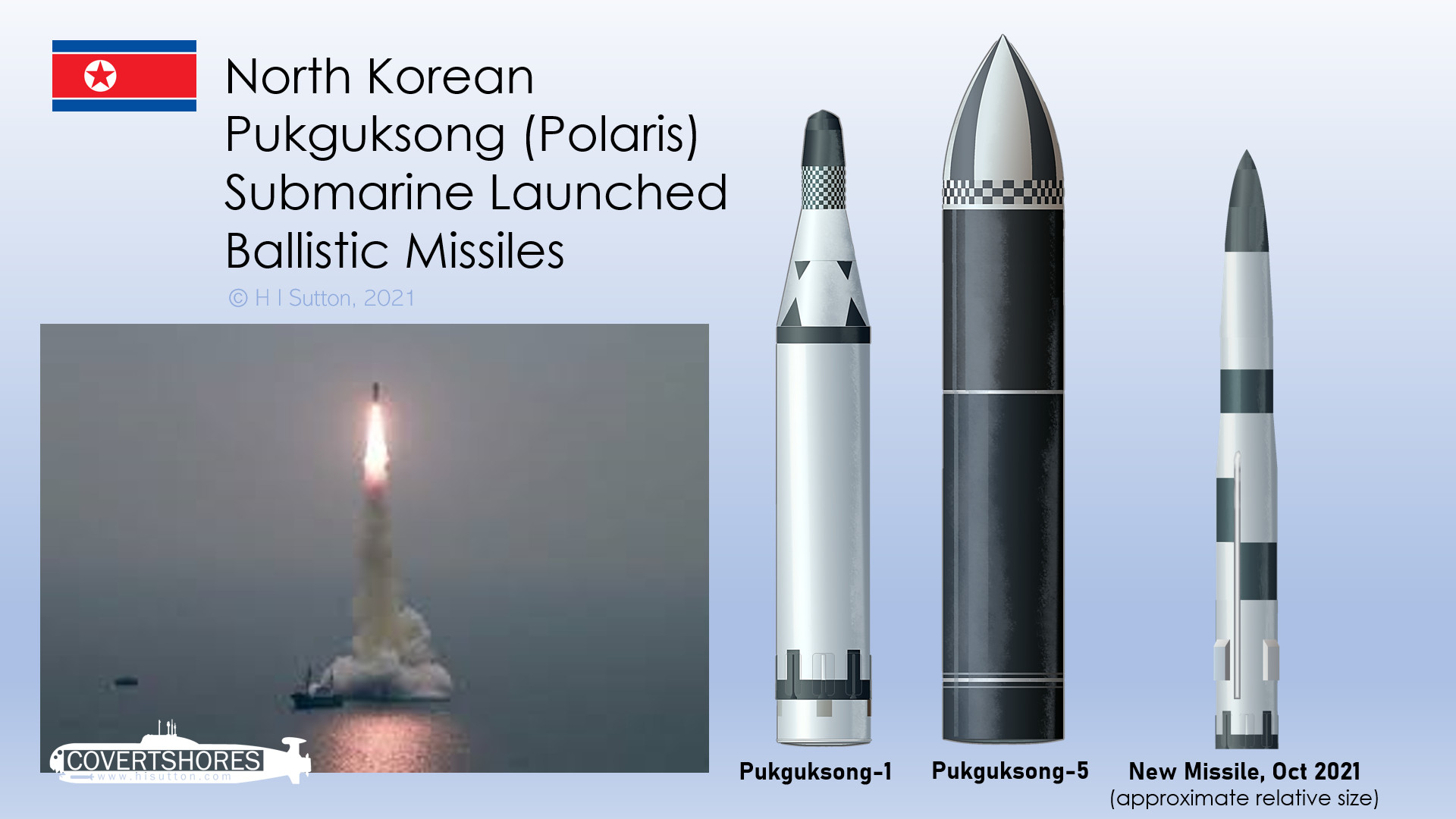
Flag North Korea North Korea unveils so many new missiles that it is hard to keep up. For submarine launched missiles, which are one of the key focuses, the trend has been bigger and bigger. Things have progressed from the Pukguksong-1 which was first shown in 2015, to the Pukguksong-5 revealed earlier this year.

Now a new missile has been displayed at an internal arms show. It is something of a mystery because it is smaller than the earlier ones.

Possible new North Korean submarine launched missile


Get The essential guide to World Submarines
This Covert Shores Recognition Guide Covers over 80 classes of submarines including all types currently in service with World Navies.
Check it out on Amazon

The missile is, at least circumstantially, connected to the submarine-launched weapons. It is however much smaller in diameter, and a bit shorter too. This places it closer to India's K-15 Sagarika and South Korea's Hyunmoo 4-4.

Arguments For it being a submarine launched missile:

  • It was displayed next to two known submarine launched missiles (Pukguksong-1 and 5) as part of the same display
  • It had generally the same black and white test paint scheme, which is different to most ground launched missiles displayed
  • There was no vehicle or other launch apparatus associated with it, unlike the ground based weapons on display

Arguments Against it being a submarine launched missile:

  • From the limited photographs seen, it does not appear to have a gas generator attached, for launching it out of a submarine's missile tube. Both of the Pukguksong series missiles were displayed with their gas generators attached. The absence of a gas generator would fir with surface launch (per Pukguksong-2)
  • It's smaller, seemingly a backward step in the progression from Pukguksong-1 to Pukguksong-5

Possible new North Korean submarine launched missile

Initial Thoughts On The New Missile

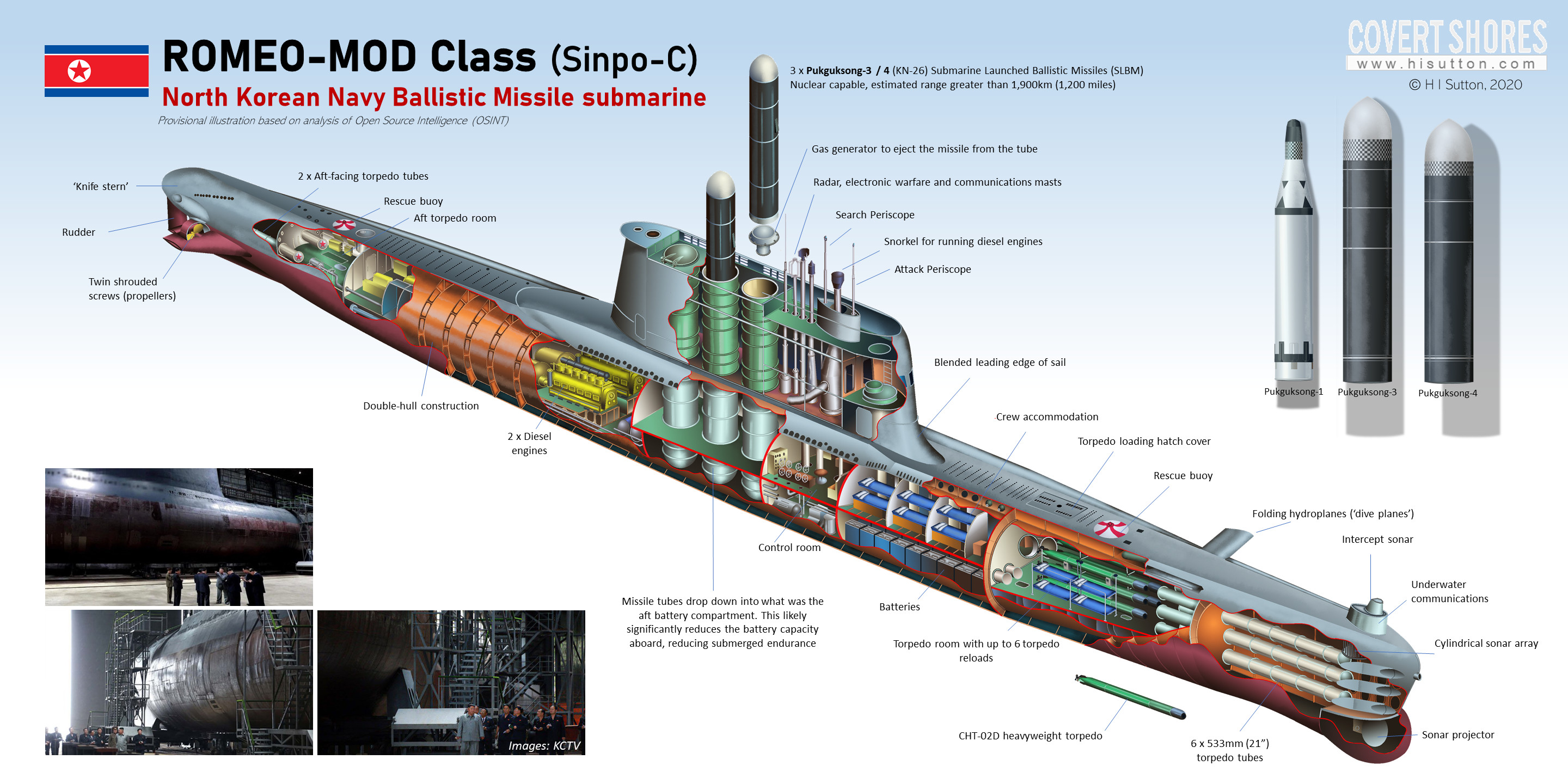
The Pukguksong family of missiles are very large, which makes them a challenge to fit aboard North Korean submarines. The locally designed Gorae class could only carry one, and the modified Soviet-era ROMEO class boats, North Korea's largest, can only carry 3. And even then they do so by compromising their already modest endurance. So North Korea may be looking fdor smaller ballistic missiles to arm some of its smaller submarines. Or at least carry more.

Original artwork. CLICK for high-resolution image.

In missile terms the compromise would be range and throw weight. But if South Korea and Japan are the targets this may be less of a limitation.

We could speculate that a submarine the size of the Gorae class could carry three of the new missiles.

Possibly the North's regime has been influenced by South Korea's use of smaller ballistic missiles for its KSS-III class. However there is no sign of the submarine development, and the missiles are still very large for North Korea's submarines.


THE book on Special Forces subs Covert Shores 2nd Edition. A world history of naval Special Forces, their missions and their specialist vehicles. SEALs, SBS, COMSUBIN, Sh-13, Spetsnaz, Kampfschwimmers, Commando Hubert, 4RR and many more.
Check it out on Amazon


Related articles (Full index of popular Covert Shores articles)
Flag North Korean Modified-Romeo Class ballistic missile submarine w/Cutaway
Flag North Korean Gorae Class SSB
Flag North Korean MS-29 YONO Class midget sub. w/Cutaway
Flag Chinese Navy's First Cruise Missile Submarine, Type-033G Wuhan Class. w/Cutaway


North Korea's 'hypersonic' missile: what we know

North Korea's 'hypersonic' missile: what we know

ph.news.yahoo.com

North Korea's 'hypersonic' missile: what we know

AFP News

North Korea this week tested what state media called a hypersonic gliding missile, sophisticated weaponry that would be the nuclear-armed nation's latest technological advance and could factor into the strategic balance.

Here are some questions and answers on the technology and North Korea's capabilities:

- What is a hypersonic missile? -

Hypersonics are defined as being able to travel at velocities of at least five times the speed of sound -- Mach 5, or more than 6,100 kilometres (3,800 miles) per hour.

As well as their sheer speed, they can manoeuvre in mid-flight, making them much harder to track and intercept than traditional projectiles.

By cutting flight times, they also reduce the opportunity to respond.

Depending on the design, they can be capable of carrying nuclear warheads or conventional only, and have the potential to alter the strategic balance.

- Who has them? -

Russia is generally seen as the world leader in the technology so far, developing a range of new hypersonic weapons that President Vladimir Putin has dubbed "invincible".

In July it successfully tested the Zircon, a ship-launched hypersonic missile travelling at seven times the speed of sound.

It already has Avangard hypersonic glide vehicles and the air-launched Kinzhal (Dagger) missiles in its arsenal.

Russian officials say the Avangard has reached a staggering 33,000 kilometres per hour during tests.

Others are looking to catch up: Washington is spending billions on several research programmes and said this week it had successfully tested an air-launched hypersonic missile built by Raytheon that reached a speed "greater than Mach 5".

China has also tested hypersonic glide vehicles, according to the US Congressional Research Service, which says both Russian and Chinese hypersonic systems are designed to be nuclear-armed.

- What exactly does North Korea have? -

Details on the North Korean missile -- the Hwasong-8 -- are limited.

Pyongyang's official KCNA news agency said the test had "confirmed the navigational control and stability of the missile", the "guiding manoeuvrability and the gliding flight characteristics of the detached hypersonic gliding warhead", and the engine.

It did not say what speed it had reached, but added that it had an "ampoule" fuel system -- a propellant canister that could eliminate the need for launch-site fuelling.

Ordinary liquid-fuelled missiles cannot be transported with their propellant on board as its volatility makes it too dangerous to do so.

Instead, they must be fuelled immediately before launch, a time-consuming process that gives an enemy ample opportunity to locate and destroy them.

- Has there been independent confirmation? -

Seoul has not confirmed what type of missile it was.

The US and South Korea are security allies and have extensive radar and surveillance technology observing the North.

The South's military usually detects and announces ballistic missile launches within minutes of them happening, and did so on Tuesday.

But it did not follow up with its usual practice of specifying the maximum altitude and flight distance.

Media reports citing unnamed sources say it reached a height of around 60 kilometres and flew less than 200 kilometres, but did not specify its speed -- the crucial variable.

In a statement, Seoul's Joint Chiefs of Staff assessed it as being "at an initial phase of development and will take a considerable time to be deployed", adding the South Korean and US militaries were "capable of detecting and intercepting it".

South Korea's Yonhap news agency suggested without citing sources that it could have reached Mach 3.

- What difference would it make? -

Some experts caution that hypersonic weapons may have only limited advantages, with a Scientific American article last month saying that "by no means do they constitute a revolution".

But if Pyongyang goes on from this week's first test to fully develop hypersonic technology, "it would pose a significant military threat", said Cheong Seong-Chang, director of the Center for North Korea Studies at the Sejong Institute.

"It is reasonable to assume the North is developing this missile with the US in mind," he told AFP, adding that it could be used as a bargaining chip in future talks with Washington.

Tuesday's launch was short-range, but Pyongyang would look to develop mid- to long-range capabilities in the field, he added.

"If developed in long-range, there is no country on earth, including the US, that can intercept such a high-speed missile."

kjk-slb/qan


Saturday, September 25, 2021

AST SpaceMobile


AST SpaceMobile. 

 https://ast-science.com/spacemobile/

The Black Swan of Low Earth Orbit satellite communication constellations.  Why is it so different?

  • TL/DR AST SpaceMobile constellation will boast the largest ever deployed area of antenna in space. Powerful enough to do what no one else does: Connect directly to smartphones. Price Target: 45 USD per share. 3.8 x current share price.

  • I am not a financial advisor. This is analysis, not financial advice.

Background. The Communication Services Sector, CSS, Telecommunications addressable market and stepwise evolution of telecom sector.

r/wallstreetbets - AST SpaceMobile. The Black Swan of Low Earth Orbit satellite communication constellations. 🦢🦢🦢🦢🦢🦢🦢🦢🦢🦢 🦅 Why is it so different?

CSS sector in the S&P 500

  • Alphabet (Google) and Facebook make up half of the S&P 500 CSS. Telecommunications companies is one fifth (21%) of sector, and about 2% of the S&P 500 total value. Internet infrastructure is not part of CSS, it is part of Information Technology sector.

  • The Total (global) telecom addressable market in 2021 is 1,000 Bn USD. Growing at CAGR 40% annually. This means the entire Telecom sector is by definition in hypergrowth. A company just maintaining its market share is, thereby, also in hypergrowth. This is largely driven by 5g rollout. And fueled by new technological concepts and evolvong standards.

  • Mainstream consumer telecom started as wire connected telegraphs, then phones, evolved into cellphones and terrestrial towers further subdivided into 2g, 3g, 4g LTE and now 5g. Research and development has started for another leap: Connecting to satellites.

  • 🦅 Incorporated in 3GPP release 16 and 17, 5g standards. For Example Qualcomm x65 release 16 chip, manufactured by Samsung, and in cellphones from early 2022 is engineered to improve its satellite connectivity. Regular cellphones has already started adapting for AST type constellations.

🦢🦢🦢🦢🦢🦢🦢🦅 Low Earth Orbit Satellite constellations. A whole lot of swans.

  • There are a lot of Low Earth Orbit communications Constellations planned and operational.

r/wallstreetbets - AST SpaceMobile. The Black Swan of Low Earth Orbit satellite communication constellations. 🦢🦢🦢🦢🦢🦢🦢🦢🦢🦢 🦅 Why is it so different?

How numerous some leading LEO constellations are planned to become. (correct for AST is 336 sats).


🦅 SpaceMobile constellation. Bigger antenna than any other.

r/wallstreetbets - AST SpaceMobile. The Black Swan of Low Earth Orbit satellite communication constellations. 🦢🦢🦢🦢🦢🦢🦢🦢🦢🦢 🦅 Why is it so different?

Ellis Island. Originally only 3.5 acres in size, today Ellis Island covers nearly 27.5 acres. Or 111.000 square meters. This is the size of the total phased array antenna that AST SpaceMobile constellation will deploy when it reaches 336 satellites.

  • 🦅 An AST satellite will be aprox 17.8 by 20 meters and flat. It features approx 331 square meters of phased array antenna. For a total of 111,216 square meters. And like Ellis Island SpaceMobile will grow in phases. And the real beauty lies not here but in the land side of the Network. The use of Altiostar virtualisation and using the internet for cellular connectivity. AST is bent pipe architechture keeping the complex stuff down on earth. No complex routing in space.

  • 🦢🦢 For comparison Starlink satellites has 4 phased array panels approximately .65 x 0.65 meters in size each or 1.7 square meters total per satellite. That is a total of 71,400 square meters for the 42,000 planned Starlink constellation and 20,400 square meters for the constellation under current application. So Starlink is smaller in antenna size, more numerous, and more complex with routing and packeting done on satellite up in Space.

r/wallstreetbets - AST SpaceMobile. The Black Swan of Low Earth Orbit satellite communication constellations. 🦢🦢🦢🦢🦢🦢🦢🦢🦢🦢 🦅 Why is it so different?

Low Earth Orbit, LEO, is satellites close to earth. Typically they are small with narrow Field of View, FoV / footprint. And use inter satellite links, ISL. See the section.

  • 🦢🦢 We see the most numerous constellations (Starlink, US, European and chinese clones) are dominant. These white swans are competitors and share a few common traits: Small satellites, narrow field of view, intersatellite links, Ku-Ka band, and most importantly: They require a proprietary handset or fixed user terminal to achieve broadband speeds.

  • 🦅 AST SpaceMobile communicates on cellular bands of terrestrial partners, a much lower frequency, compared to Starlink / Kuiper. AST has a very wide Field of View, not narrow as the others, which allow much higher share usable capacity as they will not be starring narrowly down on just deserts and oceans. AST does not use multiple inter satellite links like Iridium, instead it beams the data straight down to terrestrial gateways. This increases capacity and reduces latency.

r/wallstreetbets - AST SpaceMobile. The Black Swan of Low Earth Orbit satellite communication constellations. 🦢🦢🦢🦢🦢🦢🦢🦢🦢🦢 🦅 Why is it so different?

VSAT, very small antenna aperture.

  • 🦢🦢 The VSAT terminal cost is subject to economy of scale. For example the once 1000$ Starlink phased array terminal is now 499$ and projected to reach 200$. To this cost comes costs of distribution and mounting.

  • 🦅 AST SpaceMobile communicates with standard cellphones and tablets already in peoples pockets at a Customer Acquisition Cost of zero. For fixed home internet an off the shelf 5g dongle will do. Making it highly competitive on developing markets and ad hoc / low throughput use cases globally.

r/wallstreetbets - AST SpaceMobile. The Black Swan of Low Earth Orbit satellite communication constellations. 🦢🦢🦢🦢🦢🦢🦢🦢🦢🦢 🦅 Why is it so different?

Mobile monthly revenue per user on different markets.

  • 🦢🦢 The customer acquisition cost, CAC, that subventions of VSATs would incur is still prohibitively costly on developing world markets compared to the Lifetime Value, LTV. Compare a future 100 USD initial VSAT obstacle to a revenue in Africa of 3.4 USD per month = 40.8 USD per year. These terminals also require manufacturing.

  • 🦅 Communication satellites are getting higher throughput, and thereby lower Capital expenditures per bit transferred. AST takes this to extremes.

r/wallstreetbets - AST SpaceMobile. The Black Swan of Low Earth Orbit satellite communication constellations. 🦢🦢🦢🦢🦢🦢🦢🦢🦢🦢 🦅 Why is it so different?

CapEx per Gbps. I have added numbers from Barclays bank AST coverage, to show AST SpaceMobile numbers. 1,200 Gbps and $ 10-12 Mn cost per sat. Link to Barclays report: https://pdfhost.io/v/C0G~b~5c3_Barclays_AST_SpaceMobile_Researchpdf

  • 🦢🦢 CapEx per Gbps is coming down on the space segment as shown above. Starlink will mass produce its satellites and bring down costs to .5 Mn USD per small satellite (0.29 Mn USD per square meter phased array antenna deployed).

  • 🦅 SpaceMobile is an extreme as it will mass produce its satellites and bring down costs per huge satellite to 10-12 Mn USD (0.036 Mn USD per square meter antenna deployed). This sharing of the expensive central control module along with wide FoV is the key to accomplish outstanding CapEx/ Gbps metric.

Signal Strength.

  • 🦢🦢 Like previously mentioned other constellations has proprietary terminals in both ends to achieve enough signal strength and broadband speeds. This means they are either fixed and/or has prohibitively high user terminal / Customer acquisition costs. They use Ku band that needs free line of sight.

  • 🦅 SpaceMobile is connecting to standard cellular phones. By its application to FCC we can see what the signal strength will be like. AST use cellular band which will penetrate inside buildings and through foliage/canopies.


r/wallstreetbets - AST SpaceMobile. The Black Swan of Low Earth Orbit satellite communication constellations. 🦢🦢🦢🦢🦢🦢🦢🦢🦢🦢 🦅 Why is it so different?

From AST application. The cellular spectrum fronthaul tech specs.

  • 🦅 Maximum Power Flux Density (upper table) of transmitting Beams 5/6 (same for both polarizations) in the 1805-2200 MHz (cellular fronthaul) range is -96.6 dBW/m2 or in other format 2.19e-10 W from a single midband beam at ground level. That is 2.19e-7 mW. -110 dB is virtually no signal (dead zone) the 13.4 dB difference is since it is a log scale 22 times the power of a lost signal level.

r/wallstreetbets - AST SpaceMobile. The Black Swan of Low Earth Orbit satellite communication constellations. 🦢🦢🦢🦢🦢🦢🦢🦢🦢🦢 🦅 Why is it so different?

Signal strength and number of bars. From a research paper.

  • 🦅 By matching the chart above the signal strength of the AST application is the equivalent of 4 bars on a cellphone ( there's no real standard on how companies can represent signal bars). So if AST SpaceMobile constellation delivers what AST managment applications show then it will mean medium/good download signal strength. As far as I am able to interpret these tech specs. This high signal strength is accomplished by using phased arrays and beam forming, highly directive antennas. If we were to compare radiowaves to visible light, then AST uses lasers where others use flashlights, so to speak. These narrow beams make for smaller cells, not only resulting in higher signal strength but also more bandwidth per user.

The Businessmodel

  • 🦢🦢 Most other LEO constellations integrate vertically, it is because they have their own standard. They build the entire network including user terminals and own their spectrum. This is expensive, making their service exclusive. They fight ove Ku Ka bands.

  • 🦅 AST SpaceMobile use extreme throughput Q and V bands in their backhaul that there is little competition for and they use shared spectrum from terrestrial partners (currently partners with 1.5 Bn customers are under 50-50 revenue share agreements MOUs) at no spectrum acquisition cost for AST. Terrestrial part of network will use Altiostar/ Rakuten virtualisation / AI software to slice exisiting terrestrial infrastructure and the internet to transfer traffic optimizing latency and speed while minimizing costs. Terrestrial sites will be built and maintained by partners Vodafone group and American Towers, all world leaders in their respective field, incurring no terrestrial CapEx for AST SpaceMobile.

  • 🦅 Whenever a partner subscriber goes out of tower coverage they get an SMS so they can connect to AST SpaceMobile instead. Customer Aquisition thus automated, all digital, and requiring no extra end user equipment.

r/wallstreetbets - AST SpaceMobile. The Black Swan of Low Earth Orbit satellite communication constellations. 🦢🦢🦢🦢🦢🦢🦢🦢🦢🦢 🦅 Why is it so different?

Present and future communication satellites in south east Asia, comparison. I added AST and Starlink. Note that AST has no "join the club" one time or monthly fee. Just 2$ per GB used. No monthly cost and no starting / VSAT cost makes for easy entry.


The only pure play

  • 🦢🦢 Other constellations performing at broadband speeds, like Starlink and Amazon Kuiper are not available to invest in directly. They are part of bigger enterprises or not listed. There are companies like Iridium and Globalstar that are LEO constellations, but their latency, speed, and user costs is nowhere near competitive.

  • 🦅 AST SpaceMobile does have a 51% owned subsidiary with 90 missions flown aiming at 30% of the US nanosat market, it is called NanoAvionics. But apart from that it is a pure play for investors seeking to invest in Low Earth Orbit connectivity.

Price Targets

  • 🦢🦢 No LEO constellation ever became cash flow positive without first becoming chapter 11, bankruptcy. That is how CapEx intensive the industry is, and how few customers they get by using proprietary hardware. Starlink expects to go cash flow positive somewhere beyond 2030.

  • 🦅 AST SpaceMobile has coverage from DB and Barclays with price targets of 35 and 29 respectively for an 32 USD / share average. Todays price is 11.7 USD per share. An upcoming catalyst, launch of Bluewalker 3 with Space-x in march 2022, will be pivotal for share price.

  • 🦅 AST SpaceMobile is different in a good way, mutualistic/synergetic business model that shys away from CapEX by massproduction / economy of scale, using the reduced launch costs of Space-x, leasing terrestrial gateways from terrestrial pros, and most importantly using already paid for spectrum of terrestrial partners maximizing the use of the scarce expensive commodity of cellular spectrum in a 50-50 win-win model. By beeing different in a good way we can put some trust in company FCF projections and do DCF / NPV calculation.

r/wallstreetbets - AST SpaceMobile. The Black Swan of Low Earth Orbit satellite communication constellations. 🦢🦢🦢🦢🦢🦢🦢🦢🦢🦢 🦅 Why is it so different?

DCF / Net Present Value Sensitivity Analysis. By u/Cryptographer

  • 🦅 AST SpaceMobile investor presentation projects revenues up until 2030. And will become Cash Flow Positive upon launch of Equatorial in 2024. Using a percentage of the positive cash flow years (column) and an discount rate of your choice (row) the above table allows you to arrive at a fair current market capital. Using just 40% of the future projected positive cash flows (as a proxy for 60% failure risk) and a discount rate of 12% we arrive at 8.264 Bn market cap. Divided with 182 Mn shares that is 45 USD per share. When doing this we put zero value to subsidiary Nanoavionics a cash flow positive Nanosat provider growing yoy 300%. But beware that AST has within it many hypergrowth criteria. It is likely to either fail and be lower, or be much much higher on success.

Final thought. The impact on society.

  • 🦅 AST SpaceMobile global coverage directly to cellphones from satellite will revolutionize the world very much like cellular towers already has. Understanding these leaps of technology is easy in hindsight. But now they seem like a Black Swan. Something you have never seen. Most will react by denial at this stage, which explains the current price. The omnipresence of 5g coverage (that from 3GPP release 16 includes hardened positioning / fused LEO GNSS i.e a more secure more precise GPS) will revolutionize drones and remotely operated vehicles as they will be connected everywhere with low latency. The network will jump-start economic development in the third world and open up markets for other communication services sector companies as new customers gain access to cellular connections at broadband speeds.

    References

    https://www.sec.gov/Archives/edgar/data/1780312/000149315221012086/ex99-5.htm

Synthetic Aperture Radar Drone Gets Interferometric Imaging | Hackaday

Synthetic Aperture Radar Drone Gets Interferometric Imaging | Hackaday Backyard Coherence: A €1,000 Drone SAR Achieves Repeat-Pass Interfero...