GA-ASI Completes Full-Scale Fatigue Test on MQ-9B | General Atomics
GA-ASI Completes Rigorous Three-Lifetime Fatigue Test Campaign for MQ-9B
Comprehensive structural validation supports NATO certification push as production ramps up for international customers
November 17, 2025
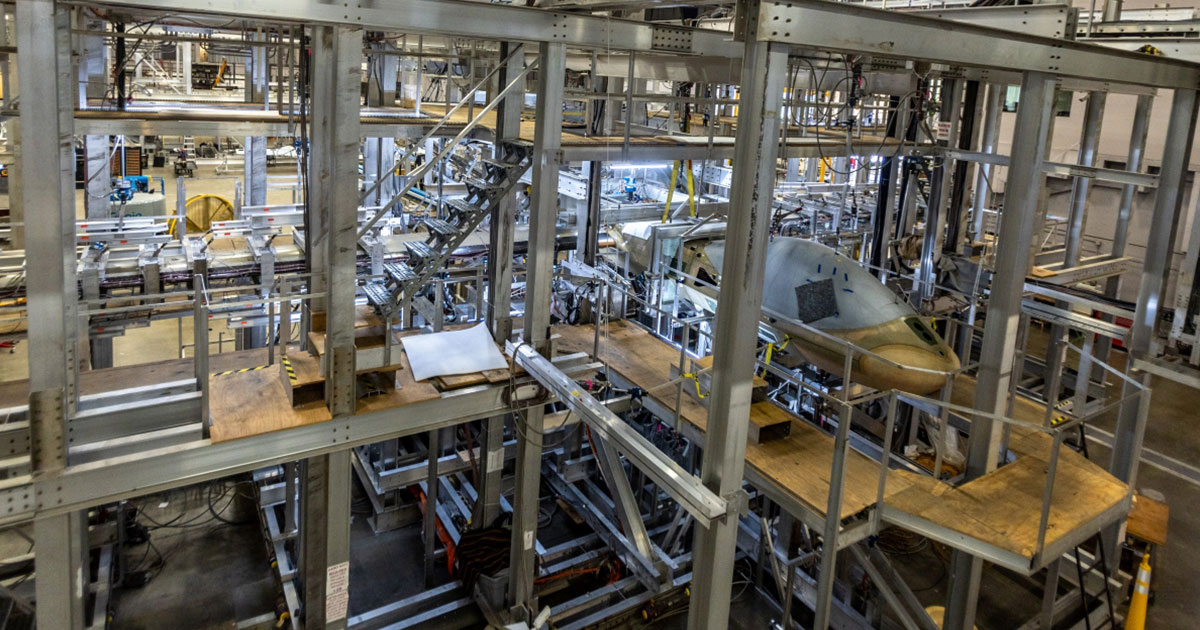
DUBAI — General Atomics Aeronautical Systems has concluded a nearly three-year full-scale fatigue (FSF) test program for its MQ-9B remotely piloted aircraft, accumulating 120,000 simulated operating hours on a production airframe—a milestone that validates the platform's structural integrity and supports its certification to NATO STANAG 4671 standards.
The completion of the "third lifetime" test on October 31, 2025, at Wichita State University's National Institute for Aviation Research marks a significant achievement for the San Diego-based manufacturer as it delivers aircraft to a growing international customer base that now includes nine countries plus U.S. Special Operations Command.
Three-Phase Validation Approach
The test program, which began in December 2022, employed a sequential approach designed to progressively stress the airframe beyond normal operational parameters. The first two 40,000-hour lifetimes simulated standard operational conditions, while the third intentionally introduced damage to critical structural components to demonstrate damage tolerance—a key requirement for military airworthiness certification.
According to GA-ASI President David R. Alexander, the testing validates years of design and analysis efforts, with the third lifetime intentionally inflicting damage to the airframe's critical components to demonstrate its ability to tolerate operational damage that could occur over the lifetime of the aircraft.
This damage-tolerance testing represents a critical phase in modern aircraft certification, particularly for platforms seeking to operate in controlled airspace alongside manned aircraft—a capability that distinguishes the MQ-9B SkyGuardian and SeaGuardian variants from their MQ-9A Reaper predecessor.
Industry Context and Comparative Analysis
Full-scale fatigue testing has become increasingly sophisticated as both manned and unmanned aircraft push operational boundaries. Modern FSF programs typically simulate 2-3 lifetimes of service, with the third often incorporating deliberate damage to validate fail-safe design features.
The MQ-9B's test regime mirrors approaches taken by major combat aircraft programs. The F-35A's full-scale durability test airframe completed its third life testing—equivalent to 24,000 flying hours—at BAE Systems's facility in Brough, East Yorkshire. The F-35 program requires a service life of 8,000 flight hours, verified through durability testing to two lifetimes, or 16,000 hours, with third life testing providing data to enable the warfighter to maintain and sustain the aircraft beyond 2050.
For all three F-35 variants, complete airframes were subjected to two lifetimes of severe design spectrum loading, with maneuver, catapults/arrestments (carrier variant only) and buffet loads applied as separate, alternating 1000 flight hour blocks during the major test sequence.
The Boeing 787 Dreamliner underwent what many consider the most extensive commercial aircraft fatigue test program ever conducted. Between 2010 and 2015, Boeing ran the 787's carbon-composite body through 165,000 simulated flights—about 3.75 times the Dreamliner's expected service life. Mounted on a 1.2 million-pound test rig, the 787 prototype flexed its wings, fuselage, and tail thousands of times as hydraulic jacks yanked, twisted, and squeezed the structure.
During ultimate load testing, the 787 was subjected to 150% of the highest loads any airplane would encounter in service, with wings flexed upward by about 25 feet (7.6 meters) and the fuselage pressurized to 150% of its maximum operating condition.
Strategic Benefits of Comprehensive Testing
The benefits of full-scale fatigue testing include identifying potential structural deficiencies, validating inspection intervals, developing repair methods, and ensuring structural life is two to four times longer than design life.
For the Royal Australian Air Force F/A-18 Hornet fleet, testing of seventeen centre fuselage structures demonstrated the repeatability of service fatigue cracking locations, collected data to characterize defect types that typically nucleate fatigue cracks, and provided a more accurate assessment of safe operating life. This improved understanding allowed increased aircraft availability and reduced maintenance costs.
The data generated during these comprehensive test programs extends far beyond simple pass/fail metrics. Boeing's 777 extended full-scale fatigue testing reached as high as 3.5 times design service objective, completing 140,000 cycles simulating 70 years of service. The test demonstrated outstanding fatigue performance, showed excellent correlation of crack growth data with analysis, and validated analysis methods while verifying damage tolerance capability.
NATO Certification Framework
NATO STANAG 4671 is the Unmanned Aircraft Systems Airworthiness Requirements (USAR) standard, intended to allow military UAS to operate in other NATO members' airspace. If a National Certifying Authority states that a UAS airworthiness is compliant with STANAG 4671, that UAS should have streamlined approval to fly in the airspace of other NATO countries that have also ratified the standard.
The standard responds as closely as practicable to a comparable minimum airworthiness level for fixed aircraft, satisfying airworthiness requirements for flight in non-segregated airspace with minimal or no restrictions.
The MQ-9B's compliance with STANAG 4671 Edition 3 positions it uniquely among large RPA platforms, enabling operation in civil airspace across NATO member states—a critical capability for European customers where population density makes segregated military airspace operations impractical.
Test Facility Capabilities
The National Institute for Aviation Research at Wichita State University is a unique R&D facility focused on providing testing and certification for airframe technologies, with a staff of 400 and 320,000 square feet of laboratory and office space in four locations across Wichita, Kansas.
NIAR's Aircraft Structural Test and Evaluation Center (ASTEC) encompasses a massive 250,000 square feet, with the primary building featuring a 30x70-ft. hangar door, clear span of 265 feet and a 48-ft. ceiling. The facility has performed full-scale structural testing on aircraft including the Learjet 85, MQ-9 Reaper, B-52, KC-135, F-35 Joint Strike Fighter, B1-B Lancer and UH-60 Black Hawk.
The facility currently houses multiple aircraft test rigs, including a Northrop Grumman MQ-4C Triton unmanned aircraft system with a 130-foot wingspan being acted on by over 100 cylinders and measured by thousands of channels of load, strain, pressure and temperature feedback.
Design Improvements Driven by Testing
Fatigue testing frequently reveals opportunities for structural optimization before fleet deployment. During F-35B development, Lockheed Martin discovered fatigue cracks on an aluminum bulkhead inside a ground test aircraft after 1,500 hours of durability testing, leading to root cause analysis and structural modifications before the issues could affect the operational fleet.
Australia's International Follow-On Structural Test Project for the F/A-18 Hornet involved 24,000 hours of test 'flying' in a specially designed rig, pioneering many new test techniques and collecting an invaluable set of operational data to support the aircraft for Royal Australian Air Force service.
Implications for MQ-9B Production
The successful completion of FSF testing removes a significant certification milestone as GA-ASI accelerates production for international customers. In addition to the Royal Air Force, GA-ASI has MQ-9B procurement contracts with Belgium, Canada, Japan, Taiwan, Poland, India, Denmark, and the U.S. Air Force in support of Special Operations Command.
Test results will be used as documentation for certification and will form the basis for in-service inspections of structural components, with the aim of identifying any potential structural deficiencies ahead of fleet usage and assisting in developing inspection and maintenance schedules for the airframe.
The comprehensive test data will prove particularly valuable as MQ-9B platforms accumulate operational hours in diverse environments, from maritime patrol missions with Japan's Coast Guard to long-endurance intelligence, surveillance and reconnaissance missions across multiple theaters.
Future of UAS Structural Testing
Increasingly, designs are tested virtually in simulations using finite element models, with physical tests used to parameterize, refine and validate the models. Design models can furnish digital twins with data, which enable prognostic monitoring of aircraft in service.
However, industry experts emphasize that virtual testing cannot yet fully replace physical validation. As Marcel Bos of the Royal Netherlands Aerospace Centre and general secretary of the International Committee on Aeronautical Fatigue and Structural Integrity notes, complex tests use many hydraulic actuators to mimic an expected lifetime of load-cycles, with fatigue being cycle-related rather than calendar-related, making it feasible to mimic many years in months.
The MQ-9B program demonstrates the continuing value of comprehensive physical testing in validating analytical predictions and providing the empirical foundation necessary for safe, long-term fleet operations—particularly for platforms designed to operate in the demanding civil airspace environment.
Sources
-
General Atomics Aeronautical Systems, Inc. "GA-ASI Completes Full-Scale Fatigue Test on MQ-9B." Press Release, November 17, 2025. https://www.ga-asi.com/ga-asi-completes-full-scale-fatigue-test-on-mq-9b
-
"General Atomics completes full-scale fatigue testing on MQ-9B drone." Aerospace Testing International, November 17, 2025. https://www.aerospacetestinginternational.com/news/general-atomics-completes-full-scale-fatigue-testing-on-mq-9b-drone.html
-
General Atomics Aeronautical Systems, Inc. "GA-ASI Completes Full-Scale Fatigue Test on MQ-9B for Second Lifetime." Press Release, September 30, 2024. https://www.ga.com/ga-asi-completes-full-scale-fatigue-test-on-mq-9b-for-second-lifetime
-
"Full-Scale Fatigue Testing - an overview." ScienceDirect Topics. https://www.sciencedirect.com/topics/engineering/full-scale-fatigue-testing
-
Lv, Shuang. "Discussion of Speeding Up Fatigue Test of Full-Scale Aircraft." Engineering Proceedings 80, no. 1 (2024): 7. https://doi.org/10.3390/engproc2024080007
-
Ball, D.L., et al. "F-35 Full Scale Durability Modeling and Test." Advanced Materials Research 891-892 (March 2014): 693-700. https://www.scientific.net/AMR.891-892.693
-
"Third life testing completed for F-35A Lightning II airframe." Aerospace Testing International, May 16, 2019. https://www.aerospacetestinginternational.com/news/fatigue-testing/third-life-testing-completed-for-f-35a-lightning-ii-airframe.html
-
"BAE Systems: Static and Fatigue Tests." HBM, November 17, 2021. https://www.hbm.com/en/2995/bae-systems/
-
"Fatigue cracks raise questions about key decision in F-35 redesign." Flight Global, December 6, 2019. https://www.flightglobal.com/fatigue-cracks-raise-questions-about-key-decision-in-f-35-redesign/96988.article
-
"How Boeing Tests Aircraft Structural Fatigue." Jalopnik, October 2024. https://www.jalopnik.com/1997030/how-boeing-tests-aircraft-structural-fatigue/
-
Boeing. "787 Quality Information." Corporate website, 2024. https://www.boeing.com/commercial/787/quality-info
-
"Boeing completes ultimate-load wing test on 787 Dreamliner." Reliable Plant, March 29, 2010. https://www.reliableplant.com/Read/23658/Boeing-wing-test-787
-
"How Much Can an Airplane Wing Bend?" Turbli Blog. https://turbli.com/blog/how-much-can-an-airplane-wing-bend/
-
"NATO STANAG 4671 - Wikipedia." Last modified September 12, 2025. https://en.wikipedia.org/wiki/NATO_STANAG_4671
-
"STANAG 4671 Unmanned Aircraft Systems Airworthiness Requirements (USAR)." Eurolab. https://www.eurolab.net/en/sektorel/askeri-testler/stanag-4671-insansiz-ucak-sistemleri-ucusa-uygun-olma-sartlari-(usar)/
-
"NATO - STANAG 4671 - UNMANNED AIRCRAFT SYSTEMS AIRWORTHINESS REQUIREMENTS (USAR)." GlobalSpec. https://standards.globalspec.com/std/13430067/stanag-4671
-
Commonwealth of Australia, Defence Aviation Safety Authority. "DASDRM S4CH2 - CERTIFIED CATEGORY UAS." https://dasa.defence.gov.au/sites/default/files/minisite/static/1c1b974f-0b9f-4cc4-898c-c8d366add5c3/pgp/dasdrm/s4_ch2.htm
-
"Mechanical Test Lab." Wichita State University NIAR. https://www.wichita.edu/research/NIAR/Laboratories/mechanical-test.php
-
"Aerospace Testing Suppliers | Spotlight: National Institute for Aviation Research." Aerospace Testing International, May 7, 2019. https://www.aerospacetestinginternational.com/supplier-spotlight/national-institute-for-aviation-research
-
"Wichita State's NIAR delivers fiber metal laminate test panel to FAA." Aerospace Manufacturing and Design, November 14, 2024. https://www.aerospacemanufacturinganddesign.com/news/wichita-state-niar-delivers-fiber-metal-laminate-test-panel-faa/
-
"National Institute for Aviation Research." Wichita State University. https://www.wichita.edu/industry_and_defense/NIAR/
-
"National Institute for Aviation Research (NIAR)." MTS Case Study. https://www.mts.com/en/articles/aerospace/case-study-niar-understanding-composite-aircraft-structures
-
"Plant tour: National Institute for Aviation Research, Wichita, Kan., U.S." CompositesWorld, May 7, 2025. https://www.compositesworld.com/articles/plant-tour-national-institute-for-aviation-research-wichita-kan-us
-
"Aircraft Structural Test and Evaluation Center (ASTEC)." Wichita State University NIAR. https://www.wichita.edu/industry_and_defense/NIAR/Laboratories/astec/astec.php
-
"Outcomes from the fatigue testing of seventeen centre fuselage structures." Engineering Fracture Mechanics 188 (February 2018): 461-481. https://www.sciencedirect.com/science/article/abs/pii/S0142112318300604
-
"Flexible Solutions for Aircraft Structural Testing." HBM, November 5, 2021. https://www.hbm.com/en/0065/flexible-solutions-for-aircraft-structural-testing/
-
"A guide to the ever-expanding field of fatigue testing." Aerospace Testing International, September 1, 2021. https://www.aerospacetestinginternational.com/features/exploring-the-ever-expanding-field-of-fatigue-testing.html
-
Swift, T. "Forty Years of Structural Testing and Airworthiness Certification at Boeing Commercial Airplanes." Boeing Technical Journal (May 2017). https://www.boeing.com/content/dam/boeing/boeingdotcom/features/innovation-quarterly/may2017/btj_strutures_full.pdf
-
"Article 3: The Science of Metal Fatigue – Aircraft Structures and Maintenance Best Practices." AviathRust. https://www.aviathrust.com/article/Aloha-Flight-243-ARTICLE-SERIES-3
-
"Aircraft fatigue." Defence Science and Technology, Australia, April 27, 2016. https://www.dst.defence.gov.au/innovation/aircraft-fatigue
SIDEBAR 1: Inside Full-Scale Fatigue Testing - What Gets Tested and What Doesn't
Full-scale fatigue (FSF) testing is often misunderstood as a comprehensive operational test of an entire aircraft system. In reality, it's a highly focused structural validation program with strict boundaries.
What FSF Testing DOES Include:
Structural Loads Simulation: Complete airframes are subjected to multiple lifetimes of design spectrum loading, with maneuver loads, catapults/arrestments (for carrier variants), and buffet loads applied as separate, alternating blocks during the major test sequence.
The test article—typically a production-representative airframe—is mounted in a massive steel rig equipped with dozens to hundreds of hydraulic actuators. For the Boeing 787, hydraulic jacks applied loads to the airplane, pushing and pulling the wings and fuselage to simulate all phases of flight and evaluated the durability of the airplane in a variety of conditions over lifetimes of service, with thousands of data points collected every second.
Typical Load Cases:
- Symmetric and asymmetric flight maneuvers
- Gust encounters and turbulence
- Landing gear impacts
- Pressurization/depressurization cycles (for pressurized aircraft)
- Ground-air-ground cycles
- High-G pullouts and rapid control inputs
For time-compressed tests, a set of flight types—rough, smooth, emergency landing, etc.—is defined and the expected loads are applied. Tests typically last a few years to simulate several times the lifetime of the aircraft.
Instrumentation: Test rigs incorporate thousands of channels of load, strain, pressure and temperature feedback, with extensive instrumentation including strain gauges monitoring structural response throughout the test program.
What FSF Testing Does NOT Include:
According to NATO STANAG 4671 documentation, the following are explicitly outside the scope of airworthiness structural testing: operating the payload (other than the potential to damage the aircraft), transport and release of weapons, pyrotechnics and other stores designed to be released during normal operations, and launch and landing equipment that is not safety critical.
Systems Not Tested in FSF:
- Weapons employment and release mechanisms
- Sensor operations (radar, electro-optical/infrared, etc.)
- Communications systems functionality
- Mission systems integration
- Avionics software and processing
- Propulsion system operations
- Actual fueling operations
- Ground support equipment interfaces
Why the Separation?
FSF testing validates structural durability and damage tolerance—proving the airframe can safely withstand design life cyclic loads without catastrophic failure. The benefits include identifying potential structural deficiencies, validating inspection intervals, developing repair methods, and ensuring structural life is two to four times longer than design life.
Operational systems undergo separate validation through flight test programs, ground integration testing, electromagnetic compatibility testing, and environmental qualification testing. This separation allows structural testing to proceed on non-flying test articles in specialized facilities while operational testing occurs on flying prototypes at flight test centers.
The Three-Lifetime Approach:
The first two lifetimes typically simulate operation under normal conditions, while the third intentionally inflicts damage to critical components to demonstrate the ability to tolerate operational damage that could occur over the aircraft's lifetime.
This damage tolerance phase validates that the structure can survive scenarios such as:
- Impact damage from maintenance accidents
- Hail strikes
- Foreign object damage
- Manufacturing defects that escaped quality control
- Environmentally-induced degradation
Boeing's extended 777 full-scale fatigue testing reached 3.5 times design service objective, completing 140,000 cycles simulating 70 years of service, with primary objectives including obtaining additional crack growth data to support structural maintenance plans for future aging fleet programs and developing analytical procedures for calculating parameters that characterize widespread fatigue damage.
The resulting data becomes the foundation for:
- In-service inspection programs
- Maintenance interval determination
- Structural health monitoring requirements
- Service life extension analysis
- Fleet management decisions
For the MQ-9B, this comprehensive structural validation provides the empirical foundation necessary for safe operation in civil airspace—a requirement unique among large military RPA platforms and essential for the platform's NATO STANAG 4671 certification objectives.
SIDEBAR 2: The Composite Challenge - Why MQ-9B's Materials Complicate Fatigue Testing
The MQ-9B's extensive use of composite materials fundamentally changes how full-scale fatigue testing must be conducted and interpreted compared to traditional metal airframes—a distinction with major implications for certification and long-term fleet management.
Different Physics, Different Problems
Fatigue test results on aluminum alloys and other aircraft quality metallic materials are much more reproducible than those for composites. Since composite structures are conservatively designed with considerable analytical reductions in strength to account for environmental effects, it is rare that full-scale fatigue testing exercises the capabilities of composite structural members, preventing composite structures from failing during fatigue testing.
This statistical unpredictability presents unique certification challenges. Where decades of data allow precise prediction of metal fatigue behavior, composites exhibit:
Distinct Failure Mechanisms:
- Delamination between composite layers
- Matrix cracking within plies
- Fiber breakage and pullout
- Bond failures at composite-to-metal interfaces
- Impact damage that may be barely visible but structurally significant
Unlike metals, which develop progressive cracks that can be detected and monitored, composite damage can remain hidden internally. During Boeing 787 development, the wing box experienced delaminations and deformations at body joint points during routine stress tests, requiring weeks of analysis to determine program impact.
Temperature Sensitivity
The interaction of materials with different coefficients of thermal expansion across wide temperature ranges presents testing challenges. Composite materials show increased shear strength at lower temperatures, but brittleness also increases, making them more prone to impact damage.
The MQ-9B operates across extreme temperature ranges—from Arctic cold to desert heat—conditions that affect composite properties more dramatically than metals. This necessitates environmental conditioning cycles during FSF testing that wouldn't be required for all-metal structures.
Manufacturing Variability
Contamination of the composite mixture during manufacturing was reported on the Boeing 787, causing a small decrease in strength while remaining within safety margins.
Composites are inherently more sensitive to production quality variations:
- Voids from improper vacuum-bag consolidation
- Contamination during layup
- Temperature/pressure variations during autoclave cure
- Humidity absorption during fabrication
- Fiber misalignment or improper ply orientation
Each introduces variability that affects fatigue performance unpredictably—variability that FSF testing must account for by testing production-representative structures rather than hand-built laboratory specimens.
Implications for MQ-9B Testing
The composite construction likely drove several FSF program decisions:
Extended Test Duration: Boeing's 787 composite airframe underwent testing described as more robust than any conducted on a previous Boeing commercial airplane, with the carbon-composite body subjected to 165,000 simulated flights—approximately 3.75 times the Dreamliner's expected service life.
The MQ-9B's 120,000-hour test program (equivalent to three full 40,000+ hour lifetimes) reflects similar conservatism necessary when validating composite structures with limited historical fleet data.
Critical Third-Lifetime Damage Tolerance: The third lifetime intentionally inflicted damage to critical structural components to demonstrate tolerance to operational damage that could occur over the aircraft's lifetime.
For composites, this phase validates survival of:
- Tool drops during maintenance (barely visible impact damage)
- Hail strikes during operations
- Bird strikes and foreign object damage
- Environmental degradation from UV exposure, moisture absorption, and thermal cycling
Enhanced Inspection Requirements: Composite damage detection requires sophisticated techniques beyond visual inspection:
- Ultrasonic C-scanning for internal delamination
- Thermography to detect disbonds
- Tap testing (acoustic response) for skin-core separation
- Shearography for detecting subsurface anomalies
Test results will form the basis for in-service inspections of structural components, with the aim of identifying potential structural deficiencies ahead of fleet usage and assisting in developing inspection and maintenance schedules.
For composite aircraft, these inspection programs must account for damage types that don't exist in metal structures.
The 787 Precedent
The multiyear 787 full-scale test program from August 2010 to September 2015 was more robust than any conducted on a previous Boeing commercial airplane. Extensive and rigorous testing of the fuselage and heavy maintenance checks of nearly 700 in-service airplanes to date have found zero evidence of airframe fatigue.
This success validates the approach but also highlights the extensive testing burden: Boeing invested five years of continuous testing to validate what might have required three years for an equivalent metal design.
Flexibility vs. Brittleness
The question of composite "flexibility" relative to metal is nuanced. Composites can be designed with significant flexibility—the Boeing 787-9's carbon fiber composite wings with a high aspect ratio of 11 (length to width) make them thin and easy to bend, representing the most flexible wings in commercial aviation.
However, composites lack the ductile "give" before failure that metals provide. Metal structures visibly deform and crack progressively, providing warning. Composites may appear intact until sudden catastrophic failure—a characteristic that makes damage tolerance testing even more critical.
NATO Certification Context
NATO STANAG 4671 provides a framework for certifying unmanned aircraft systems operating in non-segregated airspace, enabling the MQ-9B to operate alongside manned aircraft in civil airspace.
The standard's structural requirements recognize these composite-specific challenges, requiring demonstration of damage tolerance and fail-safe characteristics appropriate to the materials and construction methods employed. The MQ-9B's successful completion of three-lifetime FSF testing provides the empirical foundation necessary to satisfy these demanding requirements.
Industry Lessons:
During F-35B fatigue testing, premature cracks were discovered requiring structural redesign, with a third non-flying F-35B planned to test the redesigned structure.
Even with sophisticated analysis tools, physical testing remains essential for validating composite structures. The MQ-9B program's investment in comprehensive FSF testing reflects industry recognition that composite aircraft require more extensive validation than metal equivalents—not because composites are inferior, but because their different physical behavior demands different certification approaches.
For operators, this translates to high confidence in structural integrity but requires adherence to composite-specific maintenance practices, inspection techniques, and environmental protection measures that differ significantly from traditional metal aircraft fleet management.


No comments:
Post a Comment