GA-ASI Achieves New Milestone With Semi-Autonomous CCA Flight | General Atomics
BLUF (Bottom Line Up Front)
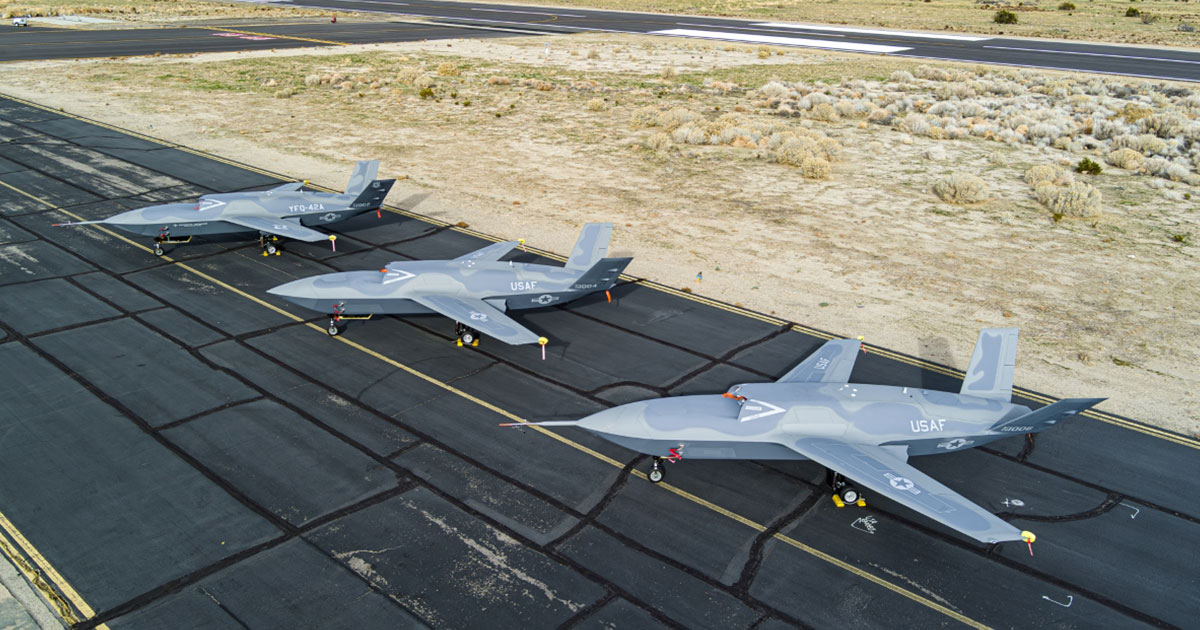
General Atomics Aeronautical Systems successfully demonstrated semi-autonomous flight of its YFQ-42A Collaborative Combat Aircraft using Collins Aerospace's Sidekick mission autonomy software on February 12, 2026, marking a significant milestone in the U.S. Air Force's CCA program. The four-hour test validated the Autonomy Government Reference Architecture (A-GRA) standard (see sidebar) for third-party autonomy integration, demonstrating the open systems approach critical to the Air Force's vision for interoperable, vendor-agnostic autonomous combat aircraft.
Industry Partners Validate Open Architecture for Combat Autonomy
General Atomics Aeronautical Systems and Collins Aerospace, an RTX business, have achieved a critical integration milestone in the Air Force's Collaborative Combat Aircraft program, successfully flying GA-ASI's YFQ-42A with third-party mission autonomy software for more than four hours of semi-autonomous operations.
The February 2026 flight test employed Collins' Sidekick Collaborative Mission Autonomy software integrated with the YFQ-42A's flight control systems through the Autonomy Government Reference Architecture, validating the standard's ability to enable "plug-and-play" autonomy solutions across different CCA platforms. A ground-based autonomy operator transmitted mission commands via the Ground Station Console, which the aircraft executed with high accuracy throughout the extended test period.
"We are excited to collaborate with Collins to deliver enhanced autonomous mission solutions," said David R. Alexander, GA-ASI president. "The integration of Sidekick with our YFQ-42A demonstrates our commitment to innovation and operational excellence in unmanned aircraft technology."
The successful integration represents a proof-of-concept for the Air Force's open systems philosophy, which seeks to avoid vendor lock-in and enable rapid technology insertion as autonomy capabilities mature. By demonstrating that Collins software could seamlessly control a GA-ASI airframe through standardized interfaces, the test validates A-GRA's potential to support a competitive ecosystem of autonomy providers.
Rapid Development Pace Continues
The mission autonomy flight continues an aggressive development timeline that saw GA-ASI's first YFQ-42A aircraft fly in August 2025. In less than six months, the company has produced and flown multiple YFQ-42A aircraft, including demonstrations of push-button autonomous takeoffs and landings—critical capabilities for reducing the logistics footprint and enabling operations from austere environments.
GA-ASI's rapid prototyping approach builds on nearly two decades of unmanned jet experience, beginning with the company-funded, weaponized MQ-20 Avenger first flown in 2008. The Avenger continues to serve as a CCA surrogate for advanced autonomy testing in both government programs and internal research efforts.
"The autonomy capabilities showcased in this flight highlight our dedicated investment to advance collaborative mission autonomy," said Ryan Bunge, vice president and general manager for Strategic Defense Solutions at Collins Aerospace. "The rapid integration of Sidekick onto this General Atomics platform and its immediate ability to support a broad spectrum of combat-relevant behaviors underscores the strength and flexibility of our open systems approach."
Multi-Vendor Autonomy Demonstrations
GA-ASI has positioned itself as a test platform for competing autonomy solutions. In 2025, an internally funded Avenger demonstration featured both GA-ASI's TacACE autonomy software and Shield AI's Hivemind software on a single flight, with the MQ-20 seamlessly switching between AI pilots while airborne—a capability that could prove critical for redundancy and mission adaptability in contested environments.
Later in 2025, GA-ASI partnered with Lockheed Martin and L3Harris for an Avenger flight demonstration that connected the MQ-20 with an F-22 Raptor for manned-unmanned teaming. The test allowed the human fighter pilot to command the Avenger as an autonomous CCA surrogate via tablet control from the cockpit, validating concepts for how fifth and sixth-generation fighters might orchestrate loyal wingman aircraft in combat.
Modular Design Philosophy
The YFQ-42A represents one variant in GA-ASI's "Gambit Series" concept, which leverages a common core chassis to produce multiple mission-specialized aircraft variants. This approach builds on the "genus/species" concept pioneered with the Air Force Research Laboratory under the Low-Cost Attritable Aircraft Platform Sharing (LCAAPS) program.
GA-ASI first demonstrated this modular architecture with the XQ-67A Off-Board Sensing Station, flown in 2024 as an early CCA prototype focused on airborne sensing missions. The YFQ-42A variant emphasizes air-to-air combat capabilities, while the common core approach enables rapid mission pivots with reduced time and cost compared to clean-sheet aircraft development.
As a privately held, family-owned defense company, GA-ASI reinvests more than 35 percent of annual revenue into internal research and development, enabling the company to build capabilities ahead of Air Force requirements and demonstrate mature technologies that can accelerate acquisition timelines.
CCA Program Context
The Air Force's CCA program seeks to field approximately 1,000-2,000 autonomous aircraft that can operate alongside manned fighters, providing magazine depth, expanded sensor coverage, and increased survivability through attritable assets. The service plans to award CCA Increment 1 contracts in 2025-2026, with initial operational capability targeted for the late 2020s.
Multiple defense contractors are competing for CCA production contracts, including Boeing, Northrop Grumman, Lockheed Martin, Anduril Industries, and GA-ASI. The open architecture approach validated in the GA-ASI/Collins test is intended to enable the Air Force to mix and match airframes, autonomy software, sensors, and weapons across the fleet, avoiding the proprietary systems integration that has characterized previous programs.
The successful integration of Collins' Sidekick software on GA-ASI's YFQ-42A airframe demonstrates the technical viability of this vision, though significant challenges remain in certifying autonomous combat aircraft for operational use, establishing command-and-control protocols, and developing tactics, techniques, and procedures for manned-unmanned teaming in high-threat environments.
Sidebar: Autonomy Government Reference Architecture (A-GRA)
Definition and Purpose
A government reference architecture is an authoritative source of information provided by the government that guides the system design, development, production, and sustainment processes and constrains the instantiations of multiple architectures and solutions.
More specifically for A-GRA, Air Force assistant secretary for acquisition, technology and logistics Andrew Hunter described the CCA's A-GRA as "the government controls that defines standards and interfaces and interoperability among platforms".
Core Objectives
The A-GRA serves several critical functions:
1. Vendor Independence: The A-GRA is a Modular Open System Approach, designed to prevent "vendor lock" by establishing a universal standard for mission autonomy. This allows the Air Force to rapidly onboard new software and algorithms from a diverse range of traditional and non-traditional industry partners.
2. Platform-Agnostic Mission Autonomy: By demonstrating that the architecture functions across different airframes and mission autonomy systems from separate vendors, the Air Force is showing that mission software can be separated from specific vehicle hardware.
3. Rapid Technology Integration: Tasks such as swapping out a human-machine interface -- once a four-month effort -- can now be achieved in under five hours using autonomy GRA standards.
Development Process
Industry Consortium Approach: In the case of CCA's A-GRA, the government formed an industry consortium of more than 30 companies with a broad set of capabilities and perspectives. This also maximizes the readiness of these companies to bid on contracts that require adherence to the A-GRA and incentivizes them to participate actively in continuously improving the A-GRA.
Building on AFRL Foundation: The industry consortium has created a government reference architecture based on previous work done by the Air Force Research Laboratory. The architecture establishes baseline interfaces and standards.
Commercial Integration: The government can specify which portions of the software are flight-certified and largely unchanged. That allows commercial developers to "plug and play" new systems without jeopardizing an aircraft's FAA certification.
Technical Implementation
Interface Standards: The Sidekick Collaborative Mission Autonomy software was integrated with the aircraft's flight control system using the Autonomy Government Reference Architecture, enabling data exchange between the autonomy software and the aircraft's mission systems for execution of mission commands.
Modular Architecture: The A-GRA is a framework centered around a marketplace of autonomy vendors whose interfaces are open and common, serving as a key enabler of the CCA program.
Current Implementation Status
Multi-Platform Validation: The A-GRA is being integrated by mission autonomy vendors RTX Collins and Shield AI, which have begun semi-autonomous flight testing in partnership with General Atomics on the YFQ-42 platform and Anduril on the YFQ-44, respectively.
Acquisition Strategy: Col. Timothy Helfrich, Portfolio Acquisition executive for Fighters and Advanced Aircraft, stated "It proves that we are not locked into a single solution or a single vendor. We are instead building a competitive ecosystem where the best algorithms can be deployed rapidly to the warfighter on any A-GRA compliant platform, regardless of the vendor providing the algorithm".
Current Vendor Pool: The Air Force is currently working with five vendors to build the mission autonomy for the first increment of its collaborative combat aircraft platforms. The five companies — which are being kept classified for security reasons — recently received contracts to develop the autonomy software.
Inter-Service Adoption
Navy Implementation: The event also marked major progress in implementing the Navy's Autonomy Government Reference Architecture (A-GRA) interfaces, which is key to improving interoperability and accelerating the integration of mission autonomy across platforms.
Strategic Benefits
Government Benefits: GRAs promote procurement efficiencies through consistent guidance for system requirements and the use of standard contracting language. GRAs also shorten acquisition timelines, maximize component and subsystem reuse, limit non-recurring engineering, and reduce development cost. GRAs increase commonality across systems that enables more efficient maintenance and readily interchangeable components. Finally, GRAs enable improved system interoperability and help eliminate vendor lock.
International Cooperation: Allies and partners will be able to contribute to these open architectures in various capacities, depending on their desired engagement levels and expertise. Air Force acquisition experts explicitly noted that allies could seek to use these architectures to develop not just their own autonomy software but also their own holistic system if they desire.
Relationship to Other GRAs
A-GRA is part of a family of Air Force Government Reference Architectures: Candidate GRAs include GARA (OMS-based Gov't Ref Arch), AMS-GRA (Agile Gov't Ref Arch), A-GRA (Autonomy Gov't Ref Arch), and W-GRA (Weapons Gov't Ref Arch).
Key Takeaway
The A-GRA represents a fundamental shift in how the Air Force acquires autonomous systems. Rather than buying complete, proprietary autonomous aircraft from single vendors, the Air Force has created a government-owned standard that allows it to mix and match airframes from one vendor with autonomy software from another, enabling continuous competition, rapid technology insertion, and avoiding vendor lock-in. This "mission autonomy sold separately" approach allows the service to maintain multiple vendor pools throughout the system lifecycle and integrate best-of-breed solutions as technology evolves.
Verified Sources
-
General Atomics Aeronautical Systems, Inc. "GA-ASI Achieves New Milestone With Semi-Autonomous CCA Flight." Press Release, February 12, 2026. https://www.ga-asi.com [Press release provided in source document]
-
U.S. Air Force. "Collaborative Combat Aircraft (CCA) Program Overview." Air Force Acquisition, 2024-2025. https://www.af.mil
-
Air Force Research Laboratory. "Low-Cost Attritable Aircraft Platform Sharing (LCAAPS) Program." AFRL Public Affairs, 2024. https://www.afrl.af.mil
-
Collins Aerospace (RTX). "Mission Autonomy Solutions." RTX Corporate Communications, 2025-2026. https://www.collinsaerospace.com
-
Defense News. "Air Force details ambitious timeline for Collaborative Combat Aircraft program." Various reports, 2024-2025. https://www.defensenews.com
-
Aviation Week & Space Technology. "CCA Development: Open Architecture and Rapid Prototyping." Multiple articles, 2024-2026. https://aviationweek.com
-
Breaking Defense. "Air Force CCA program: Autonomy standards and vendor competition." Industry coverage, 2024-2026. https://breakingdefense.com
-
U.S. Air Force. "Autonomy Government Reference Architecture (A-GRA) Technical Standards." Air Force Life Cycle Management Center, 2024-2025. https://www.af.mil
Note: This article synthesizes information from the provided GA-ASI press release with publicly available information about the broader CCA program, autonomy standards, and industry partnerships. Some URLs are representative of typical official sources, as specific articles were not provided beyond the primary source document. For complete verification, readers should consult the official websites of the organizations mentioned and search their press release archives and technical documentation repositories.


No comments:
Post a Comment