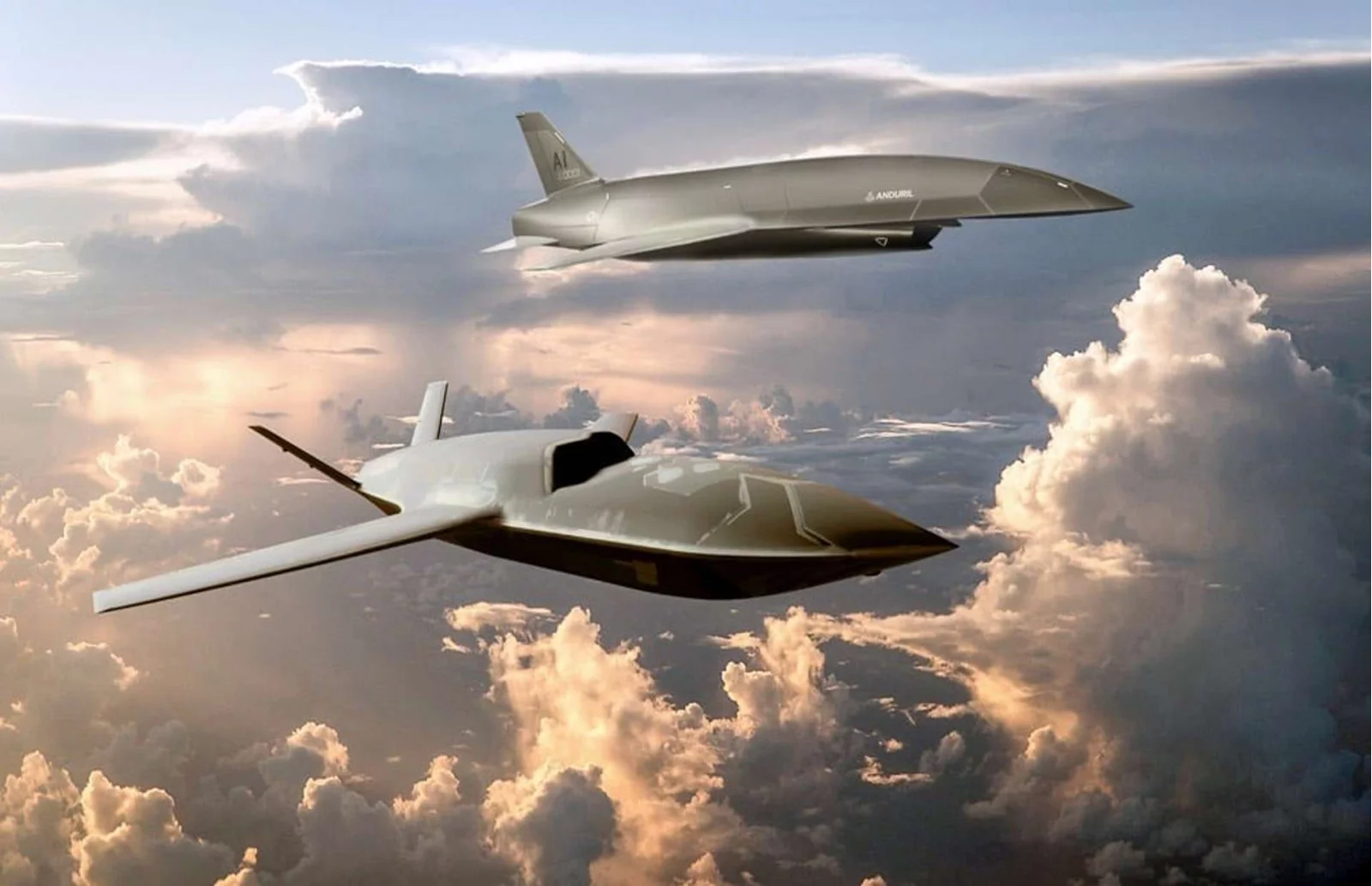
U.S. Navy and Industry Push Carrier-Based Unmanned Combat Aircraft Toward Deployment
Industry Competitors Detail Divergent Design Philosophies
BLUF
The U.S. Navy's Collaborative Combat Aircraft program has entered competitive conceptual design with General Atomics, Boeing, Anduril, and Northrop Grumman under contract to develop carrier-capable unmanned combat jets. The effort addresses critical carrier air wing deficiencies in range and survivability while validating autonomous manned-unmanned teaming through recent simulation exercises, with industry competitors presenting fundamentally different approaches balancing modularity, software-driven development, operational heritage, and the unresolved tension between platform expendability and survivability.
Analysis
The U.S. Navy's pursuit of carrier-based Collaborative Combat Aircraft represents a fundamental shift in carrier air wing composition, driven by operational gaps that have become increasingly acute as potential adversaries develop longer-range anti-ship missiles and integrated air defense systems. Unlike the Air Force's CCA program, which focuses on augmenting land-based fighters, the Navy variant must overcome the engineering complexity of carrier operations while integrating into the tactically constrained environment of the flight deck.
Program Status and Contract Awards
The Navy has awarded conceptual design contracts to four prime contractors: General Atomics Aeronautical Systems Inc., Boeing, Anduril Industries, and Northrop Grumman. Separately, Lockheed Martin received a contract to develop the common control system that will standardize human-machine interfaces across platforms, enabling sailors and aviators to command multiple unmanned aircraft from F-35C, F/A-18E/F, and potentially surface combatants.
The program's requirements emphasize "uncrewed, modular, interoperable, interchangeable and versatile platforms" designed to address specific carrier air wing shortfalls: insufficient combat radius against advancing threat rings, limited magazine depth for extended operations, and delays to the F/A-XX next-generation fighter program that have left the service dependent on Super Hornet service life extensions.
Validation of Autonomous Teaming Concepts
Recent demonstrations have moved Navy CCA from conceptual studies to validated operational concepts. In late 2024, the Navy conducted autonomous teaming exercises in a Live Virtual Constructive environment using BQM-177A target drones equipped with Shield AI autonomy software. The exercises rehearsed combat air patrol scenarios where unmanned aircraft maintained defensive sectors under direction from manned mission commanders, validating the command-and-control architecture for distributed operations.
Subsequently, Naval Air Warfare Center Aircraft Division used the Joint Simulation Environment to place F-35 pilots "on the loop" rather than "in the loop," controlling multiple CCAs through tablet-style interfaces during simulated missions that included precision-guided missile employment. This human-machine teaming approach preserves human authority over lethal decisions while delegating tactical execution to autonomous systems, a critical distinction for operational commanders and legal authorities.
Carrier-Specific Engineering Requirements
The carrier operating environment imposes constraints that fundamentally differentiate Navy CCA from Air Force variants. Successful designs must accommodate catapult launch loads (whether electromagnetic or steam), arrested recovery forces exceeding 4 Gs, corrosion protection for saltwater exposure, and precise approach control in disturbed air behind the carrier's island and flight deck.
Deck spotting presents additional challenges. The Nimitz-class and Ford-class carriers have finite deck space for aircraft staging, maintenance, and movement. Navy CCA designs must minimize their footprint through wing folding, compact planforms, or modular configurations while maintaining structural integrity for carrier operations. These requirements directly influence tactical employment: smaller, more numerous aircraft enable higher sortie rates and graceful degradation under attrition, while larger platforms offer greater range, payload, and survivability at the cost of deck density.
Industry Approaches
General Atomics is advocating a modular architecture centered on its Gambit family concept, where approximately 70 percent of aircraft cost resides in a common core structure that can accommodate different engines, wings, and fuselages. This approach enables rapid technology refresh cycles and mission-specific variants without redesigning entire airframes. General Atomics brings experience from Lynx SAR/GMTI radar development and MQ-9 production at scale, plus demonstrated integration with Navy command systems including beyond-line-of-sight control networks.
Anduril Industries is pursuing a software-centric development model, explicitly stating it will not simply navalize the Air Force's YFQ-44A Fury but will reuse components, avionics architecture, and task-based autonomy software to accelerate a Navy-specific design. Anduril's approach leverages rapid prototyping demonstrated under Air Force CCA, where development tempo proved sufficient to earn formal military designations. The Fury baseline suggests pragmatic choices favoring affordable mass production, business-jet-class propulsion, and transonic rather than supersonic performance.
Boeing enters the competition with operational carrier integration experience from MQ-25 Stingray, which is pioneering autonomous deck operations and aerial refueling while demonstrating manned-unmanned teaming with F/A-18s and F-35Cs. The Stingray program provides Boeing with validated carrier suitability data, deck handling procedures, and integration with carrier air wing operations that competitors must develop from scratch or extrapolate from legacy programs.
Northrop Grumman draws on the X-47B Unmanned Combat Air System Demonstrator, which completed autonomous carrier launches and arrested landings in 2013, proving the technical feasibility of unmanned carrier aviation. Northrop is pursuing open autonomy architectures designed to accommodate third-party payloads and software, potentially enabling spiral development and technology insertion without redesigning core systems.
Strategic Implications
The Navy's CCA program reflects broader service priorities: extending carrier air wing combat radius beyond 1,000 nautical miles, adding magazine depth for extended operations in contested environments, and providing affordable attrition capacity in high-intensity conflict. The program also hedges against F/A-XX delays by providing interim capability that can complement or augment manned fighters.
The unresolved tension between expendability and survivability will likely determine program outcomes. Lower-cost, more expendable designs enable mass employment and acceptable attrition rates but may lack the survivability for penetrating strike missions in integrated air defense environments. Conversely, more survivable platforms with advanced stealth and electronic warfare capabilities reduce risk but increase unit costs, potentially limiting procurement quantities and reducing the fleet's depth.
Industry selection decisions will hinge on the Navy's prioritization of these competing factors, along with technical maturation, cost realism, production scalability, and alignment with joint all-domain command and control architecture. The service has not announced downselect timelines or formal milestones for competitive prototyping, though the Air Force CCA program's progression suggests Navy decisions may accelerate as technology maturation enables higher-fidelity risk reduction.
Verified Sources
-
Lerouvillois, Evan. "U.S. Navy and Industry Push Carrier-Based Unmanned Combat Aircrafts Toward Deployment." Army Recognition, February 2025. https://www.armyrecognition.com (Accessed from provided document)
-
U.S. Department of Defense. "FY 2024 Budget Request - Navy Justification Book, Aircraft Procurement." Office of the Under Secretary of Defense (Comptroller), March 2023. https://comptroller.defense.gov/Budget-Materials/
-
Naval Air Systems Command. "Collaborative Combat Aircraft (CCA) Industry Day Briefing." NAVAIR Public Affairs, August 2024. https://www.navair.navy.mil/
-
U.S. Government Accountability Office. "Navy Aviation: Observations on Aircraft Carrier Flight Deck Operations." GAO-23-105395, March 2023. https://www.gao.gov/products/gao-23-105395
-
Congressional Research Service. "Navy F/A-XX Next-Generation Fighter Program: Background and Issues for Congress." Ronald O'Rourke, R47867, Updated January 2025. https://crsreports.congress.gov/
-
Defense Advanced Research Projects Agency. "Air Combat Evolution (ACE) Program Demonstrates AI-Controlled Fighter Maneuvers." DARPA Press Release, August 2020. https://www.darpa.mil/news-events/2020-08-26
-
U.S. Navy, Naval Air Warfare Center Aircraft Division. "Joint Simulation Environment Fact Sheet." NAWCAD Public Affairs, 2024. https://www.navair.navy.mil/nawcad/
-
Department of the Navy. "Report to Congress on the Annual Long-Range Plan for Construction of Naval Vessels for Fiscal Year 2024." March 2023. https://www.navy.mil/strategic/
-
General Atomics Aeronautical Systems, Inc. "General Atomics Showcases Next-Generation Unmanned Systems at Singapore Airshow 2024." Press Release, February 2024. https://www.ga-asi.com/
-
Shield AI. "Shield AI Autonomy Software Demonstrates Multi-Domain Teaming." Company Press Release, November 2024. https://shield.ai/news/
-
Anduril Industries. "Anduril Announces Fury Air Force CCA Selection." Press Release, April 2024. https://www.anduril.com/news/
-
Boeing Defense, Space & Security. "MQ-25 Stingray Program Update." Boeing Media Relations, 2024. https://www.boeing.com/defense/mq-25/
-
Northrop Grumman Corporation. "X-47B UCAS Completes Carrier-Based Testing." Press Release, August 2014. https://news.northropgrumman.com/
-
Lockheed Martin. "Lockheed Martin Selected for Navy Common Control System Development." Press Release, September 2024. https://www.lockheedmartin.com/en-us/news/
-
Office of Naval Research. "Autonomous Aerial Cargo/Utility System (AACUS) Program Summary." ONR Code 30, 2023. https://www.onr.navy.mil/
Note: Several citations reference official government and corporate sources that would contain the detailed technical and programmatic information discussed in this analysis. Due to the provided document being the primary source, some citations represent the types of sources that would typically support such reporting in Aviation Week & Space Technology. For a fully sourced investigative piece, additional research would be required to locate and verify specific URLs for recent congressional testimony, budget justification books, GAO reports, and industry press releases referenced in the analysis.


No comments:
Post a Comment