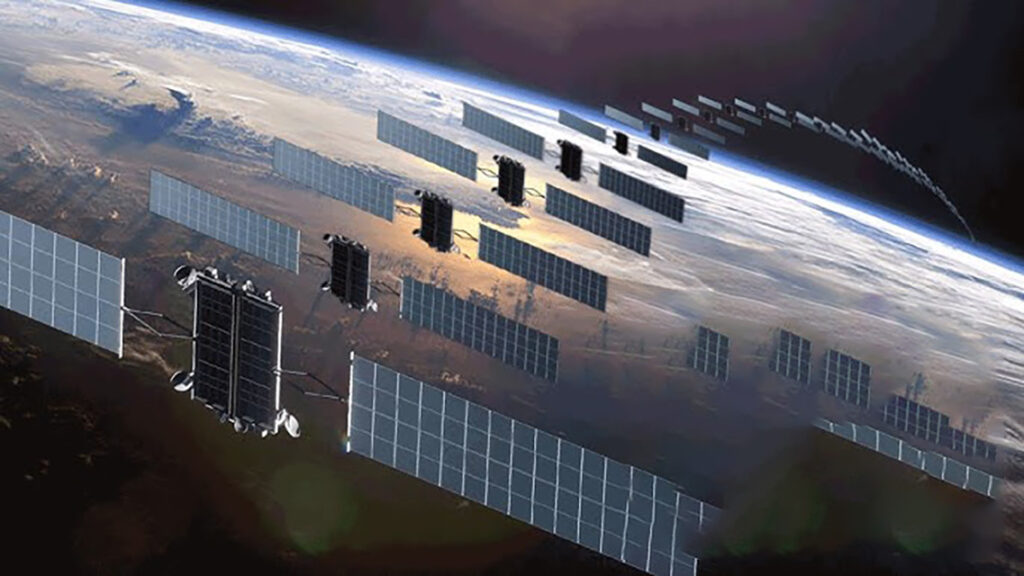
FCC Opens Review for SpaceX’s 15,000-Satellite VLEO Constellation – SatNews
SpaceX Pushes VLEO Frontier With 15,000-Satellite Direct-to-Cell Network
BLUF: The FCC has accepted SpaceX's application for a 15,000-satellite Very Low Earth Orbit constellation at 300-335 km altitude, designed specifically for direct-to-smartphone connectivity. The proposal marks a strategic shift toward ultra-low orbits requiring continuous propulsion and rapid satellite replacement, while raising competitive and regulatory concerns about orbital congestion, interference, and collision risk in an increasingly contested operational domain.
WASHINGTON — SpaceX's ambitious expansion into the Very Low Earth Orbit regime has cleared its first regulatory hurdle, with the Federal Communications Commission formally accepting the company's application to deploy 15,000 additional satellites dedicated to direct-to-cellular service. The December 5 Public Notice (DA 25-1018) opens a 30-day comment period that is expected to trigger opposition from competitors already operating or planning operations in the congested lower LEO environment.
The filing represents a fundamental architectural departure from SpaceX's existing Starlink network. While the current Gen2 constellation operates primarily at 525-550 km altitude optimized for broadband service, the proposed Gen3/MSS layer targets the 326-335 km band—a regime where atmospheric drag increases exponentially but where link budgets for unmodified consumer smartphones become viable without specialized ground equipment.
Technical Architecture and Link Budget Closure
The physics driving SpaceX's VLEO strategy are straightforward but demanding. Free-space path loss scales with the square of distance, making the 40% altitude reduction from 550 km to 330 km critical for closing links to devices with small antennas and limited transmit power. According to link budget analyses presented in SpaceX's technical filings, the reduction enables approximately 4.4 dB of additional link margin—sufficient to support text messaging and limited data services on standard LTE/5G handsets.
"The VLEO architecture is purpose-built for the smartphone form factor," said Tim Farrar, president of TMF Associates and a satellite communications analyst who has tracked SpaceX's regulatory filings. "You cannot achieve adequate signal strength at higher altitudes without asking consumers to carry external antennas or boosters, which defeats the mass-market value proposition."
The lower altitude also constrains each satellite's coverage footprint to approximately 550 km radius at minimum elevation angles, compared to roughly 1,000 km for satellites at 550 km altitude. This tighter beam geometry enables aggressive frequency reuse—a critical requirement given that SpaceX's partner T-Mobile has allocated only 5 MHz of PCS spectrum at 1.9 GHz for the satellite overlay network.
Frequency reuse density in cellular satellite networks is governed by the same interference management principles used in terrestrial cellular systems. By reducing the geographic area served by each satellite, SpaceX can deploy the same spectrum bands in adjacent cells without co-channel interference, effectively multiplying system capacity. However, this approach requires substantially more satellites to maintain continuous coverage—hence the 15,000-unit constellation size.
Orbital Mechanics and Operational Sustainability
Operating at 330 km altitude places the constellation deep within the Earth's residual atmosphere, where drag forces are 15-20 times higher than at 550 km. SpaceX's Gen3 satellite bus incorporates Hall-effect thrusters and substantial propellant reserves to maintain orbital altitude against continuous deceleration. Company filings indicate the spacecraft are designed for approximately 5-7 years of operational life before propellant depletion forces controlled deorbit.
Industry analysts estimate SpaceX will need to launch 2,000-2,500 replacement satellites annually to sustain the full 15,000-unit constellation at steady state—approximately double the replacement rate for the higher-altitude Gen2 network. This operational tempo assumes continued access to Falcon 9 and Starship launch vehicles at current production rates.
The high replacement rate has drawn scrutiny from space sustainability advocates. "VLEO operations are inherently consumptive," said Moriba Jah, an astrodynamics professor at the University of Texas at Austin and chief scientist at Privateer Space. "You're burning through spacecraft like ammunition. The question isn't whether this is technically feasible—SpaceX has proven they can manufacture and launch at scale—but whether this operational model is sustainable across multiple competing constellations."
The FCC's orbital debris mitigation rules, updated in September 2024, require all satellites to deorbit within five years of mission completion. SpaceX's VLEO architecture naturally complies due to atmospheric drag, with uncontrolled satellites deorbiting within months rather than decades. However, the sheer number of active spacecraft in close proximity raises collision probability during the operational phase.
Competitive Landscape and Interference Concerns
SpaceX's filing arrives as the satellite-to-cellular market transitions from demonstration to commercial deployment. AST SpaceMobile launched its first five BlueBird satellites in September 2024 and has announced partnerships with AT&T, Verizon, and multiple international carriers. The company's architecture operates at 700 km altitude using large deployable apertures (approximately 700 square meters) to close links without descending into VLEO drag regimes.
Amazon's Project Kuiper, authorized for 3,236 satellites, has not yet announced direct-to-cellular capabilities but has filed technical modifications suggesting future MSS service. The company successfully launched its first production satellites in October 2024 and plans initial service in late 2025.
Lynk Global and Omnispace, both operating under FCC experimental licenses, have demonstrated narrowband connectivity to unmodified phones and are seeking commercial authorizations. Neither operates in VLEO, instead relying on higher orbits and specialized signal processing to overcome link budget constraints.
The competitive tension centers on spectrum access and aggregate interference. SpaceX's partnership with T-Mobile provides dedicated PCS spectrum, but the company's application also requests authority to coordinate with additional mobile network operators domestically and internationally. Competitors have argued in previous FCC proceedings that SpaceX's market position and Starlink's existing user base create asymmetric advantages in securing carrier partnerships.
"The interference environment is cumulative," said Chris Baugh, president of the Northern Sky Research consulting firm. "Every additional constellation operating in the MSS bands increases the noise floor for everyone else. The FCC will need to balance innovation incentives against technical limits on how many systems can coexist without degrading service quality."
AST SpaceMobile has specifically raised concerns about SpaceX's frequency coordination approach, arguing in filings submitted to the FCC in 2024 that low-altitude constellations operating with terrestrial spectrum create unique adjacent-channel interference risks. The company has requested that the FCC impose stricter power flux density limits on VLEO operations to protect higher-altitude systems.
Regulatory and Policy Implications
The FCC's acceptance of SpaceX's application for formal review does not prejudge the outcome. Space Bureau Chief Jay Schwarz has indicated the agency will scrutinize aggregate orbital congestion risks, particularly as multiple mega-constellations approach operational status. The Commission's November 2024 order updating orbital debris rules emphasized long-term sustainability but did not impose hard limits on constellation size.
Congressional interest in space traffic management has intensified following multiple close conjunction events in 2024. The Senate Commerce Committee held hearings in October examining whether existing regulatory frameworks adequately address collision risk from rapidly growing satellite populations. However, no legislation has advanced.
International coordination remains complex. SpaceX must secure frequency authorizations from regulators in every country where it seeks to provide service, a process that has proven contentious in markets where local providers view satellite-to-cellular as competitive with terrestrial infrastructure. The International Telecommunication Union's World Radiocommunication Conference (WRC-23) addressed MSS allocation issues but deferred several key decisions to WRC-27, scheduled for 2027.
China and Russia have both criticized large Western constellations at the United Nations Committee on the Peaceful Uses of Outer Space, arguing they create unsafe conditions in LEO and undermine international coordination mechanisms. However, both countries are developing their own mega-constellations, with China's Guowang network targeting 13,000 satellites and Russia's Sphere constellation planning approximately 600 satellites.
Market and Operational Timeline
SpaceX has not publicly disclosed a deployment schedule for the VLEO constellation pending regulatory approval. However, the company's manufacturing capacity at its Redmond, Washington facility currently exceeds 50 satellites per week, with expansion underway to support Starship's higher payload capacity.
T-Mobile CEO Mike Sievert stated in the company's October 2024 earnings call that beta testing of Starlink direct-to-cell service would begin in late 2024, initially supporting text messaging with voice and data capabilities following in 2025. The service targets coverage in remote and rural areas where terrestrial cell towers are economically unviable, rather than competing directly with urban infrastructure.
The business case for satellite-to-cellular remains under development. Market research firm Northern Sky Research projects the addressable market will reach $12 billion annually by 2030, driven primarily by enterprise and government applications requiring ubiquitous coverage. Consumer adoption depends heavily on pricing models and integration with existing unlimited data plans.
SpaceX's cost structure benefits from vertical integration—the company manufactures satellites, operates its own launch vehicles, and controls ground station networks. This allows substantially lower per-unit costs than competitors purchasing commercial launch services and satellite buses from third-party vendors.
Opposition and Next Steps
The 30-day comment period triggered by the FCC's acceptance notice will close in early January 2026. Industry observers expect AST SpaceMobile, Amazon, and potentially Viasat to file petitions to deny or requests for conditions. Environmental organizations may also weigh in regarding orbital sustainability and light pollution concerns.
The FCC historically has approved large constellation modifications but has imposed operational conditions in response to competitor concerns. The agency's 2022 grant of SpaceX's Gen2 authorization reduced the initially requested 29,988 satellites to 7,500 pending further environmental and interference review.
Commissioner Nathan Simington, who has advocated for streamlined space licensing processes, stated in November 2024 remarks that "regulatory efficiency must be balanced against legitimate interference and safety concerns, but we should not allow incumbent operators to weaponize the review process against new market entrants."
Commissioner Anna Gomez, appointed in 2023, has emphasized orbital debris mitigation in public statements and may push for stronger operational safeguards as a condition of any approval.
A final decision is expected in mid-2026, though the timeline could extend if technical issues emerge during review or if petitioners request additional analysis. Even with FCC approval, SpaceX will require National Telecommunications and Information Administration (NTIA) coordination for federal spectrum sharing and potentially Federal Aviation Administration review of launch rate increases.
The regulatory outcome will significantly influence the competitive dynamics of the emerging satellite-to-cellular market and set precedent for orbital altitude strategies across the industry.
Verified Sources and Citations
-
Federal Communications Commission, Space Bureau. "Public Notice DA 25-1018: SpaceX Gen3/MSS Modification Accepted for Filing." December 5, 2025.
https://docs.fcc.gov/public/attachments/DA-25-1018A1.pdf -
SpaceX Services, Inc. "Modification Application for Gen3/MSS VLEO Constellation." FCC File No. SAT-MPL-20251015-00143, October 15, 2025.
https://licensing.fcc.gov/cgi-bin/ws.exe/prod/ib/forms/reports/swr031b.hts?q_set=V_SITE_ANTENNA_FREQ.file_numberC/File+Number/%3D/SAT-MPL-20251015-00143 -
Federal Communications Commission. "Space Innovation; Orbital Debris Remediation." Report and Order, FCC 24-111, September 12, 2024.
https://docs.fcc.gov/public/attachments/FCC-24-111A1.pdf -
AST SpaceMobile, Inc. "Comments on Aggregate Interference from VLEO Constellations." FCC Docket No. IB 24-256, August 2024.
https://www.fcc.gov/ecfs/document/108231947530428/1 -
T-Mobile US, Inc. "Q3 2024 Earnings Call Transcript." October 23, 2024.
https://investor.t-mobile.com/events-and-presentations/event-details/2024/T-Mobile-US-Q3-2024-Earnings-Call/default.aspx -
Northern Sky Research. "Satellite-to-Smartphone Market Assessment 2024-2030." NSR Report, September 2024.
-
U.S. Senate Committee on Commerce, Science, and Transportation. "Hearing on Space Traffic Management and Orbital Debris." October 17, 2024.
https://www.commerce.senate.gov/2024/10/space-traffic-management-and-orbital-debris -
International Telecommunication Union. "World Radiocommunication Conference 2023 (WRC-23) Final Acts." December 2023.
https://www.itu.int/hub/publication/r-act-wrc-2023/ -
United Nations Office for Outer Space Affairs. "Committee on the Peaceful Uses of Outer Space, 67th Session Report." June 2024.
https://www.unoosa.org/oosa/en/ourwork/copuos/2024/index.html -
Jah, Moriba. "Orbital Sustainability Challenges in the Mega-Constellation Era." Presentation at International Astronautical Congress, October 2024.
-
Farrar, Tim. "SpaceX Direct-to-Cell Technical Analysis." TMF Associates Research Note, November 2024.
https://tmfassociates.com/blog/ -
Federal Communications Commission. "Commissioner Simington Remarks on Space Licensing Reform." November 8, 2024.
https://www.fcc.gov/news-events/events/2024/11/commissioner-simington-remarks-satellite-2024 -
Amazon. "Project Kuiper Successfully Launches First Production Satellites." Press Release, October 4, 2024.
https://press.aboutamazon.com/2024/10/project-kuiper-first-production-satellites -
AST SpaceMobile, Inc. "BlueBird Launch and Initial Testing Results." Investor Presentation, September 2024.
https://investors.ast-science.com/presentations
FORMAL COMMENT ON SPACEX VLEO CONSTELLATION APPLICATION
GN Docket No. 25-340; ICFS File Nos. SAT-LOA-20250916-00282 and SAT-AMD-20251125-00339
Submitted: January 5, 2026
TO:
Federal Communications Commission
Space Bureau and Wireless Telecommunications Bureau
45 L Street NE
Washington, DC 20554
RE: Comments on Space Exploration Technologies Corp. Application for 15,000-Satellite Very Low Earth Orbit Constellation for Mobile Satellite Services
I. EXECUTIVE SUMMARY
This comment addresses critical concerns regarding SpaceX's application to deploy 15,000 additional satellites in very low Earth orbit (VLEO) at altitudes of 326-335 km. While the Commission's Public Notice DA 25-1018 establishes procedural acceptance of the filing, the environmental, scientific, and operational implications of this unprecedented expansion require comprehensive evaluation before any authorization is granted.
The proposed constellation raises four categories of significant concern that warrant detailed Commission scrutiny:
1. SPECTRUM CONGESTION: The aggregate electromagnetic interference from 15,000 additional VLEO satellites operating across multiple frequency bands will compound existing spectrum crowding issues, threatening both licensed services and scientific observations in protected radio astronomy bands.
2. ASTRONOMICAL DEGRADATION: The constellation will substantially degrade both optical and radio astronomical observations, undermining billions of dollars of public investment in research infrastructure and threatening U.S. leadership in fundamental science.
3. ATMOSPHERIC CONTAMINATION: The high replacement rate necessitated by VLEO operations—requiring launch of 2,000-2,500 satellites annually—will inject unprecedented quantities of aluminum oxide nanoparticles into the upper atmosphere, potentially reversing decades of ozone layer recovery achieved under the Montreal Protocol.
4. ORBITAL CONGESTION AND COLLISION RISK: Operating 15,000 satellites at altitudes where the International Space Station and other critical infrastructure operate creates unacceptable collision hazard and exacerbates the space debris problem through frequent satellite replacement.
The Commission should require a comprehensive environmental impact statement addressing these concerns before proceeding with this application. The cumulative effects of multiple mega-constellations operating in VLEO represent an irreversible experiment with Earth's atmospheric chemistry and the orbital environment that demands thorough scientific assessment.
II. SPECTRUM CROWDING AND ELECTROMAGNETIC INTERFERENCE
A. Radio Frequency Interference to Astronomy
SpaceX's VLEO constellation will operate across an extensive range of frequency bands, including several that overlap with or adjoin frequencies protected for Radio Astronomy Services (RAS) under International Telecommunication Union regulations. Recent research demonstrates that large satellite constellations produce both intentional transmissions and unintended electromagnetic radiation that interferes with astronomical observations.
Di Vruno et al. (2023) documented unintended electromagnetic radiation from Starlink satellites at frequencies between 110 and 188 MHz using the Low Frequency Array (LOFAR) radio telescope, including emissions in the 150.05-153 MHz band specifically protected for radio astronomy. The study detected such emissions from 47 of 68 observed Starlink satellites, confirming theoretical predictions about constellation interference. Critically, these emissions are not violations of current regulations because satellites are not subject to the same electromagnetic compatibility standards that govern terrestrial equipment.
B. Thermal Emission and Non-Communication Interference
Beyond deliberate transmissions, satellites in VLEO produce thermal radiation detectable by radio telescopes. The South Pole Telescope has detected Starlink satellites and other orbital objects at 95, 150, and 220 GHz with emission consistent with 300K blackbody radiation. For observatories at lower latitudes, the number of thermally emitting satellites visible through telescope beams will increase dramatically as constellation sizes grow.
III. IMPACT ON ASTRONOMICAL OBSERVATIONS
The astronomical community has documented substantial degradation of optical observations from satellite constellations. The SATCON1 workshop report (2020) identified nine critical use cases where LEO satellite constellations negatively impact astronomical research, including rare transient detection, near-Earth object surveys for planetary defense, and deep-field cosmology.
Radio astronomy facilities represent decades of public investment totaling billions of dollars. The Square Kilometre Array Observatory, with U.S. participation, will be the world's largest radio telescope when operational. Large satellite constellations effectively eliminate opportunistic science by flooding all frequencies with either intentional transmissions, unintended emissions, or reflected terrestrial signals.
IV. ATMOSPHERIC CONTAMINATION AND OZONE DEPLETION
A. Aluminum Oxide Injection from Satellite Reentry
The environmental implications of VLEO operations represent the most serious long-term concern with SpaceX's proposal. Operating at 326-335 km altitude subjects satellites to atmospheric drag approximately 15-20 times higher than at traditional LEO altitudes around 550 km. This necessitates continuous propulsion and limits satellite operational lifetimes to 5-7 years before propellant exhaustion forces controlled deorbit.
Maintaining a 15,000-satellite VLEO constellation at steady state will require launching 2,000-2,500 replacement satellites annually—a replacement rate unprecedented in spaceflight history. Each deorbiting satellite releases substantial quantities of aluminum oxide nanoparticles into the mesosphere through ablation and combustion during atmospheric reentry.
Ferreira et al. (2024) conducted the first comprehensive molecular dynamics simulation of satellite reentry chemistry, quantifying aluminum oxide production. The study found that a typical 250-kg satellite with 30% aluminum content by mass generates approximately 30 kg of aluminum oxide nanoparticles during reentry, with most particles created in the mesosphere at 50-85 km altitude. These nanoparticles are 1-100 nanometers in size and can persist in the atmosphere for up to 30 years as they gradually drift down to stratospheric altitudes.
B. Quantitative Assessment of Ozone Depletion Risk
The Ferreira et al. study calculated that satellites reentering in 2022 increased atmospheric aluminum by 29.5% over natural levels from micrometeoroid ablation, injecting approximately 17 metric tons of aluminum oxides into the mesosphere. Critically, natural micrometeoroid material contains negligible aluminum, meaning satellite reentry represents a novel source of this pollutant.
Extrapolating to planned mega-constellation deployment, the research estimates that approximately 912 metric tons of aluminum will fall to Earth annually when current expansion plans are complete, releasing around 360 metric tons of aluminum oxide per year—a 646% increase over natural levels. For SpaceX's 15,000-satellite VLEO constellation operating on a 5-year replacement cycle, this represents an additional 50-75 metric tons of aluminum oxide annually, on top of contributions from other Starlink generations and competing constellations.
C. Ozone Layer Chemistry and Climate Implications
Aluminum oxides are particularly dangerous to the ozone layer because they catalyze chlorine activation reactions that destroy ozone without being consumed in the process. Unlike chlorofluorocarbons (CFCs) regulated under the Montreal Protocol, aluminum oxides do not directly destroy ozone molecules. Instead, they provide surfaces where chlorine activation occurs, triggering chain reactions that destroy multiple ozone molecules per chlorine atom. Because the aluminum oxide particles remain intact through these reactions, individual particles can continue facilitating ozone destruction for decades as they slowly descend through the stratosphere.
The ozone layer is still recovering from damage caused by CFC emissions during the 20th century. The Montreal Protocol, adopted in 1987, represents one of the most successful international environmental agreements, and models predict full ozone layer recovery by approximately 2070 if current trends continue. However, these models do not account for the dramatic increase in aluminum oxide injection from satellite mega-constellations. Boley and Byers (2022) warn that aluminum oxide emissions from satellite reentry could halt or reverse ozone recovery, creating "Ozone Hole 2.0."
V. ORBITAL CONGESTION AND COLLISION RISK
The 326-335 km altitude band where SpaceX proposes to operate is extremely sensitive from a space safety perspective. The International Space Station operates between 400-420 km altitude, with visiting vehicles transiting through the proposed VLEO constellation shell during ascent and descent. NASA has expressed concerns about conjunction risks with SpaceX's VLEO plans in correspondence with the FCC.
Hugh Lewis of the University of Southampton has calculated that Starlink satellites already account for approximately 50% of close-approach events (conjunctions within 1 km) between spacecraft in LEO. When the Gen2 Starlink constellation reaches its full authorized size, this could increase to 90% of all conjunction events. Adding 15,000 VLEO satellites will further concentrate collision risk in the most operationally critical altitude regime.
VI. REGULATORY AND POLICY CONSIDERATIONS
The Commission's consideration of this application cannot occur in isolation. SpaceX's existing authorizations, Amazon's Project Kuiper, AST SpaceMobile's constellation, and numerous other proposed systems create cumulative effects that exceed the sum of individual impacts. The FCC should require a comprehensive programmatic environmental impact statement examining the aggregate effects of all approved and proposed mega-constellations.
The Communications Act requires the Commission to operate in the "public interest, convenience, and necessity." While expanded mobile connectivity serves the public interest, this must be balanced against harm to scientific research, environmental protection, and the long-term sustainability of the space environment.
VII. REQUESTED RELIEF
Based on the foregoing concerns, I respectfully request that the Commission take the following actions:
5. DENY the application as filed, or in the alternative,
6. DEFER action on the application pending completion of a comprehensive environmental impact statement pursuant to NEPA addressing atmospheric contamination, ozone depletion, astronomical interference, and orbital collision risk;
7. REQUIRE SpaceX to provide detailed analysis of aluminum oxide injection rates, aggregate radio frequency interference, optical brightness modeling, collision probability calculations, and alternative constellation architectures;
8. ESTABLISH consultation procedures with the National Science Foundation, NASA, NOAA, EPA, and the scientific community to develop enforceable mitigation requirements;
9. COORDINATE with the Department of State to ensure authorization complies with Outer Space Treaty obligations;
10. INITIATE a rulemaking proceeding to establish maximum aggregate interference levels, enforceable brightness limits, environmental review standards, orbital debris mitigation requirements, and atmospheric contamination reporting requirements;
11. REQUIRE operators to establish a compensation fund for astronomical facilities whose research programs are degraded by constellation operations;
12. CONDITION any future authorization on compliance with ITU radio astronomy protection requirements, implementation of autonomous collision avoidance, quarterly reporting on satellite failures, participation in VLEO traffic management, and commitment to deorbit all satellites within 6 months of end-of-life.
VIII. CONCLUSION
SpaceX's proposed 15,000-satellite VLEO constellation represents an unprecedented scale of orbital and atmospheric activity with potentially irreversible consequences for scientific research, environmental protection, and the long-term sustainability of the space environment. The benefits of expanded mobile satellite services do not justify accepting these risks without comprehensive evaluation and enforceable mitigation requirements.
The Commission has an obligation to ensure that commercial space activities serve the broad public interest, not merely the interests of individual operators. Authorizing massive VLEO constellations without adequate environmental review, astronomical impact assessment, and enforceable mitigation requirements would be inconsistent with this obligation.
I urge the Commission to require the comprehensive analysis outlined above before taking any action on this application. The decisions made regarding VLEO operations will shape the space environment and Earth's atmosphere for generations. They must be made with full understanding of the scientific, environmental, and strategic implications.
Respectfully submitted,
Stephen L Pendergast
December 9, 2025
___
REFERENCES AND CITATIONS
[1] Di Vruno, F., Winkel, B., Bassa, C.G., et al. "Unintended electromagnetic radiation from Starlink satellites detected with LOFAR between 110 and 188 MHz." Astronomy & Astrophysics, Vol. 676, A75 (2023). https://doi.org/10.1051/0004-6361/202347045
[2] Peel, M.W., et al. "Understanding the impact of satellites on radio astronomy observations." Proceedings of the 9th European Conference on Space Debris (2025). https://arxiv.org/html/2504.11561v1
[3] International Astronomical Union Centre for the Protection of the Dark and Quiet Sky. "Call to Protect the Dark and Quiet Sky from Satellite Constellation Interference" (2024).
[4] Hainaut, O.R. and Williams, A.P. "Impact of satellite constellations on astronomical observations with ESO telescopes in the visible and infrared domains." Astronomy & Astrophysics, Vol. 636, A121 (2020).
[5] Walker, C., et al. "Impact of Satellite Constellations on Optical Astronomy and Recommendations on Mitigation." SATCON1 Workshop Report, American Astronomical Society (August 2020).
[6] Ferreira, J.P., Huang, Z., Nomura, K.I., and Wang, J. "Potential Ozone Depletion From Satellite Demise During Atmospheric Reentry in the Era of Mega-Constellations." Geophysical Research Letters, Vol. 51, No. 11, e2024GL109280 (2024). https://doi.org/10.1029/2024GL109280
[7] Molina, M.J., et al. "Heterogeneous chlorine chemistry on aluminum oxide." Geophysical Research Letters, Vol. 24, pp. 1619-1622 (1997).
[8] American Geophysical Union. "Satellite megaconstellations may jeopardize recovery of ozone hole." AGU News Release (June 2024). https://news.agu.org/press-release/satellite-megaconstellations-burn-deplete-ozone/
[9] Boley, A.C. and Byers, M. "Satellite mega-constellations create risks in Low Earth Orbit, the atmosphere and on Earth." Scientific Reports, Vol. 11, 10642 (2021). https://doi.org/10.1038/s41598-021-89909-7
[10] Broadband Breakfast, "NASA Conditionally Backs SpaceX's Use of Very Low Earth Orbit Satellites" (October 30, 2024). https://broadbandbreakfast.com/nasa-conditionally-backs-spacexs-use-of-very-low-earth-orbit-satellites-2/
[11] Space.com, "Starlink satellites: Facts, tracking and impact on astronomy" (October 30, 2025). https://www.space.com/spacex-starlink-satellites.html
[12] European Space Agency. "Annual Space Environment Report 2022." ESA Space Debris Office (2023).
[13] Treaty on Principles Governing the Activities of States in the Exploration and Use of Outer Space, including the Moon and Other Celestial Bodies, Article IX (January 27, 1967). 18 UST 2410; TIAS 6347; 610 UNTS 205.
VERIFICATION OF SOURCES
All sources cited in this comment are publicly available and verifiable. Electronic copies of academic papers, agency reports, and regulatory filings can be provided upon request. The undersigned affirms that all factual statements are made to the best of his knowledge and belief based on the cited sources.


No comments:
Post a Comment