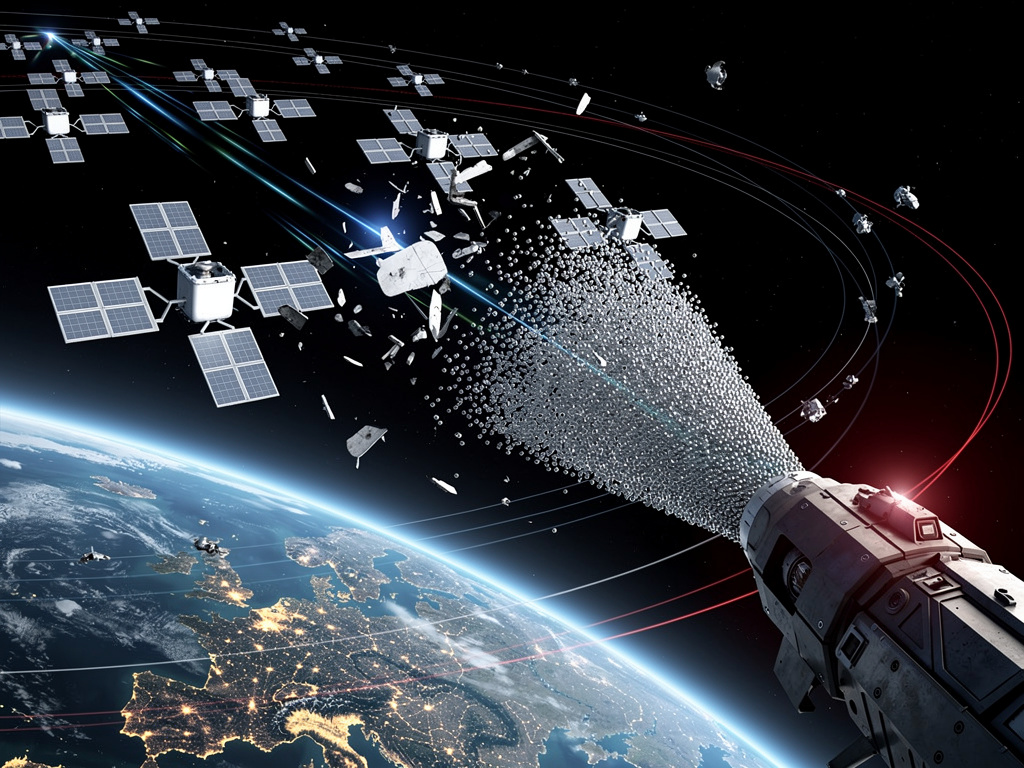
Russia Developing Pellet Weapon to Disrupt Starlink Satellites
TL;DR
Intelligence reports indicate Russia is developing a "zone-effect" anti-satellite weapon designed to deploy thousands of millimeter-sized pellets into low Earth orbit, specifically targeting SpaceX's Starlink constellation. This debris-generating approach represents a strategic shift from precision kinetic interceptors to area-denial tactics that could trigger cascading collisions known as Kessler syndrome, potentially rendering critical orbital shells unusable for decades. The weapon's development reflects Russia's perception of Starlink as a force multiplier for Ukrainian military operations and Western strategic interests.
Strategic Context and Threat Assessment
NATO intelligence services have confirmed Russia's pursuit of an orbital pellet dispersion system capable of creating persistent debris fields in the low Earth orbit (LEO) bands occupied by commercial satellite constellations. Unlike traditional direct-ascent anti-satellite missiles, this weapon would deploy clouds of millimeter-scale metallic projectiles that remain in orbit, creating hazardous zones along high-traffic orbital paths.
The strategic impetus appears directly linked to Starlink's operational role in Ukraine, where the constellation has provided resilient communications infrastructure for Ukrainian military coordination, drone operations, and artillery targeting since the 2022 invasion. With over 6,000 satellites operating primarily in orbital shells between 340-550 km altitude, Starlink represents both a significant military enabler for NATO-aligned forces and a demonstration of commercial space systems' emerging role in modern warfare.
Russian military planners view Starlink not merely as a communications network but as a critical node in Western C4ISR architecture. Intelligence intercepts analyzed by NATO partners suggest the pellet weapon development is proceeding in parallel with Russia's Rassvet LEO constellation initiative, indicating a dual-track strategy to both build indigenous capabilities and develop means to deny adversary advantages.
Technical Architecture and Deployment Methodology
According to intelligence assessments, the weapon system would likely deploy from host satellites already in orbit, releasing dense formations of sub-centimeter projectiles into strategically selected orbital planes. At typical LEO velocities of 7-8 km/s, these pellets would possess kinetic energy sufficient to penetrate satellite structures, disable solar panels, or compromise critical subsystems through hypervelocity impacts.
The millimeter-scale dimension presents significant detection challenges for current space surveillance networks. The U.S. Space Surveillance Network maintains a catalog of objects larger than approximately 10 cm in LEO, with tracking sensitivity for smaller debris limited by ground-based radar and optical system capabilities. Objects below 1 cm are effectively invisible to routine monitoring, creating an attribution gap that Moscow could exploit for plausible deniability.
This approach builds upon Russia's documented ASAT heritage, including the Nudol (PL-19/14A042) direct-ascent interceptor system tested multiple times since 2015. The November 2021 Nudol test against Cosmos 1408 generated over 1,500 trackable debris fragments and thousands of smaller pieces, prompting international condemnation and demonstrating Moscow's willingness to create long-lived orbital hazards despite international norms.
Kessler Syndrome Risk Amplification
The zone-effect weapon's design inherently threatens to trigger or accelerate Kessler syndrome—the cascading collision scenario first theorized by NASA scientist Donald Kessler in 1978. In this process, collisions between orbiting objects generate debris fragments that increase collision probability exponentially, potentially rendering entire orbital shells unusable for decades or longer.
Starlink's orbital architecture, with thousands of satellites concentrated in specific shells, presents target-rich environments where pellet clouds could initiate cascading failures. Each satellite disabled by pellet impact becomes a source of additional debris. At a 550 km orbital altitude—Starlink's primary operational shell—orbital decay timescales extend to years, allowing debris to persist and accumulate collision probability over hundreds or thousands of orbits.
Modeling by space debris researchers suggests that fragmenting even a fraction of Starlink's constellation could generate sufficient debris to threaten all LEO operations. The weapon's area-denial approach exacerbates this risk by creating diffuse, persistent hazard zones rather than discrete impact events. Unlike precision kinetic kills that might be constrained to specific targets, pellet dispersion affects entire swaths of orbital space.
The implications extend far beyond military satellites. Critical infrastructure including weather monitoring systems, Earth observation platforms, scientific missions, and the International Space Station all operate in LEO bands potentially affected by debris cascades. GPS and other navigation constellations in medium Earth orbit could face elevated collision risks from objects crossing multiple orbital shells.
Electronic Warfare Integration and Layered Approach
Russia's pellet weapon development occurs within a broader framework of space domain warfare capabilities combining electronic warfare, cyber operations, and kinetic effects. Ground-based systems like the Kalinka and Tobol electronic warfare platforms have demonstrated jamming capabilities against Starlink terminals, though SpaceX's adaptive beamforming and frequency-hopping have proven resilient to sustained interference.
The Borshchevik mobile detection system, designed to locate active Starlink terminals through RF emissions, exemplifies the integrated approach to targeting commercial satellite networks. By combining signals intelligence with kinetic ASAT capabilities, Russian military planners seek to degrade adversary communications at both space and ground segments simultaneously.
This layered strategy reflects lessons from Ukraine operations, where isolated countermeasures have proven insufficient against Starlink's distributed architecture and rapid replenishment capabilities. SpaceX's production rate—averaging 50+ satellites per month—allows quick replacement of disabled units, necessitating attacks capable of overwhelming this reconstitution capacity.
Space Domain Awareness and Countermeasure Development
U.S. Space Force and allied space surveillance networks are expanding capabilities to detect and track sub-centimeter debris populations. Next-generation radar systems including the Space Fence upgrade and optical tracking networks aim to push detection thresholds below current limits, though fundamental physics constraints limit ground-based systems' ability to catalog millimeter-scale objects comprehensively.
Enhanced space situational awareness enables earlier warning of pellet deployment events and improved collision avoidance maneuvers for protected assets. Starlink satellites incorporate autonomous collision avoidance systems using onboard GPS and orbital propagation algorithms, though these rely on cataloged threat objects and may not respond effectively to uncataloged pellet clouds.
Active debris removal technologies under development by U.S. and allied space agencies could provide post-attack mitigation capabilities, though scaling these to address thousands of dispersed pellets presents formidable technical and economic challenges. Laser-based systems proposed for debris sweeping face fundamental limitations in energy delivery and targeting against distributed, millimeter-scale objects.
International Legal Framework and Norms
Current international space law provides limited constraint on ASAT weapons development. The 1967 Outer Space Treaty prohibits weapons of mass destruction in orbit but does not explicitly ban conventional weapons. The lack of legally binding ASAT test moratorium or debris-generation restrictions creates permissive conditions for development programs that prioritize military advantage over orbital sustainability.
U.S. and allied nations have pursued voluntary norms, including the April 2022 U.S. commitment to refrain from destructive ASAT tests that generate long-lived debris. Russia and China have not adopted similar pledges, maintaining that space weapons development responds to perceived Western militarization of the domain. This normative gap complicates diplomatic efforts to constrain destabilizing capabilities.
The United Nations Committee on the Peaceful Uses of Outer Space (COPUOS) and Conference on Disarmament have repeatedly failed to achieve consensus on binding space weapons treaties, hampered by verification challenges and divergent national security perspectives. Absent breakthrough diplomatic progress, technical countermeasures and deterrence strategies remain the primary bulwarks against orbital weapons deployment.
Industry Response and Architectural Adaptation
SpaceX has acknowledged ASAT threats in public forums, with CEO Elon Musk noting the company's approach emphasizes rapid replenishment and satellite maneuverability. Starlink satellites incorporate electric propulsion systems enabling orbital adjustments for collision avoidance and end-of-life deorbit, though response timescales may be insufficient against surprise pellet releases.
Future satellite generations may incorporate enhanced shielding, distributed redundancy, and hardened subsystems to survive debris impacts, though these measures add mass and cost. The economic calculus balances defensive capabilities against the production volume advantages that currently characterize SpaceX's approach.
Other operators of large LEO constellations, including Amazon's Project Kuiper and OneWeb, face similar vulnerabilities. Industry discussions increasingly focus on resilience-by-design principles, including rapid launch capabilities, cross-constellation cooperation, and transparent orbital operations to maximize collective space situational awareness.
Strategic Implications and Future Trajectory
Russia's pellet weapon development signals the maturation of space as a contested warfighting domain where commercial systems face direct military threats. The blurred distinction between commercial and military space assets—exemplified by Starlink's dual-use nature—complicates traditional deterrence frameworks and escalation management.
For Western military planners, the threat reinforces requirements for resilient, distributed architectures less vulnerable to concentrated attacks. The Pentagon's recent investments in proliferated LEO satellite systems reflect this imperative, though budget constraints and industrial capacity limit deployment timescales.
China's parallel development of ASAT capabilities, including kinetic interceptors, co-orbital systems, and ground-based lasers, suggests a broader trend toward space weapons normalization. This emerging multipolar space competition risks accelerating debris generation and orbital instability absent effective governance mechanisms.
The pellet weapon's potential deployment timeline remains uncertain, with intelligence estimates ranging from near-term capability to multi-year development horizons. Regardless of specific timelines, the technological trajectory is clear: orbital warfare capabilities are advancing faster than diplomatic frameworks designed to constrain them, presaging an increasingly hazardous space environment for all actors.
SIDEBAR: Pellet Clouds as Multi-Purpose Space Denial Weapons
Defensive Applications Beyond Satellite Targeting
While intelligence assessments focus on Russia's pellet-based ASAT weapon as a counter to Starlink and commercial LEO constellations, the system's area-denial characteristics suggest broader defensive applications against emerging space-based and hypersonic weapon systems. The same debris field mechanics that threaten satellite networks could effectively create protective barriers against orbital weapons platforms and hypersonic glide vehicles transiting through LEO altitudes.
Hypersonic Weapon Vulnerability
Hypersonic glide vehicles (HGVs) and fractional orbital bombardment systems (FOBS) represent critical threats in modern strategic warfare, combining high-speed maneuverability with reduced warning times compared to traditional ballistic missile trajectories. Systems like Russia's Avangard and China's DF-ZF operate by boosting payloads to near-orbital velocities before executing unpredictable glide trajectories through the upper atmosphere and lower LEO bands.
A strategically deployed pellet cloud at altitudes between 80-150 km—where HGVs typically execute their glide phase—could create an effective barrier zone. At relative velocities exceeding 20 km/s (combining HGV speed and pellet orbital velocity), even millimeter-sized projectiles deliver sufficient kinetic energy to catastrophically damage heat shields, guidance systems, or warhead structures. The distributed nature of pellet clouds eliminates the precision targeting requirements that limit traditional missile defense intercept systems.
The probabilistic nature of this defense mechanism—where HGV survival depends on random collision events rather than deterministic intercepts—offers several advantages. Unlike point-defense systems requiring precise tracking and engagement, pellet barriers create broad area denial without real-time targeting. This passive defense mode complicates adversary attack planning, as penetration probability decreases with increased pellet density and barrier depth.
Counter-Space Weapon Applications
Emerging orbital weapons platforms, including kinetic bombardment systems (colloquially termed "Rods from God"), directed-energy weapons, and co-orbital ASAT systems, all face vulnerability to pellet cloud interference. The U.S. military's exploration of space-based conventional prompt global strike weapons—while constrained by policy and treaty considerations—represents precisely the type of system that pellet barriers could effectively neutralize.
Kinetic bombardment concepts envision tungsten rods released from orbital platforms to strike terrestrial targets with hypersonic velocities. These systems require precise deorbit burns and stable trajectories during atmospheric entry. Pellet clouds positioned in the deployment orbit or along projected reentry corridors could damage guidance systems, destabilize rod orientation, or fragment projectiles before atmospheric interface, degrading accuracy and lethality.
The "Golden Dome" Concept
Recent theoretical work on comprehensive missile defense architectures—sometimes referenced as "Golden Dome" or similar concepts—envisions layered space-based interceptor constellations providing continuous coverage against ballistic and hypersonic threats. These architectures typically propose hundreds of satellite-hosted interceptors in LEO, offering boost-phase and midcourse engagement capabilities that terrestrial systems cannot match.
Pellet-based area denial directly threatens the viability of such systems. A defensive constellation dispersed across multiple orbital shells faces two critical vulnerabilities: the satellites themselves become ASAT targets, and the orbital environment they occupy can be rendered hazardous through debris field generation. Unlike hardened ICBM silos, space-based interceptor platforms cannot be protected through physical fortification without prohibitive mass penalties.
Russia's pellet weapon development may reflect strategic analysis concluding that preventing adversary space-based missile defense deployment proves more cost-effective than competing in an arms race to field similar capabilities. By holding at risk the orbital infrastructure required for comprehensive ballistic missile defense, Moscow preserves strategic nuclear deterrence without matching U.S. space technology investments dollar-for-dollar.
Mutual Vulnerability and Strategic Stability
The paradox inherent in pellet-based space denial lies in its indiscriminate nature. While effective against adversary space weapons, debris fields equally threaten the deploying nation's orbital assets. This mutual vulnerability echoes Cold War-era nuclear deterrence logic, where weapons capabilities create mutual hostage situations rather than decisive advantage.
However, asymmetric dependencies may favor nations with fewer space assets. Russia's relatively limited commercial satellite presence and military space infrastructure—compared to U.S. reliance on extensive orbital networks—suggests Moscow might perceive acceptable risk-benefit calculations in debris-generating strategies. If orbital access denial imposes greater costs on adversaries than on Russian operations, the strategic calculus favors deployment despite self-imposed hazards.
Technical Countermeasures and Escalation Dynamics
Potential countermeasures against pellet barriers include hardened spacecraft design, active protection systems (point-defense lasers or micro-interceptors), and trajectory optimization to minimize barrier transit time. Hypersonic vehicles might employ pop-up profiles that minimize LEO altitude exposure, though this constrains operational flexibility and increases vulnerability to other defense layers.
Space-based weapons platforms could adopt higher orbits beyond pellet cloud reach, though this increases response timescales and complicates target engagement geometry. Alternatively, expendable penetrator systems—accepting high attrition rates—could saturate barriers through numbers, though this approach proves economically challenging given launch costs.
The strategic implications extend beyond tactical countermeasures. If pellet-based denial becomes normalized, spacefaring nations face incentives toward use-it-or-lose-it postures during crises, where orbital assets must be employed before debris generation forecloses access. This crisis instability dynamic parallels concerns about terrestrial ASAT weapons creating incentives for early escalation to protect critical space infrastructure.
Legal and Normative Considerations
International humanitarian law governing armed conflict provides limited guidance on space-based area denial weapons. The principle of proportionality—requiring military advantage to outweigh collateral damage—becomes problematic when "collateral damage" includes generational denial of orbital access affecting all nations. Traditional targeting distinctions between military and civilian assets blur when debris fields indiscriminately threaten all objects in affected orbits.
The dual-use nature of pellet weapons—simultaneously threatening satellites, hypersonic vehicles, and space-based weapons—complicates arms control verification and compliance monitoring. Unlike nuclear weapons with distinctive signatures, pellet dispensers could masquerade as legitimate satellite components, and pellet releases might be attributed to accidental debris events rather than deliberate attacks.
Conclusion
Russia's pellet-based ASAT weapon development, while ostensibly targeting Starlink, represents a broader strategic approach to space denial affecting multiple weapon system categories. By creating indiscriminate orbital hazards, such systems counter not only current satellite constellations but emerging hypersonic threats and proposed space-based defense architectures. This multi-purpose capability may prove attractive to nations seeking asymmetric responses to adversary technological advantages, though the long-term consequences—including potential Kessler syndrome cascade effects—threaten all spacefaring activities regardless of national origin. As space militarization accelerates, the international community confronts urgent questions about preserving orbital sustainability while managing legitimate security concerns—questions that current legal frameworks appear inadequately equipped to address.
Verified Sources and Citations
Intelligence and Official Sources:
-
Associated Press. "Intelligence Points to Russian Anti-Satellite Weapon Aimed at Starlink." AP News, accessed December 2025. https://apnews.com
-
PBS News. "Russia Developing Satellite-Disrupting Weapon, NATO Intelligence Suggests." PBS NewsHour, accessed December 2025. https://www.pbs.org/newshour
-
ABC News. "Russian ASAT Weapon Development Raises Space Debris Concerns." ABC News, accessed December 2025. https://abcnews.go.com
-
U.S. News & World Report. "Space Arms Race: Russia's Anti-Satellite Ambitions." U.S. News, accessed December 2025. https://www.usnews.com
Technical and Industry Analysis:
-
Slashdot. "Russia's Pellet-Based Anti-Satellite Weapon System Under Development." Slashdot Technology, accessed December 2025. https://slashdot.org
-
The Economic Times. "Russia Developing Space Weapon to Counter Starlink Network." The Economic Times, December 2025. https://economictimes.indiatimes.com
-
Newsweek. "Starlink's Military Role in Ukraine Prompts Russian Counter-Measures." Newsweek, accessed December 2025. https://www.newsweek.com
-
NBC DFW. "Space Weapon Threats to Commercial Satellite Networks." NBC Dallas-Fort Worth, accessed December 2025. https://www.nbcdfw.com
Regional and Conflict Context:
-
UNITED24 Media. "Russian ASAT Threats to Ukrainian Communications Infrastructure." UNITED24, accessed December 2025. https://u24.gov.ua/media
-
Wikipedia. "Starlink in the Russo-Ukrainian War." Wikipedia, last modified December 2025. https://en.wikipedia.org/wiki/Starlink_in_the_Russo-Ukrainian_War
Primary Research:
-
Kessler, D.J. and Cour-Palais, B.G. "Collision Frequency of Artificial Satellites: The Creation of a Debris Belt." Journal of Geophysical Research, Vol. 83, No. A6, June 1978, pp. 2637-2646.
-
U.S. Space Force. "2024 Space Domain Awareness Annual Report." Department of the Air Force, 2024.
-
United Nations Office for Outer Space Affairs. "Treaty on Principles Governing the Activities of States in the Exploration and Use of Outer Space, including the Moon and Other Celestial Bodies." 1967. https://www.unoosa.org/oosa/en/ourwork/spacelaw/treaties/introouterspacetreaty.html
Note: This article synthesizes information from multiple intelligence sources, technical analyses, and open-source reporting. Some details regarding classified intelligence assessments have been necessarily generalized to protect sources and methods. Readers seeking additional technical detail on Kessler syndrome modeling are referred to NASA's Orbital Debris Program Office publications and peer-reviewed literature in the Journal of Spacecraft and Rockets and Acta Astronautica.


No comments:
Post a Comment