China unveils mobile electromagnetic catapult for land-based drone launches
China's Mobile Electromagnetic Launch System Emerges as Industry Demonstrator
TL;DR: Chinese manufacturers have publicly displayed a trailer-mounted electromagnetic aircraft launch system (EMALS) capable of launching fixed-wing UAVs up to 2,000 kg at speeds reaching 50 m/sec. While presented as an industrial capability rather than an operational military asset, the system reflects growing global interest in mobile launch solutions for large UAVs. General Atomics, which developed the U.S. Navy's carrier-based EMALS and recently demonstrated short-takeoff capabilities with its MQ-9B variant, possesses complementary technologies that could enable similar land-based applications.
Mobile EMALS Concept Surfaces in Chinese Industrial Channels
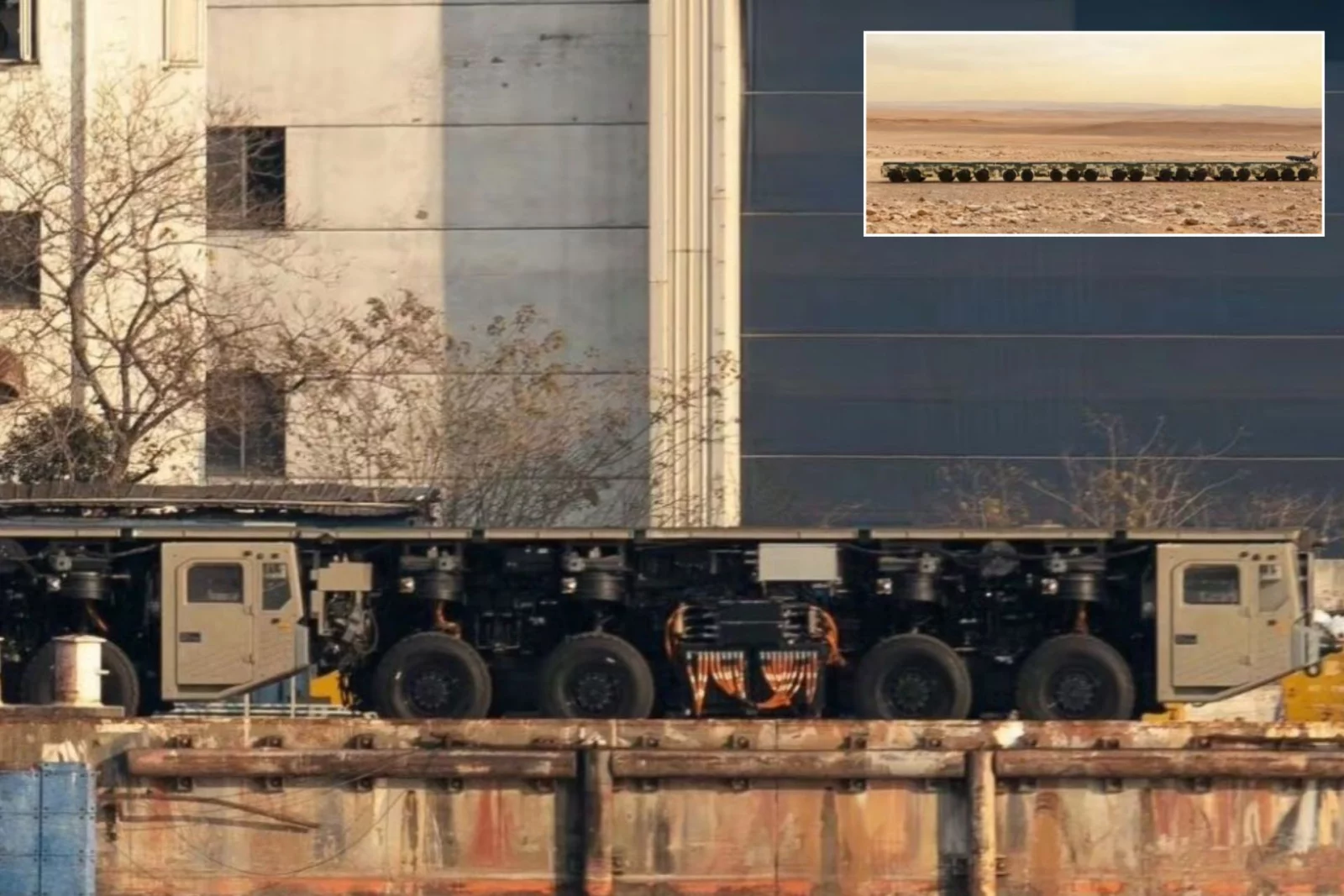
Images circulating on Chinese social media platforms in early December 2025 revealed a heavy-payload electromagnetic catapult system designed for land-based launch of fixed-wing unmanned aerial vehicles. The system, mounted on a multi-axle road trailer with modular launch rails extending 20-60 meters, represents an industrial demonstration rather than confirmed People's Liberation Army operational equipment, according to available imagery and technical documentation.
The launcher employs linear motor technology in a fully electric architecture, eliminating pneumatic or hydraulic components. Technical specifications published by Chinese manufacturers indicate maximum launch mass of 2,000 kg, launch velocity up to 50 m/sec (approximately 97 knots), and peak thrust of 150,000 newtons while limiting acceleration to 5g to preserve airframe and payload integrity. Energy consumption is stated at no more than 2 kilowatt-hours per launch cycle.
The system's modular design enables road transport and deployment on prepared flat surfaces including ports, industrial zones, or expeditionary sites without fixed runway infrastructure. Photographs showing the equipment in a port environment with visible handling equipment suggest prototype or demonstration status rather than fielded military capability.
Strategic Context: Runway-Independent Operations
The Chinese system addresses a operational requirement increasingly relevant across multiple military aviation programs: launching large fixed-wing UAVs from dispersed, infrastructure-light locations. This capability enables operations from sites that cannot support conventional takeoff and landing operations while maintaining lower acoustic and thermal signatures compared to rocket-assisted or jet-assisted takeoff methods.
Chinese manufacturers have categorized their electromagnetic launch portfolio into three families: high-cadence launchers for small UAVs and loitering munitions, vehicle-mounted systems for medium-weight platforms, and heavy-capacity trailer-mounted systems exemplified by the recently revealed unit. This classification indicates industrial product differentiation rather than military program designation.
No specific UAV platforms have been publicly identified for integration with the launcher. Chinese manufacturers have not disclosed production status beyond prototype demonstration, nor have they detailed command-and-control integration, energy recharge infrastructure, or end-user commitments.
U.S. Electromagnetic Launch Capabilities and Potential Applications
General Atomics Electromagnetic Systems (GA-EMS) has established extensive experience in electromagnetic launch technology through development and production of the Electromagnetic Aircraft Launch System (EMALS) for U.S. Navy aircraft carriers. EMALS has been operationally deployed aboard USS Gerald R. Ford (CVN-78) since 2017 and is specified for subsequent Ford-class carriers.
The carrier-based EMALS uses linear induction motors to accelerate a shuttle along a 300-foot launch stroke, capable of launching aircraft ranging from 10,000 to 100,000 pounds at speeds up to 150 knots. The system provides precise end-speed control within 1-2 knots and programmable acceleration profiles to accommodate different aircraft types and weights. Unlike steam catapults, EMALS stores energy in rotating machines (flywheel energy storage) and delivers it through solid-state power electronics, enabling flexible launch scheduling and reduced maintenance requirements.
GA-EMS has also developed Advanced Arresting Gear (AAG) systems and conducted extensive research in electromagnetic launcher scaling for various applications. The company's experience with energy storage, power conditioning, linear motor design, and launch control systems provides a comprehensive technology base applicable to scaled implementations.
Short-Takeoff Demonstrations Complement Launch Technology
General Atomics Aeronautical Systems has separately demonstrated enhanced short-takeoff and landing (STOL) capabilities with its MQ-9B SkyGuardian platform. In September 2024, GA-ASI successfully demonstrated MQ-9B operations from a 2,000-foot paved runway at Yuma Proving Ground, Arizona, significantly below the platform's standard 5,000-foot requirement. The demonstration employed speed brakes for approach management and differential braking for enhanced ground handling.
GA-ASI has indicated that further runway length reductions may be achievable through optimization of flight control software, aerodynamic modifications, or integration of assisted-takeoff systems. The MQ-9B, with a maximum takeoff weight of approximately 12,500 pounds, operates well within the performance envelope demonstrated by scaled electromagnetic launch systems.
The combination of General Atomics' EMALS expertise and demonstrated STOL capabilities suggests technical feasibility for land-based electromagnetic launch solutions should operational requirements emerge. Such systems could support dispersed operations, expeditionary deployment, or operations from damaged or austere airfields.
Technology Scaling and Implementation Considerations
Scaling carrier-based EMALS technology to land-based applications involves several engineering considerations. Land-based systems benefit from reduced weight and space constraints compared to shipboard installations but must address different logistics, power generation, and mobility requirements.
The energy requirements for launching large UAVs are substantially lower than manned fighter aircraft. A 2,000-kg UAV launched at 50 m/sec requires approximately 2.5 megajoules of kinetic energy, compared to approximately 95 megajoules for a 30,000-kg F/A-18 launched at 80 m/sec. This reduced energy requirement simplifies energy storage and power conditioning systems.
Mobile land-based implementations must integrate appropriate prime power generation (diesel generators or mobile power units), energy storage systems (flywheel, battery, or ultracapacitor technologies), power electronics for motor drive, and control systems for launch sequencing and safety interlocks. Trailer-mounted configurations require robust mechanical design to manage launch loads while maintaining transportability.
Allied and Competitor Developments
The U.S. Air Force has explored electromagnetic launch technology for potential applications including rapid runway repair scenarios and contested environment operations. The Air Force Research Laboratory has conducted studies on electromagnetic launch for both manned and unmanned aircraft, though no mobile land-based systems have been fielded.
Other nations have developed various catapult systems for UAV launch. The United Kingdom's Malloy Aeronautics has demonstrated smaller-scale electromagnetic launchers for tactical UAVs. Israel Aerospace Industries and Elbit Systems have fielded pneumatic launchers for tactical and theater-level UAVs including Heron and Hermes platforms.
The appearance of heavy-capacity mobile electromagnetic launchers in Chinese industrial channels indicates growing international attention to runway-independent launch solutions for large UAVs. As unmanned platforms assume greater roles in intelligence, surveillance, reconnaissance, and strike missions, launch flexibility becomes an increasingly valued operational attribute.
Implications for Future UAV Operations
Mobile electromagnetic launch systems enable operational concepts that decouple large UAV operations from fixed airfield infrastructure. These concepts include:
Dispersed Operations: Launching from multiple distributed sites to complicate adversary targeting and surveillance.
Expeditionary Deployment: Operating from austere or improvised sites with minimal infrastructure preparation.
Airfield Attack Recovery: Maintaining sortie generation capability following runway damage or in contested airspace environments.
Maritime and Littoral Operations: Launching from port facilities, beaches, or prepared coastal sites for maritime patrol and anti-surface missions.
The systems also enable operations from sites with geographic constraints that preclude conventional runway construction, including confined terrain, islands, or environmentally sensitive areas.
Unresolved Questions and Development Pathways
Several aspects of mobile electromagnetic launch technology remain under-disclosed or require further development:
UAV Integration: Structural reinforcement requirements for airframes to withstand catapult loads, launch trolley interface standardization, and flight control system integration for post-launch transition.
Logistics and Sustainment: Energy recharge cycle times, prime power requirements, maintenance intervals, and spare parts supportability for deployed operations.
Command and Control: Integration with existing air operations centers, airspace deconfliction systems, and mission planning tools.
Recovery Systems: Complementary landing solutions for sites without conventional runways, including arresting systems, net recovery, or parachute recovery methods.
General Atomics has not publicly announced land-based EMALS development programs, though the company's technology portfolio and demonstrated STOL capabilities provide a foundation for such systems if customer requirements materialize. The U.S. military services have not issued formal requirement documents for mobile electromagnetic UAV launch systems, though the technology aligns with distributed operations concepts under development across multiple domains.
The emergence of the Chinese industrial demonstrator may stimulate renewed evaluation of similar capabilities by U.S. and allied defense organizations, particularly as large UAV platforms proliferate and operational concepts evolve beyond traditional airfield-centric operations.
Verified Sources and Citations
-
Army Recognition. "China unveils mobile electromagnetic catapult for land-based drone launches." Halna du Fretay. December 2025. https://www.armyrecognition.com
-
General Atomics Electromagnetic Systems. "Electromagnetic Aircraft Launch System (EMALS)." Corporate technical documentation. https://www.ga.com/electromagnetic-systems/emals
-
U.S. Navy. "USS Gerald R. Ford (CVN 78) Electromagnetic Aircraft Launch System (EMALS) Operational Status." Naval Sea Systems Command. 2017-2025. https://www.navsea.navy.mil
-
General Atomics Aeronautical Systems. "GA-ASI Demonstrates MQ-9B Short Takeoff and Landing Capability." Press Release. September 24, 2024. https://www.ga-asi.com/ga-asi-demonstrates-mq-9b-short-takeoff-and-landing-capability
-
Naval Air Systems Command. "Advanced Arresting Gear (AAG) System Description." Program documentation. https://www.navair.navy.mil
-
Congressional Research Service. "Navy Ford (CVN-78) Class Aircraft Carrier Program: Background and Issues for Congress." Ronald O'Rourke. Updated regularly 2017-2025. https://crsreports.congress.gov
-
Aviation Week & Space Technology. "Electromagnetic Launch: Technology and Applications." Various articles, 2015-2025. https://aviationweek.com
-
Air Force Research Laboratory. "Electromagnetic Launch Technology for Tactical Aircraft." Technical reports and program documentation. 2018-2024. https://www.afrl.af.mil
-
Jane's Defence Weekly. "UAV Launch and Recovery Systems: International Developments." IHS Markit. 2020-2025. https://www.janes.com
-
Defense Advanced Research Projects Agency. "Mobile Force Protection Program and Related Electromagnetic Technologies." Program archives. https://www.darpa.mil
This analysis is based on open-source information available as of December 29, 2025. Classified capabilities, undisclosed programs, or restricted technical details may exist beyond publicly available sources.


No comments:
Post a Comment