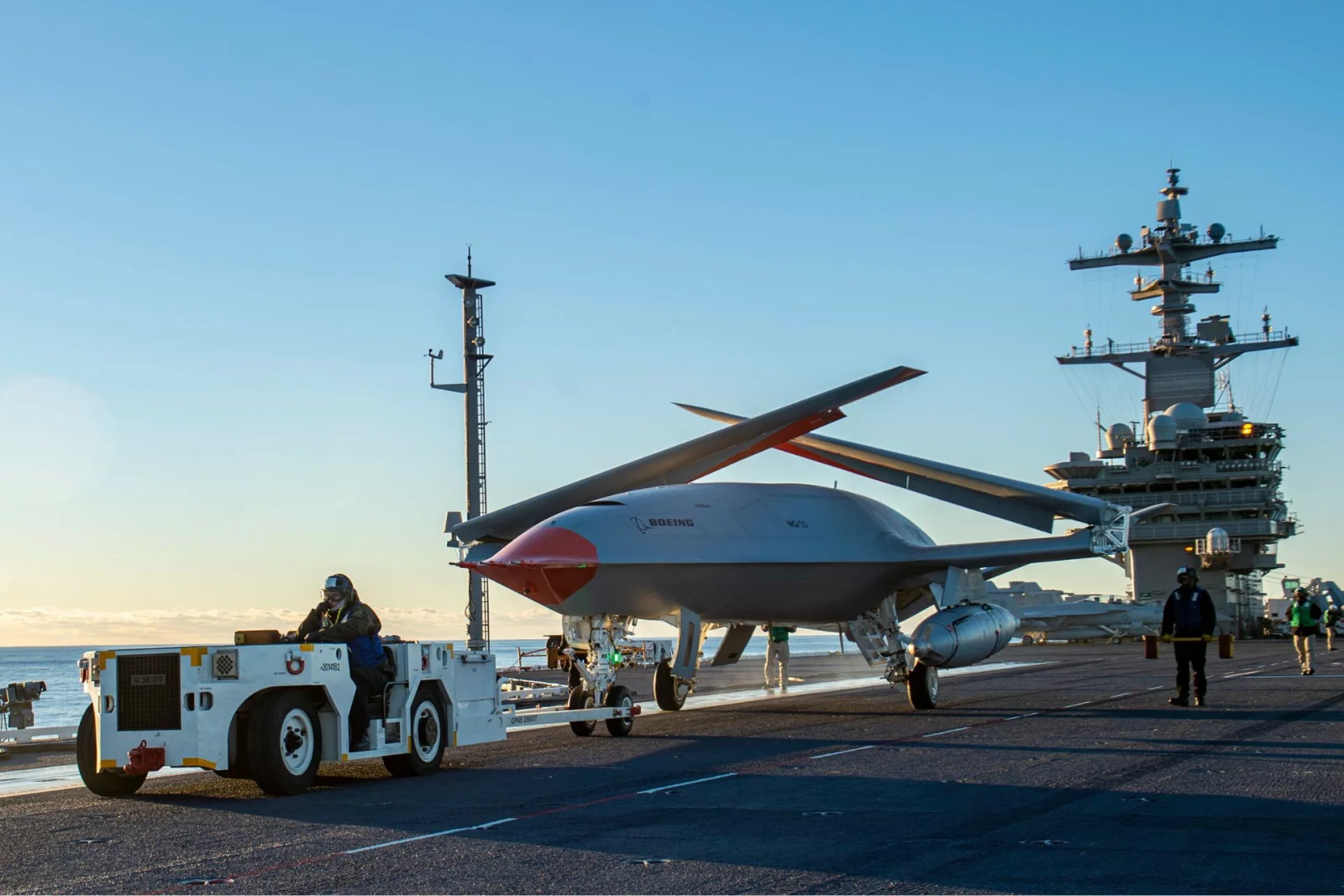
U.S. Navy MQ-25A Stingray tanker drone anchors future carrier operations in FY2026 plan
The MQ-25 Dilemma: Tanker First, or Multi-Mission Now?
The U.S. Navy's MQ-25A Stingray unmanned tanker enters low-rate production in 2026, but critical capability gaps in carrier air wings—particularly fixed-wing anti-submarine warfare—are forcing reassessment of the platform's mission scope. Should the Navy expand MQ-25 capabilities or develop purpose-built unmanned systems? The decision will shape carrier aviation for decades.
TL;DR: The MQ-25A's transition to production comes as carrier air wings face widening capability gaps in ASW, electronic warfare, and strike depth. General Atomics' demonstrated multi-mission capabilities with the MQ-9 Reaper prove technical feasibility, but the Navy must choose between mission expansion that risks compromising the tanker program versus costly parallel development of specialized platforms. Budget constraints, Chinese carrier aviation advances, and 20 years of requirements debates frame a decision that will define the future of naval aviation.
From Strike Platform to Tanker—And Back Again?
Twenty years of shifting priorities brought us here. The program began in 2006 as UCAS-D, envisioning a stealthy strike platform. Northrop Grumman's X-47B validated the concept with autonomous carrier landings in 2013, but budget realities and risk aversion drove the 2016 pivot to CBARS—a pure tanker mission designed to free F/A-18 Super Hornets from "buddy tanking" duties.
Boeing won with a low-risk design optimized for fuel delivery: 15,000 pounds at 500 nautical miles. The FY2026 acquisition plan confirms delivery of four Engineering Development Models and three Low-Rate Initial Production aircraft, with first flight scheduled for Q1 2026. Initial operational capability targets the late 2020s.
But the operational environment hasn't cooperated with narrow mission definitions. China's DF-21D and DF-26 anti-ship ballistic missiles push carriers to standoff distances exceeding 800 nautical miles. Russian and Chinese submarines armed with long-range cruise missiles patrol closer. The carrier air wing's defensive perimeter has capability gaps the MQ-25 wasn't designed to fill—but potentially could.
The S-3 Viking Gap: A Decade of Vulnerability
The 2016 retirement of the S-3B Viking eliminated carrier-based fixed-wing ASW, creating a vulnerability that grows more critical as adversary submarine capabilities proliferate. The S-3B provided extended-range prosecution, surface surveillance, and over-the-horizon targeting across a 1,000-nautical-mile radius. Those missions now fall to MH-60R helicopters operating at 150-200 nautical miles with limited endurance.
That's inadequate against modern threats. China's Type 039A/B submarines carry YJ-18 anti-ship cruise missiles with 290+ nautical mile range, enabling engagement from positions well beyond helicopter patrol areas. Russia's improved Kilo and Lada classes present parallel threats. North Korea operates approximately 70 submarines optimized for acoustically challenging littoral operations.
Admiral Michael Gilday acknowledged the gap in 2022 Congressional testimony: "The loss of fixed-wing ASW represents a capability gap we must address as submarine threats proliferate." Yet developing a dedicated platform would cost billions competing with other modernization priorities—Columbia-class SSBNs, Constellation-class frigates, F-35C procurement, and Next Generation Air Dominance.
Could the MQ-25 fill the gap? The platform's endurance and payload capacity could theoretically support active and passive sonobuoys, magnetic anomaly detection, and synthetic aperture radar. General Atomics' MQ-9B SeaGuardian demonstrates maritime patrol configurations with Leonardo Seaspray radar, AIS, and sonobuoy deployment.
But effective ASW requires weapons. Mk 54 lightweight torpedoes weigh 608 pounds and demand specialized carriage, release mechanisms, and targeting interfaces. The current MQ-25 lacks weapons provisions. Adding them requires substantial airframe modifications, flight testing, and certification—potentially compromising the tanker mission that justified the program.
Electronic Warfare: Four to Five Aircraft Against Integrated Air Defenses
EA-18G Growlers provide the carrier air wing's entire electronic warfare capacity—typically four to five aircraft per wing. Total Growler production caps at 160 aircraft, barely sufficient for 16-18 squadrons across Navy and Marine Corps requirements. Attrition, training demands, and depot maintenance reduce operational availability further.
Operating Growlers in high-threat environments risks two aircrew per sortie. Against advanced SAM systems—Russian S-400, Chinese HQ-9—standoff jamming distances may prove insufficient. Each Growler represents a Super Hornet airframe unavailable for strike missions. And effective jamming against modern, frequency-agile, low-probability-of-intercept radars increasingly requires "stand-in" positioning that exposes manned aircraft to unacceptable risk.
Unmanned EW platforms offer compelling advantages: expendable systems operating close to threat emitters, higher sortie rates without pilot fatigue constraints, lower costs enabling larger force structures. General Atomics has demonstrated EW pods on MQ-9, validating reactive and pre-emptive jamming against simulated threats.
Integrating similar capabilities on MQ-25 requires significant modifications. High-power jammers demand 100+ kilowatts—exceeding current electrical generation capacity. EA-18G-style pods need hardpoints rated for aerodynamic loads, electrical interfaces, and data links. Operating high-power EW systems creates electromagnetic interference risks for flight controls and navigation. And EW operations require specialized operator consoles and threat libraries not present in current Unmanned Carrier Aviation Mission Control System architecture.
Estimated investment: $500-800 million for mission systems integration alone, plus structural modifications, flight testing, and operator training.
The Strike Mission: Payload-Range Compromises
General Atomics' MQ-9 Reaper has logged over 10 million flight hours employing AGM-114 Hellfire, GBU-12 Paveway II, GBU-38 JDAM, and AGM-114R9X variants. The weapons integration provides a proven baseline, but carrier-based strike presents distinct challenges.
Naval strike employs diverse weapons: anti-ship missiles (Harpoon, Naval Strike Missile, LRASM), anti-radiation missiles (AGM-88 HARM), air-to-air missiles, and various guided munitions. Comprehensive strike capability requires integration across this inventory—each weapon type demanding 2-4 years certification testing.
Coordination complexity multiplies. Naval strike depends on Aegis combat systems, E-2D command and control, Link 16, Cooperative Engagement Capability, and Naval Integrated Fire Control-Counter Air architectures. Unmanned strike platforms must integrate seamlessly.
But the fundamental tradeoff is physical: adding weapons payload reduces fuel capacity. A strike-configured MQ-25 carrying 4,000 pounds of weapons significantly diminishes tanker effectiveness. The air wing might require more platforms to maintain both missions—competing for finite deck space, hangar capacity, and logistics support.
Current Navy planning identifies the Next Generation Air Dominance program's Collaborative Combat Aircraft for strike missions, not MQ-25 expansion. The Air Force's CCA program envisions attritable platforms costing $15-30 million each, substantially below MQ-25's $130-150 million unit cost. That cost differential suggests purpose-built platforms may prove more economical than multi-mission compromises.
Four Options, No Easy Answers
The Navy faces a decision matrix shaped by competing imperatives:
Option 1: Maintain Tanker Focus. Complete MQ-25 development, achieve operational capability, accumulate fleet experience before considering expansion. Pursue separate platforms for other missions as budgets permit.
Pros: Protects core program, reduces technical risk, enables disciplined sequential development.
Cons: Delays addressing capability gaps, foregoes potential commonality benefits, requires multiple parallel programs competing for constrained budgets.
Option 2: Phased Mission Expansion. Develop multi-mission variants after achieving tanker operational maturity, leveraging common airframe and mission control infrastructure.
Pros: Economies of scale, industrial base stability, growth path for existing platform.
Cons: May compromise tanker effectiveness, creates configuration management complexity, increases program costs and schedule risk.
Option 3: Concurrent New Platform Development. Initiate separate programs for strike, EW, and ASW unmanned platforms while continuing MQ-25 tanker production.
Pros: Optimizes each platform for specific missions, avoids compromise solutions, enables faster capability delivery.
Cons: Multiplies development costs, fragments funding, increases logistics complexity, strains acquisition workforce already managing unprecedented modernization portfolio.
Option 4: Commercial Platform Adaptation. Modify proven UAVs (e.g., MQ-9 variants) for carrier operations.
Pros: Leverages mature technology, potentially reduces costs, accelerates schedule.
Cons: "Navalizing" land-based designs typically costs 60-80% of clean-sheet development while delivering compromised performance. Arrested landing structural reinforcement, catapult compatibility, corrosion protection, and deck handling requirements demand extensive modification.
The Budget Reality
None of these options is cheap, and all compete with existential priorities. Columbia-class SSBNs consume approximately $130 billion. Constellation-class frigates face cost growth. F-35C procurement continues below optimal rates. NGAD represents multi-hundred-billion-dollar, multi-decade investment. Shipboard systems modernization—Aegis upgrades, EW improvements, cybersecurity—requires sustained funding.
Comprehensive multi-mission MQ-25 capability demands estimated investment of $1.5-2.7 billion: $200-400 million for structural modifications, $500-800 million for mission systems integration, $300-500 million for flight testing, $400-700 million for software development, $150-300 million for operator training. These figures assume leveraging existing subsystems where possible.
Chief of Naval Operations Admiral Lisa Franchetti signaled discipline in September 2025 Congressional testimony: "We must be disciplined in our requirements process, avoiding the temptation to add missions that compromise core capabilities or drive unaffordable cost growth."
That philosophy suggests Option 1—maintain tanker focus—as the likely path forward, at least until late-decade operational experience informs further decisions.
Lessons from Acquisition History
The measured approach reflects hard-won lessons. Littoral Combat Ship's concurrent seaframe and mission module development resulted in massive cost growth and schedule delays. Ford-class carrier's simultaneous EMALS, Advanced Arresting Gear, and dual-band radar development created integration nightmares delaying operational capability.
Current Navy acquisition strategy emphasizes sequential development, demonstrated technology readiness (TRL 7+ before production transition), modular architecture accommodating future growth, and realistic testing under operational conditions. Applying these principles to MQ-25 mission expansion requires demonstrating tanker mission maturity through multiple deployment cycles before initiating multi-mission development.
Navy officials informally indicate mission expansion decisions unlikely before 2028-2030, after initial operational capability and early operational experience evaluation.
The Congressional Wild Card
Congressional defense committees are pressing Navy leadership for explicit strategy articulation. House Armed Services Committee report language in the FY2025 National Defense Authorization Act directs the Navy to provide comprehensive assessment of unmanned carrier aviation requirements across tanking, strike, EW, and ISR missions, including platform commonality opportunities, cost-capability tradeoffs, and industrial base implications.
The resulting report, expected mid-2026, will likely influence decisions on MQ-25 expansion versus new platform development. Congressional staffers indicate particular interest in whether common unmanned airframe designs serving multiple missions with modular payloads—analogous to General Atomics' MQ-9 variant approach—can achieve cost savings.
But F-35 Joint Strike Fighter's challenges accommodating three service variants have made some legislators cautious about requirements complexity. Senator Roger Wicker stated in November 2025: "We need the Navy to get the MQ-25 tanker right before we burden it with additional missions that could delay or compromise its primary purpose."
What China Is Doing
China's People's Liberation Army Navy pursues unmanned carrier aviation more aggressively than U.S. efforts, potentially developing multi-mission platforms rather than specialized tankers. Recent imagery reveals land-based electromagnetic catapult systems for UAVs, demonstrating technological maturity in unmanned launch systems.
PLAN carrier aviation remains less mature than U.S. operations, and autonomous carrier landing reliability—the most challenging technical aspect—hasn't been publicly demonstrated by Chinese systems. But strategic competition in the Indo-Pacific may ultimately determine whether budget constraints or operational imperatives drive American decision-making pace.
The Path Forward
From pure engineering perspective, expanding MQ-25 capabilities is technically feasible. General Atomics' MQ-9 experience validates multi-mission unmanned platform viability. But carrier-specific challenges—arrested landing loads, catapult launch compatibility, corrosion protection, deck handling, space constraints—distinguish naval aviation from land-based operations.
The Navy hasn't publicly committed to specific pathways, indicating internal assessments remain ongoing. Given fiscal constraints, competing priorities, and technical risks, the most probable outcome is maintaining MQ-25 tanker focus while conducting technology maturation for future unmanned platforms without near-term production commitments.
This approach protects immediate operational priority—aerial refueling capacity extending strike group reach—while preserving options for future capability expansion as requirements clarify, technologies mature, and budgets permit.
But preserving options isn't strategy. The S-3 Viking gap has existed nine years. EA-18G inventory constraints worsen as airframes age. Chinese submarine capabilities grow. At some point, deliberate assessment must yield decisive action.
The MQ-25 represents carrier aviation's first step into autonomous operations. Whether it becomes a multi-mission platform or remains a specialized tanker enabling purpose-built follow-on systems will determine how rapidly—and how effectively—the Navy transforms its most important power projection asset for great power competition.
The decision cannot wait forever. Peer competitors aren't standing still, and capability gaps don't fill themselves. The Navy got here through 20 years of shifting priorities and compromised requirements. The next decision must be better.
Sources
-
U.S. Navy, "Selected Acquisition Report (SAR): MQ-25A Stingray," Office of the Under Secretary of Defense for Acquisition and Sustainment, December 2024.
-
U.S. Navy, "Acquisition Program 2026," Department of the Navy, July 2025.
-
Congressional Research Service, "Navy MQ-25 Stingray Unmanned Tanker Aircraft Program: Background and Issues for Congress," Ronald O'Rourke, November 2025.
-
Boeing Defense, Space & Security, "MQ-25 Program Update," corporate documentation, 2019-2025.
-
Naval Air Systems Command, "MQ-25 Unmanned Carrier Aviation (PMA-268) Program Overview," Program Executive Office documentation.
-
U.S. Government Accountability Office, "Weapon Systems Annual Assessment: MQ-25A Program Status," GAO-25-106059, June 2025.
-
Lockheed Martin, "Unmanned Carrier Aviation Mission Control System (UMCS)," program documentation.
-
Center for Strategic and Budgetary Assessments, "Regaining the High Ground at Sea: Transforming the U.S. Navy's Carrier Air Wing," Clark, Walton, and Cropsey, May 2018.
-
General Atomics Aeronautical Systems, "MQ-9B SeaGuardian: Maritime Capabilities Overview," corporate documentation, 2020-2025.
-
Center for Strategic and International Studies, "Closing the Gap: The Case for Unmanned Carrier-Based ASW," Karako and Rumbaugh, January 2024.
-
U.S. Government Accountability Office, "Navy Aviation: Addressing Capability Gaps in Carrier Air Wings," GAO-24-107212, March 2024.
-
Chief of Naval Operations, "Unmanned Campaign Framework," Department of the Navy, March 2024.
-
House Armed Services Committee, "National Defense Authorization Act for Fiscal Year 2025, Conference Report," Report 118-301, December 2024.
-
Mitchell Institute for Aerospace Studies, "The Carrier Air Wing of the Future: Integrating Manned and Unmanned Systems," Penney and Gunzinger, September 2024.
-
Congressional Budget Office, "The U.S. Navy's Fiscal Year 2026 Shipbuilding Plan: Background and Issues," October 2025.
-
Senate Armed Services Committee, "Hearing on Department of the Navy Fiscal Year 2026 Budget Request," transcript, March 19, 2025.
-
Naval War College Review, "Manned-Unmanned Teaming in Naval Aviation: Lessons from Air Force MQ-9 Operations," CDR James P. Sullivan, USN, Spring 2025.
-
Aviation Week & Space Technology, "X-47B Demonstrates Autonomous Carrier Operations," Graham Warwick, July 14, 2013.
Stephen L. Pendergast is a Senior Engineer Scientist with over 20 years of experience in radar systems engineering and aerospace defense. He served as an Engineering Duty Officer in the U.S. Navy and subsequently worked as a systems engineer at Raytheon Company and General Atomics Aeronautical Systems. He holds an MS in Electrical Engineering from MIT. The views expressed are the author's alone and do not represent official positions of any organization.


No comments:
Post a Comment