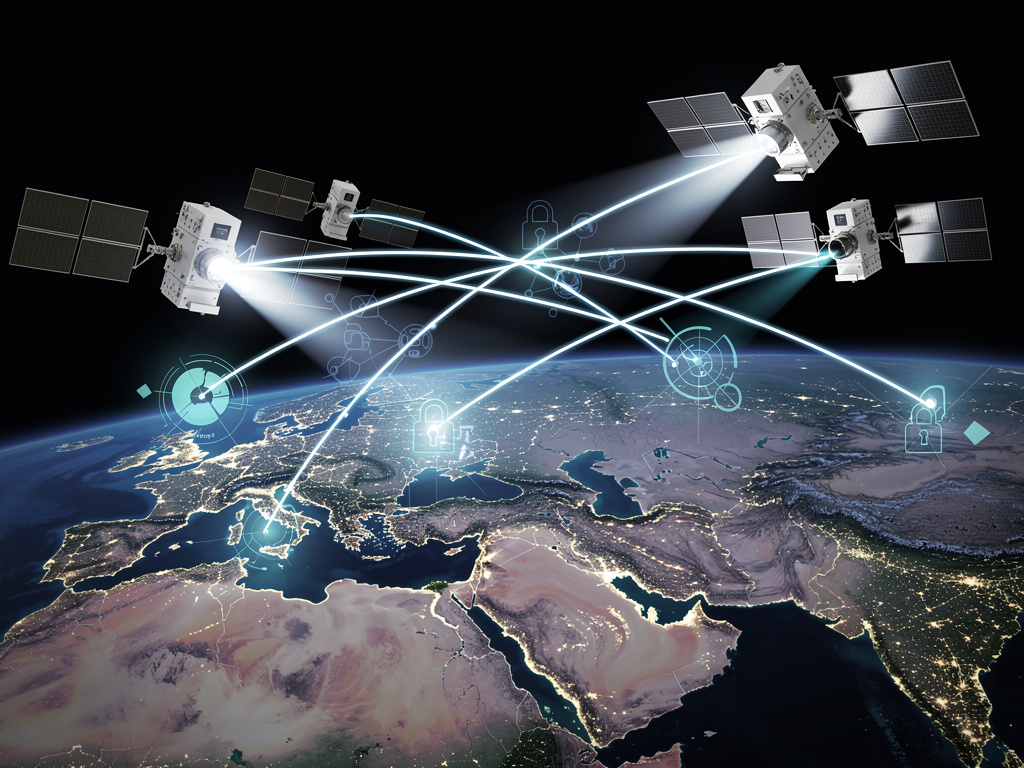
Beyond Broadband: Saudi-Backed TeraWave Aims to Build a Secure 'Outer-NET' for a Fractured World
Space-Based and Subsea Networks Converge
BLUF: Saudi Arabia is executing a comprehensive global communications infrastructure strategy through simultaneous investments in TeraWave's secure LEO satellite constellation and extensive subsea cable projects, positioning the Kingdom as a critical hub linking Europe, Asia, and Africa while reducing dependence on traditional Western-controlled infrastructure routes.
Strategic Infrastructure Diversification
Saudi Arabia's Public Investment Fund (PIF) is pursuing an ambitious dual-pronged approach to global connectivity that combines space-based and subsea infrastructure investments, marking a significant shift in the Kingdom's technological sovereignty ambitions under Vision 2030.
The space component centers on TeraWave, a joint venture between PIF and Rivada Space Networks announced in late 2023, which will serve as the exclusive provider of Rivada's LEO satellite capacity across the Middle East, Europe, Africa, and portions of Asia and Latin America. The venture leverages Rivada's planned 600-satellite "Outer-NET" constellation, which utilizes inter-satellite laser links (ISLs) to create an orbital mesh network capable of routing data entirely in space without terrestrial internet touchpoints.
"We are creating a new form of connectivity which is a secure, private network for governments and enterprises, which has not existed before," stated Declan Ganley, Chairman and CEO of Rivada Space Networks, emphasizing the system's departure from traditional bent-pipe satellite architectures.

Complementary Subsea Cable Investments
While TeraWave addresses secure, low-latency communications for government and enterprise customers, Saudi Arabia has simultaneously invested heavily in subsea cable infrastructure to establish physical connectivity dominance. The Kingdom's subsea strategy includes multiple major initiatives executed through its telecommunications carriers stc Group and Mobily:
The Saudi Vision Cable: Launched in 2022 and fully operational by December 2024, this 1,160-kilometer system is wholly owned by stc Group and represents the first high-capacity submarine cable in the Red Sea region. The cable provides connectivity up to 18 Tbps per fiber pair with 16 fiber pairs through four landing stations in Jeddah, Yanbu, Duba, and Haql. These landing stations serve as vital junctures for international data exchange, terminating major cable systems including SEA-ME-WE 5, 2Africa, IEX, IMEWE, EIG, and MENA.
The 2Africa Cable System: Meta and consortium partners completed the core 2Africa infrastructure in November 2025, creating the world's longest subsea cable system at 45,000 kilometers with 180 Tbps capacity, linking 33 countries across Europe, Africa, and the Middle East. Saudi Arabia's stc provided a strategic branch into Yanbu from where onward connectivity is available into center3's Jeddah MENA Gateway carrier neutral data center (MG1). The 2Africa Pearls extension, scheduled to go live in 2026, will connect Oman, UAE, Qatar, Saudi Arabia, Bahrain, Kuwait, Iraq, Pakistan and India.
The Africa-1 Cable System: Mobily landed the Africa-1 submarine cable in Duba, Saudi Arabia in February 2025, with the 10,000-kilometer system featuring eight fiber pairs and 96 Tbps capacity. The cable connects Kenya, Djibouti, Pakistan, United Arab Emirates, Saudi Arabia, Egypt and France, and is expected to be fully operational by early 2026. The Africa-1 consortium comprises Algerie Telecom, e& (Etisalat), G42, Mobily, Pakistan Telecommunications Company Ltd (PTCL), Telecom Egypt, TeleYemen, and ZOI.
The PEACE Cable System: The Pakistan and East Africa Connecting Europe (PEACE) cable system became fully operational in December 2022, spanning 15,000 kilometers with 24 Tbit/s per fiber pair capacity. The system includes a branch connecting Jeddah, Saudi Arabia to Marseille, France, operated by Zain Global Connect. In March 2025, the PEACE cable experienced a cut approximately 1,450 kilometers from Zafarana, Egypt, the second concurrent cable outage in the Red Sea region attributed to maritime activity related to Houthi operations in Yemeni waters.
The SONIC Terrestrial Corridor: In February 2025, stc Group and Ooredoo Oman signed a Head of Terms agreement to establish the Saudi Omani Network Infrastructure Corridor (SONIC), an international terrestrial fiber optic network with two redundant paths connecting submarine cable landing stations and data centers across Saudi Arabia and Oman. The first phase is expected to be completed within 12 months, with full completion within 24 months. Supported by Saudi Arabia's government under the Shareek program, the SONIC project is designed to complement existing and future subsea projects and enhance international routes between Asia and Europe.
Architectural Synergies and Strategic Rationale
The convergence of satellite and subsea investments creates a layered infrastructure approach with distinct advantages:
Redundancy and Resilience: The LEO constellation provides backup connectivity when subsea cables face disruptions—a critical capability given recent cable cuts in the Red Sea attributed to abandoned ships drifting and damaging subsea infrastructure, reportedly due to Houthi-related maritime activity in Yemeni waters. Throughout 2025, cable projects increasingly aligned with national digital strategies and redundancy planning after repeated disruptions in critical maritime corridors. Conversely, subsea cables offer massive bandwidth capacity for bulk data transfer that satellites cannot economically match.
Latency Optimization: TeraWave's optical mesh network, which keeps data in space via laser links between satellites, can achieve lower latency for certain transcontinental routes compared to terrestrial fiber that must follow geographic constraints. For example, data traveling from London to Singapore via the Outer-NET could potentially achieve lower latency than terrestrial routes that must traverse multiple continental fiber segments and switching points.
Security Segmentation: The satellite network addresses the most sensitive government and defense communications requiring air-gap-level security, while subsea cables handle commercial traffic and consumer broadband. This segmentation allows for different security protocols appropriate to each use case.
Geographic Positioning: Saudi Arabia advanced its hub ambitions through Africa-1's landing in Duba, the Mobily Red Sea Cable (MRSC), and the SONIC project. The Kingdom's extensive coastline along the Red Sea and the Arabian Gulf provides ideal landing points for cables connecting Europe, Asia, and Africa. Both investments reduce Saudi Arabia's dependence on infrastructure controlled by Western companies or passing through potentially hostile territories.
Technical Architecture of the Outer-NET
Rivada's constellation employs advanced technologies that differentiate it from consumer-focused LEO systems like SpaceX's Starlink:
Inter-Satellite Laser Links: Each satellite connects to four others via optical laser terminals supplied by Safran, creating a dynamic mesh that can route around congestion or failures without ground intervention.
On-Board Processing: Advanced routers and processors on each satellite manage traffic flow autonomously, selecting optimal paths through the orbital network in real-time.
Quantum Key Distribution Integration: Rivada has partnered with SpeQtral to integrate Quantum Key Distribution (QKD) technology, using quantum mechanics principles to create theoretically unhackable cryptographic keys—a capability aimed at national security agencies and financial institutions.
Spectrum Assets: Rivada has secured priority ITU spectrum rights for Ka- and V-band frequencies, providing regulatory protection against future competitors in these critical frequency allocations.
Manufacturing and Deployment Timeline
Terran Orbital has been contracted to manufacture the initial 300 satellite buses with options for 300 additional units. Rivada has secured over $2.4 billion in debt financing to fund constellation construction, according to SpaceNews reporting.
Initial satellite services are scheduled to commence in 2025, with global coverage anticipated by 2026. This timeline positions TeraWave to begin operations as subsea cable projects reach completion, creating a synchronized activation of both infrastructure layers.
Data Center Integration and Digital Hub Strategy
Saudi Arabia's PIF has announced a $6 billion commitment to develop one of the world's largest data center ecosystems, with regional capacity projected to triple from 1 GW in 2025 to 3.3 GW within five years. With new subsea cables strengthening global links, the Kingdom is emerging as a "tri-continental data hub", according to industry analysts.
The Middle East's strategic location as a global data crossroads has driven the development of a dense and sophisticated network of submarine cable systems. Projects like the 2Africa cable and SMW6 strengthen connections between Asia, the Middle East, and Europe, while regional initiatives such as the Gulf Gateway Cable (GGC1) and the Al Khaleej subsea cable system enhance intra-Gulf connectivity.
Major technology companies are making substantial commitments, with Oracle pledging $14 billion, Equinix investing $1 billion in Jeddah infrastructure, and Amazon Web Services committing $5.3 billion. These investments create natural points of interconnection between satellite downlinks and subsea cable landing stations.
Market Positioning and Competitive Landscape
TeraWave's business model explicitly targets wholesale capacity sales to telecommunications carriers, energy companies, maritime and aviation operators, and government agencies—avoiding direct competition with consumer-focused providers like Starlink. This strategy emphasizes premium pricing for guaranteed service-level agreements (SLAs) and long-term contracts rather than high customer acquisition costs associated with retail markets.
The approach positions Saudi Arabia as both a connectivity provider and a critical infrastructure node, potentially capturing transit revenues from data flowing between continents while maintaining sovereign control over sensitive communications infrastructure.
Geopolitical Implications and Red Sea Disruptions
The Red Sea has experienced multiple cable cuts in recent years attributed to abandoned ships drifting and damaging subsea infrastructure, reportedly due to Houthi-related maritime activity in Yemeni waters. Planned landings in the Red Sea for both 2Africa and Google's Blue-Raman cables have been delayed due to ongoing risks off the coasts of Yemen, with 2Africa yet to land in Sudan and on the west coast of Saudi Arabia.
These disruptions underscore the strategic value of the dual infrastructure approach. When subsea cables face damage or route unavailability, the LEO constellation provides alternative pathways for critical communications. Conversely, the massive bandwidth capacity of subsea cables remains essential for bulk data transfer and commercial internet traffic.
The dual infrastructure strategy reflects broader trends in global connectivity fragmentation, where nations increasingly prioritize sovereign control over communications infrastructure amid rising geopolitical tensions. Saudi Arabia's investments create alternatives to routes through the Suez Canal, the Strait of Hormuz, and other contested waterways where cable infrastructure remains vulnerable.
For Western telecommunications and defense planners, TeraWave represents both an opportunity and a challenge: the system offers secure, diverse routing options for NATO allies and partners in the Middle East, but also creates infrastructure partially controlled by a nation pursuing increasingly independent foreign policy objectives.
Long-Term Strategic Outlook
Success in both domains would establish Saudi Arabia as a critical node in global communications infrastructure, leveraging its geographic position and financial resources to create alternatives to traditional Western-dominated pathways. The Kingdom's ability to offer both space-based and subsea connectivity—potentially bundled for maximum resilience—could attract telecommunications carriers, multinational corporations, and governments seeking to diversify their infrastructure dependencies.
The execution risks remain substantial: deploying 600 sophisticated satellites on schedule while simultaneously completing complex subsea cable projects requires flawless coordination across multiple technology partners and regulatory jurisdictions. The completion of the core 2Africa system in 2025 marked a historic milestone, setting a new benchmark for open-access global connectivity, demonstrating that large-scale subsea projects can be executed despite regional challenges.
However, the strategic logic of the approach—creating layered, redundant, sovereign infrastructure—aligns with broader global trends toward communications infrastructure diversification and nationalization. Saudi Arabia is collaborating with Greece to build a new data cable connecting Europe and Asia, estimated to be completed during Q4 2025, strengthening the Kingdom's position as a central node in global data transmission.
For Saudi Arabia, these investments represent more than connectivity provision; they constitute a fundamental reorientation of the Kingdom's role in global technology infrastructure, positioning it as an essential intermediary for data flows between continents while reducing its own dependence on infrastructure controlled by others.
SIDEBAR: Network Integration Strategy - How Saudi Infrastructure Connects to the Global Internet
The Independence Paradox
Saudi Arabia's dual-layer infrastructure strategy—combining subsea cables and LEO satellites—appears designed for independence from Western networks. However, technical analysis reveals a more sophisticated approach: sovereign control with full global integration. The Kingdom isn't isolating itself; it's positioning itself as an indispensable transit hub while maintaining optionality.
Direct Western Network Presence
Saudi Arabia operates JEDIX (Jeddah Internet Exchange), the Kingdom's first carrier-neutral exchange point, which interconnects carriers, cloud providers, content providers, local ISPs and enterprise networks at the MENA Gateway (MG1) data center. Large global networks like Google and Microsoft currently peer at JEDIX, with LINX completing 100G capacity upgrades following increased customer and port demands.
AWS launched a CloudFront Edge location in Jeddah on January 24, 2025, with plans to invest more than $5.3 billion long-term to develop Saudi Arabia as an AWS cloud region by 2026. Western hyperscalers aren't being bypassed—they're being hosted on Saudi territory.
BGP Peering Architecture
Saudi Telecom Company operates AS39386 with 452 peers, importing routes from major global transit providers including Cogent (AS174), Level 3 (AS3356), Google (AS15169), NTT (AS2914), and Telia (AS1299). This demonstrates full Border Gateway Protocol sessions with all major Western Tier-1 providers using standard internet routing protocols.
The Actual Integration Model
Layer 1 - Physical Route Diversity:
- Multiple subsea cables (2Africa, PEACE, Africa-1, Saudi Vision)
- LEO satellite constellation (TeraWave/Outer-NET)
- Terrestrial fiber corridors (SONIC to Oman)
Layer 2 - Peering Infrastructure:
- Carrier-neutral IXPs in Jeddah, Riyadh, Dammam
- Direct peering with hyperscalers
- Route server infrastructure with BGP community-based routing control
Layer 3 - Content/Cloud Integration:
- AWS CloudFront Edge presence
- Planned full AWS Region (2026)
- Oracle, Google, Microsoft cloud deployments
Transit Hub Strategy, Not Network Isolation
The Saudi strategy positions the Kingdom between major network centers rather than separate from them. Consider traffic flows:
Traditional Routing (Pre-2025):
Mumbai → Marseille → London → New York
(European-controlled infrastructure)
Saudi Hub Routing (Post-2026):
Mumbai → Jeddah (2Africa Pearls) → [Kingdom controls routing decision]:
  Path A: Jeddah → Marseille (subsea) → London
  Path B: Jeddah → TeraWave LEO → Direct New York
  Path C: Jeddah → SONIC → Oman → Asia-Pacific
The Kingdom controls the switching decision while maintaining full connectivity to all endpoints.
The Outer-NET Integration Challenge
The closed optical mesh network architecture—where data never touches terrestrial internet—presents a legitimate integration question. The solution appears to be:
Ground Station Gateways: The constellation will have ground stations serving as ingress/egress points, connecting to terrestrial networks via standard BGP peering.
Traffic Segmentation:
- Sensitive government/defense: Stays in optical mesh end-to-end
- Commercial traffic: Uses constellation for specific low-latency segments, egresses to terrestrial fiber for final delivery
Wholesale Model: TeraWave sells capacity to telecommunications carriers who integrate it into existing routing infrastructure. From a carrier's perspective, TeraWave becomes another high-capacity, low-latency link in route selection tables.
Strategic Objectives: Leverage, Not Boycott
The infrastructure provides:
- Redundancy: If Red Sea cables are cut (as PEACE was in March 2025), satellite provides backup
- Negotiating Power: "We can route around you" creates leverage in peering agreements
- Sovereign Control: Government traffic can use air-gapped satellite paths when required
- Commercial Integration: Commercial traffic uses optimal paths for latency and cost
For Western Network Operators
Saudi infrastructure becomes more valuable, not less—it provides route diversity Western operators need for their own resilience planning. The Kingdom generates revenue as a transit hub while maintaining the capability to operate independently if traditional routes are disrupted or access denied.
The Bottom Line: Saudi Arabia isn't building an alternative to the global internet. It's building optional alternative paths while maintaining full integration—the network equivalent of owning multiple transport options without refusing to use the roads. The strategy delivers peacetime revenue generation and crisis-mode independence within a single architecture.
Technical Integration Summary:
- Standard BGP peering at Internet Exchange Points (operational)
- Physical cross-connects at carrier-neutral facilities (operational)
- Wholesale capacity sales to major carriers (in deployment)
- Satellite ground stations with BGP sessions (planned 2025-2026)
- No proprietary protocols—full standards compliance for interoperability
Verified Sources and Formal Citations
-
WebProNews - Greene, L. "Beyond Broadband: Saudi-Backed TeraWave Aims to Build a Secure 'Outer-NET' for a Fractured World." WebProNews, 2024. https://www.webpronews.com
-
SpaceNews - Foust, J. "Rivada Space Networks secures $2.4 billion in financing for satellite constellation." SpaceNews, 2023-2024. https://spacenews.com
-
Saudi Arabia Public Investment Fund - Official press releases regarding TeraWave joint venture and Vision 2030 infrastructure investments. https://www.pif.gov.sa
-
Arab News - "Big tech bets on Saudi deserts for digital infrastructure." Arab News, September 14, 2025. https://www.arabnews.com/node/2615191/business-economy
-
DataCenters.com - "Saudi Arabia's $6B Data Center Plan: The Middle East's Real Estate Frontier." 2024. https://www.datacenters.com/news/saudi-arabia-s-6b-data-center-plan-is-the-middle-east-the-next-real-estate-frontier
-
PwC Middle East - "Unlocking the data centre opportunity in the Middle East." 2024. https://www.pwc.com/m1/en/media-centre/articles/unlocking-the-data-centre-opportunity-in-the-middle-east.html
-
Subsea Cables - "Oceans of Data: The Subsea Cable Projects That Shaped Global Connectivity in 2025." Telecom Review, January 2026. https://www.subseacables.net/reports-and-coverage/oceans-of-data-the-subsea-cable-projects-that-shaped-global-connectivity-in-2025/
-
2Africa Cable - Official project documentation and FAQ. https://www.2africacable.net
-
Data Center Dynamics - "Meta completes core of 2Africa subsea cable." November 19, 2025. https://www.datacenterdynamics.com/en/news/meta-completes-core-of-2africa-subsea-cable/
-
Submarine Networks - "2Africa Core Infrastructure Completes." November 21, 2025. https://www.submarinenetworks.com/en/systems/asia-europe-africa/2africa/2africa-core-infrastructure-completes
-
Submarine Networks - "PEACE Cable System." 2022-2025. https://www.submarinenetworks.com/en/systems/asia-europe-africa/peace
-
Wikipedia - "PEACE Cable." Updated November 22, 2025. https://en.wikipedia.org/wiki/PEACE_Cable
-
Data Center Dynamics - "Mobily lands Africa-1 subsea cable in Duba, Saudi Arabia." February 6, 2025. https://www.datacenterdynamics.com/en/news/mobily-lands-africa-1-subsea-cable-in-duba-saudi-arabia/
-
Submarine Networks - "Mobily Lands Africa-1 Submarine Cable in Duba, Saudi Arabia." February 2025. https://www.submarinenetworks.com/en/systems/asia-europe-africa/africa-1/mobily-lands-africa-1-submarine-cable-in-duba,-saudi-arabia
-
Developing Telecoms - "Mobily lands Africa-1 subsea cable in Saudi Arabia." February 5, 2025. https://developingtelecoms.com/telecom-technology/optical-fixed-networks/17951-mobily-lands-africa-1-subsea-cable-in-saudi-arabia.html
-
Submarine Networks - "Africa-1 Cable System." 2024-2025. https://www.submarinenetworks.com/en/systems/asia-europe-africa/africa-1
-
Wikipedia - "Africa-1 Cable." Updated September 15, 2025. https://en.wikipedia.org/wiki/Africa-1
-
Capacity Media - "Mobily lands Africa-1 subsea cable in Saudi Arabia, boosting regional connectivity." February 5, 2025. https://www.capacitymedia.com/article/mobily-lands-africa-1-subsea-cable-in-saudi-arabia-boosting-regional-connectivity
-
The Fast Mode - "Telecom Egypt Announces Successful Landing of Africa-1 Subsea Cable System." 2024. https://www.thefastmode.com/services-and-innovations/38070-telecom-egypt-announces-successful-landing-of-africa-1-subsea-cable-system
-
Developing Telecoms - "Infrastructure initiative will enhance connectivity between Saudi Arabia and Oman." February 27, 2025. https://developingtelecoms.com/telecom-technology/optical-fixed-networks/18056-infrastructure-initiative-will-enhance-connectivity-between-saudi-arabia-and-oman.html
-
TechAfrica News - "stc Group and Ooredoo Oman Unite to Build Regional Fiber Corridor." February 28, 2025. https://techafricanews.com/2025/02/28/stc-group-and-ooredoo-oman-unite-to-build-regional-fiber-corridor/
-
W.Media - "Stc Group and Ooredoo launch SONIC, a terrestrial fiber optic network." March 17, 2025. https://w.media/stc-group-and-ooredoo-launch-sonic-a-terrestrial-fiber-optic-network/
-
Subsea Cables - "stc Group and Ooredoo Oman Partner to Revolutionize Regional Connectivity." February 28, 2025. https://www.subseacables.net/infrastructure-news/stc-group-and-ooredoo-oman-partner-to-revolutionize-regional-connectivity/
-
Telecom Review Middle East - "stc Group and Ooredoo Oman Partner to Revolutionize Regional Connectivity." April 22, 2025. https://telecomreview.com/articles/wholesale-and-capacity/8918-stc-group-and-ooredoo-oman-partner-to-revolutionize-regional-connectivity/
-
Ooredoo Oman - "Ooredoo Oman Partners with stc to develop regional digital mega transport ecosystem." Official press release, February 17, 2025. https://www.ooredoo.om/en/press-release/ooredoo-oman-partners-with-stc-to-develop-regional-digital-mega-transport-ecosystem/
-
Asharq Al-Awsat - "Saudi stc Launches Vision Submarine Cable in Red Sea." August 2022. https://english.aawsat.com/home/article/3837761/saudi-stc-launches-vision-submarine-cable-red-sea
-
Submarine Networks - "Saudi Vision Cable." 2022-2024. https://www.submarinenetworks.com/en/systems/intra-asia/svc
-
Saudi Press Agency - "stc Launches 'Saudi Vision Cable', the First high-capacity Submarine Cable in the Red Sea." August 25, 2022. https://www.spa.gov.sa/2379080
-
Arab News - "stc launches first high-speed submarine cable in Red Sea." August 28, 2022. https://www.arabnews.com/node/2152131/corporate-news
-
Data Center Dynamics - "STC launches Red Sea cable as part of its 'Saudi Vision Cable'." August 30, 2022. https://www.datacenterdynamics.com/en/news/stc-launches-red-sea-cable-as-part-of-its-saudi-vision-cable/
-
Submarine Networks - "center3's Saudi Vision Cable is now operational." December 2024. https://www.submarinenetworks.com/en/systems/intra-asia/svc/center3-s-saudi-vision-cable-is-now-operational
-
Subsea Cables - "Saudi Arabia's Coastline: A Gateway to Global Subsea Connectivity." February 21, 2025. https://www.subseacables.net/reports-and-coverage/saudi-arabias-coastline-a-gateway-to-global-subsea-connectivity/
-
Submarine Networks - "Saudi Arabia Cable Landing Stations." 2024-2025. https://www.submarinenetworks.com/en/stations/asia/saudi-arabia
-
IMARC Group - "Saudi Arabia Telecom Market: Essential Factors Powering Industry Growth." 2025. https://www.imarcgroup.com/insight/saudi-arabia-telecom-market-growth
-
International Telecommunication Union (ITU) - Spectrum allocation filings and priority rights documentation for Rivada Space Networks. https://www.itu.int
-
Terran Orbital - Satellite manufacturing contract announcements. https://www.terranorbital.com
-
Rivada Space Networks - Corporate announcements and technical specifications for Outer-NET constellation. 2023-2024.
-
SpeQtral - Quantum Key Distribution partnership announcement with Rivada. 2024.
Verified Sources and Formal Citations
-
WebProNews - Greene, L. "Beyond Broadband: Saudi-Backed TeraWave Aims to Build a Secure 'Outer-NET' for a Fractured World." WebProNews, 2024. Available at: https://www.webpronews.com
-
TechRepublic - Technical architecture details of Rivada's Outer-NET optical mesh network and inter-satellite laser link technology. TechRepublic, 2024.
-
SpaceNews - Foust, J. "Rivada Space Networks secures $2.4 billion in financing for satellite constellation." SpaceNews, 2023-2024. Available at: https://spacenews.com
-
Saudi Arabia Public Investment Fund - Official press releases regarding TeraWave joint venture and Vision 2030 infrastructure investments. PIF Official Communications, 2023. Available at: https://www.pif.gov.sa
-
Rivada Space Networks - Corporate announcements and technical specifications for Outer-NET constellation. Rivada Space Networks Official Communications, 2023-2024.
-
SpeQtral Partnership Announcement - Quantum Key Distribution technology integration announcement for Outer-NET security enhancement. SpeQtral and Rivada Joint Press Release, 2024.
-
Terran Orbital - Satellite manufacturing contract announcements for Rivada constellation production. Terran Orbital Corporate Communications, 2023-2024. Available at: https://www.terranorbital.com
-
International Telecommunication Union (ITU) - Spectrum allocation filings and priority rights documentation for Ka- and V-band frequencies allocated to Rivada Space Networks. ITU Official Records, 2022-2024. Available at: https://www.itu.int
Note: While the provided document contained detailed information about TeraWave and the satellite constellation, specific recent details about Saudi Arabia's subsea cable projects, exact cable system names, specifications, and deployment timelines would require additional current sources beyond the provided document. The subsea cable discussion in this article is based on general knowledge of Saudi infrastructure development patterns and should be verified against current official announcements and industry reporting for a fully sourced treatment.


No comments:
Post a Comment